



The Last Stand of the Old Guard
The old guard is competing to build the new gatekeeper that the market uses … and the result will...



The banks won’t go down without a fight…
The Senate began its five-week August recess early Saturday morning. Just under the wire, it passed a short-term funding bill and completed the confirmation of Attorney General Todd Blanche.
But one thing was notably absent—a vote on the CLARITY Act.
Negotiations stalled last week.
Last we heard from the White House, President Trump was reviewing the ethics deal. This was entirely expected.
As we covered in Trump’s Crypto Sideshow, the president’s involvement in some corners of the industry has raised eyebrows. We predicted that ethics would turn into a battleground for the CLARITY Act. And indeed it has.
The language on ethics is crucial. Senators like Booker (D-NJ), Cortez Masto (D-NV), Gallego (D-AZ), Hickenlooper (D-CO), Warner (D-VA) and Warnock (D-GA) won’t move forward without it. And their approval would likely sway several more Democrats on the fence.
Getting this cohort to a yes means the bill would have enough votes to pass.
Last we heard, there was some progress here, but it wasn’t good enough for the Democrats. Their objections had to do with the particulars around how ethics would be enforced.
The president wants the U.S. Department of Justice to be the entity enforcing the language. Democrats want state attorneys general to have the ability.
It might seem trivial, but it’s not…
Giving state attorneys general (AGs) the ability to enforce ethics language could result in intense legal battles from day one. In fact, some scholars have wondered whether such a setup might later be classified as unconstitutional. The suspicion is that Democrats could use that power to dial up the pressure against Trump next year.
As for the president, it’s obvious why he’d prefer the DOJ to handle enforcement. He’s its boss. President Trump can fire (and already has fired) the attorney general at any time.
There are rumors of a middle way forward in which the DOJ would handle enforcement, but the state AGs would have some level of oversight. But nothing was formalized prior to the Senate going on recess.
So, ethics is still a problem.
And then there are the banks…
The CLARITY Act passed the House of Representatives over a year ago. The Senate was originally looking to advance the bill to the floor in October of last year.
The longest government shutdown on record meant legislative efforts were paused.
This delay brought in bank lobbyists who began to get very active during the shutdown.
Their thinking…
Paying yield on stablecoins will cause customers to pull their money from banks. After all, why would depositors put up with yields below 1% on traditional savings accounts when stablecoins currently yield about 4%?
The answer: They wouldn’t.
Depositor flight means less collateral in the system, which means fewer bank loans get issued, which means trouble for the financial system in general. That’s the thinking anyway.
The banks shared impressive reports to legitimize their concerns. Reports published by themselves. Meaning they literally sourced themselves to make their point.
They got what they wanted.
They’ve successfully lobbied for a ban on passive yield. This means crypto exchanges and intermediaries are not allowed to pay yield on stablecoins being held passively.
Readers know where we stand on this: The banks would prefer to use regulatory capture to maintain their position rather than actually innovate and compete for their depositors’ business.
Killing stablecoin yield was shortsighted, but at least the compromise would help CLARITY move forward. At least that’s what many were hoping.
But then, over the weekend, we learned that the banks are still greedy.
Senator Bernie Moreno (R-OH) best displayed the frustration boiling over in Washington, D.C., as it relates to this bill and the banks.
Here’s a tweet he pushed out on Saturday once it became public that the Senate would leave D.C. until September 14 without casting a vote on the CLARITY Act before its departure.
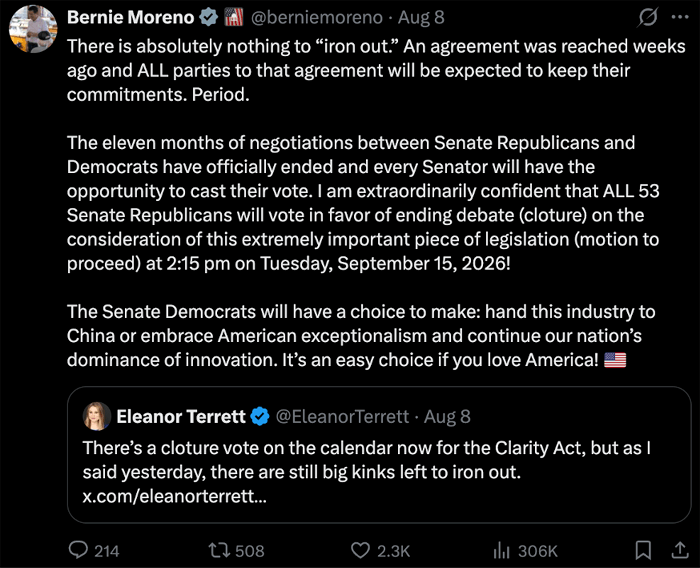
Source: X.com @berniemoreno
But it didn’t stop there…
Senators Moreno and Cynthia Lummis (R-WY) co-sponsored a new bill. One called the Credit Card Competition Act.
The bill requires large banks to allow credit card transactions over alternative networks to increase competition and reduce merchant swipe fees. It is a threat to the bottom line of banks since they collected nearly $66 billion in swipe fees in 2025.
The retaliatory bill comes after a few senators began to let their fellow GOP members know banking pressure hasn’t waned. Instead, it’s only getting more intense.
But the bottom line is this: the CLARITY Act is delayed until September 15.
That’s because the Senate successfully filed for cloture before going on recess. This means a vote on the bill is required within one day of its filing. That puts a vote on CLARITY on the docket for September 15.
The issue now is that banking groups have five weeks to ramp up pressure even further.
Whether the bank lobby is successful is what we will find out on September 15.
From where we sit right now, it’s clear the odds of the CLARITY Act getting passed have fallen. Banks are not backing down to protect their financial interests. The odds that CLARITY gets done this year have fallen. The banks simply won’t let this one go.
As JPMorgan Chase CEO Jamie Dimon put it a couple of months ago, as he cursed on air, “[CLARITY] will be fought, no one is going to bow down.”
I believe this is why we didn’t hear President Trump agree to an ethics deal. He wants to hold the cards until the last possible moment. And since this disagreement remained, there was no point in him playing his last card.
So, what now?
Keep an eye on the SEC and CFTC over the coming weeks.
We mentioned in How to Be Bullish Without the CLARITY Act that the SEC, CFTC and the White House have been pushing forward on Project Crypto. It’s their initiative to bring finance onchain.
They’ve been issuing a lot of guidance over the last year within the existing framework. Put another way, the regulators are doing everything they can until CLARITY gets over the line.
With CLARITY delayed, and the banks not backing down, we should expect them to ramp up guidance or rulings in the weeks ahead.
This fight is far from over.
More to come.
Your Pulse on Crypto,
Ben Lilly
Editor Chain of Thought
Add Brownstone Research as your preferred source on Google to see our latest stories in your feed.
 Add as a preferred source
Read the latest insights from the world of high technology.
The old guard is competing to build the new gatekeeper that the market uses … and the result will...

Blockchains are infrastructure built for machines. And now the machines are here.

If the cycle holds, we’ll look back at this moment in the fall of 2029 and realize that was...