



The Machine-Native Economy
Blockchains are infrastructure built for machines. And now the machines are here.



The old guard is competing to build the new gatekeeper that the market uses … and the result will be to abandon gatekeepers altogether.

Managing Editor’s Note: At The Dollar Trap emergency briefing on Wednesday night, Jeff Brown and Larry Benedict will share why the U.S. dollar is in a trap that’s mathematically inescapable… and why not even the president himself can stop it from snapping shut.
They’ll also show why the winners of the AI boom could effectively lose up to 40% of their gains in the aftermath… and how you can turn this chaos into profits if you know how to tackle it.
If you haven’t yet signed up to attend, don’t worry. You can add your name to the list with one click right here.
There’s a battle underway. One between old versus new.
This battle will decide the architecture of our financial system.
And the outcome will dictate how money moves for the rest of our lives.
Faryar Shirzad, chief policy officer at Coinbase, laid it out in a lengthy post on X last week.
In his words,
There was a bigger story behind the battle over stablecoin rewards in the CLARITY Act: a fight over who will control the underlying infrastructure of digital finance as tokenization moves rapidly from experiment to broad adoption.
The fight is unfolding in some surprising places.
The Bank for International Settlements (BIS) is the central bank of central banks. To compete with the developments happening on public blockchains, the BIS began to build out Project Agorá. It’s a permissioned tokenized settlement system with commercial banks at the center.
The DTCC is another battlefield. It is the clearinghouse that settles nearly every stock trade in America. The tokens listed on its solution are merely claims on its ledger. Not what we should consider innovation in this day and age.
And more recently, we heard about IBM and Swift. Swift is the messaging network that moves money between the world’s banks. And it’s partnering with IBM, the old dinosaur of the technology sector. The two are now racing to update Swift’s half-century-old architecture to handle tokenized assets.
All three of these examples are showcasing the same move …
They’re all attempts to adopt blockchain technology while maintaining the role of the established gatekeepers.
Each system is separate. Each is permissioned. And each one is trying to win the role of the single ledger that everyone else abides by.
Right off the bat, that could prove a challenge …
The disjointed, permissioned nature of these systems inhibits the network effect. It also ignores the fact that technology is supposed to reduce friction.
At the end of the day, liquidity will flow to where it can move most easily.
But that’s the fight. Old gatekeepers attempting to keep the new stewards at bay.
That’s one side of the battlefield. And it’s worth taking a look across no man’s land.

Larry Benedict went 20 straight years on Wall Street without a losing year. Jeff Brown recommended Bitcoin at $240 and Nvidia in 2016. Now they’ve issued the biggest warning of their careers: The U.S. dollar will break on Wednesday, October 7, at 1:00 p.m. ET – on a deadline set by the federal government… It could lose up to a third of its value. Or even half… And the money doesn’t vanish. It moves into a market that could have potentially handed you over $410,000 the last time something like this happened. On Wednesday, September 30, at 8:00 p.m. ET, they share all the proof, free. Click here to reserve your seat for free.
As much as $1 trillion in 401(k) savings is about to change hands. The last time Washington rewrote retirement rules, Larry Benedict’s readers had the chance at 188% gains. Now he’s naming the one ticker in the “Transfer’s” path – free. Click here.
Michael Selig, the chairman of the CFTC, delivered a keynote speech at the U.S. Treasury Market Conference.
Here’s what he had to say about tokenization (emphasis added):
In order to embrace innovation, we cannot simply modernize yesterday’s markets. We have to prepare for tomorrow’s. The work will not be easy, but preparing our markets for the new frontier of finance is imperative. This means readying our markets for mass tokenization, tailoring legacy frameworks so that innovative technologies, such as blockchains and artificial intelligence (‘AI’), can be adopted at scale, and ensuring our market participants are prepared for the world of onchain finance and 24/7 markets.
Read that again …
A U.S. markets regulator is not talking about whether tokenization will happen. He’s telling the market to get ready for it at mass scale.
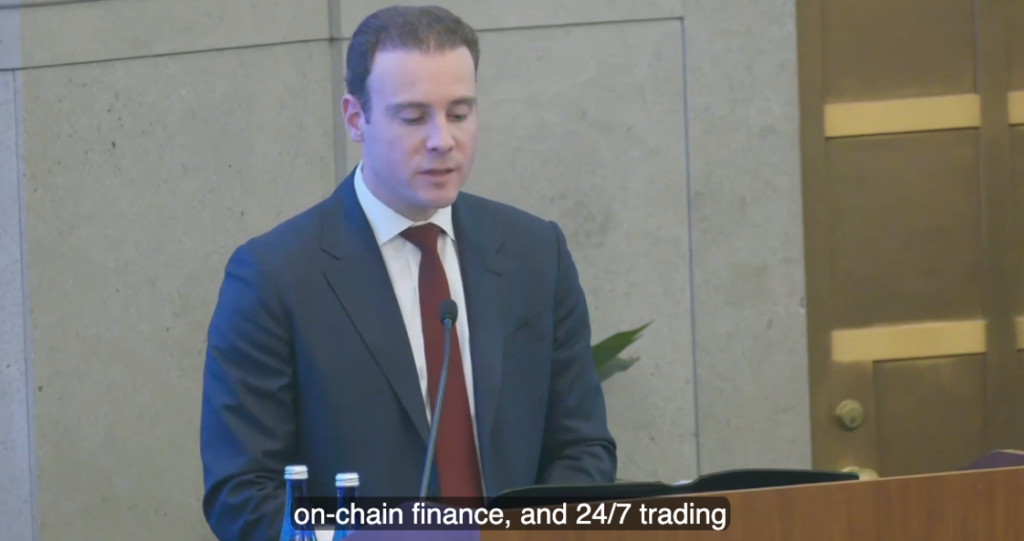
CFTC Chairman Michael Selig at the 2026 U.S. Treasury Market Conference | Source: X.com @CryptoTice_
And let’s not let the venue go unnoticed here.
These comments were delivered at a conference about the U.S. Treasury market.
We’ve been writing for weeks about how Treasury Secretary Scott Bessent plans to grow the stablecoin market to manufacture new demand for U.S. debt. Every dollar stablecoin minted is a dollar of Treasuries purchased. And to boost that demand, assets such as tokenized stocks need to move onchain.
That’s because assets and the money that trades against them grow in unison.
And in the days that followed these comments, the market began to make news.
The first news story came from Coinbase.
Last Friday, the lending and borrowing protocol Aave launched an “Equities Hub” on Coinbase’s layer-two chain called Base. It looks like this:
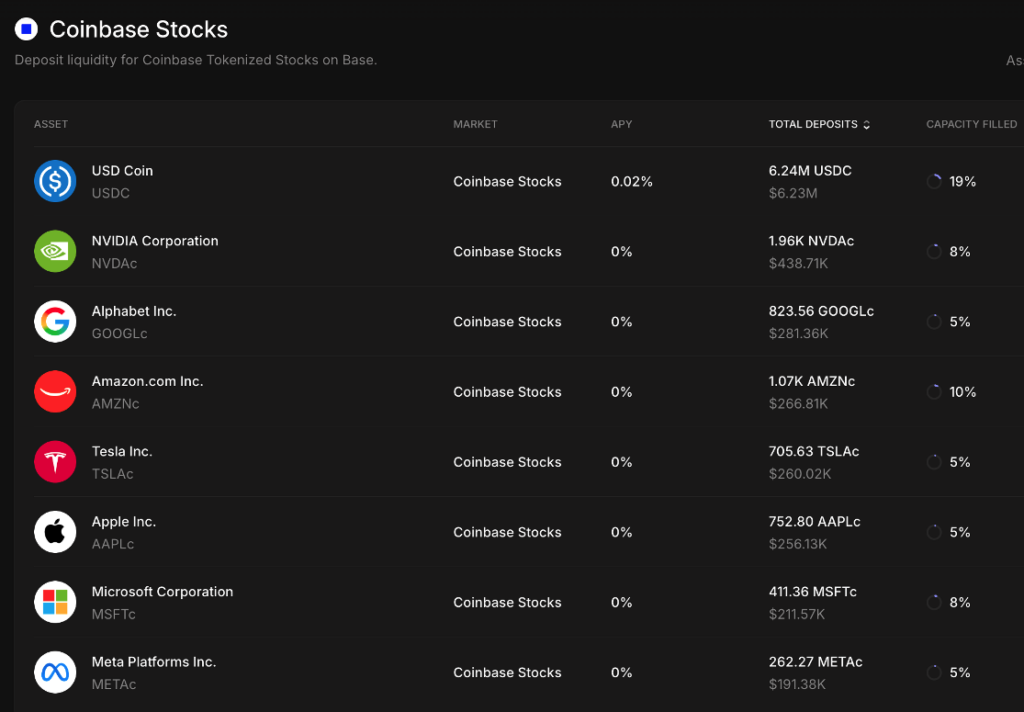
Source: pro.aave.com
Aave is the largest lending and borrowing protocol in DeFi, and the largest on Ethereum.
What makes this so timely is that the hub accepts Coinbase’s tokenized stocks. These include Apple, Amazon, Alphabet, Meta, Microsoft, Nvidia, and Tesla. These stocks can be used as collateral for borrowing USDC stablecoins.
Sit with that for just a moment …
A share of Apple, held as a token, can now be used to borrow dollars onchain. It can be done at any hour, no middleman, no credit application.
Think about all the steps that would be required to set up that same process in your current brokerage account.
The second news story came from the synthetic stablecoin provider Ethena.
Ethena operates less like a traditional dollar stablecoin and more like a money market fund. The project originally generated yield through a strategy called “the crypto basis trade.”
The mechanics of the basis trade go something like this …
Hold an asset in spot, short the same asset in perpetual futures, and collect what’s known as the funding rate. The funding rate is the periodic payment that is paid by longs or shorts to the other side to help keep a perpetual future’s price tethered to the spot price. The position is price-agnostic. It doesn’t care if the asset rises or falls; it simply harvests the funding rate payment.
The issue here is that funding rates have been very low. That’s forced Ethena to diversify how it finds yield. Its top two yield destinations are now lending assets into credit markets and holding tokens such as USDtb – a token backed primarily by BlackRock’s BUIDL fund, which invests mainly in Treasuries. Here’s a broader breakdown of where Ethena’s backing sits:
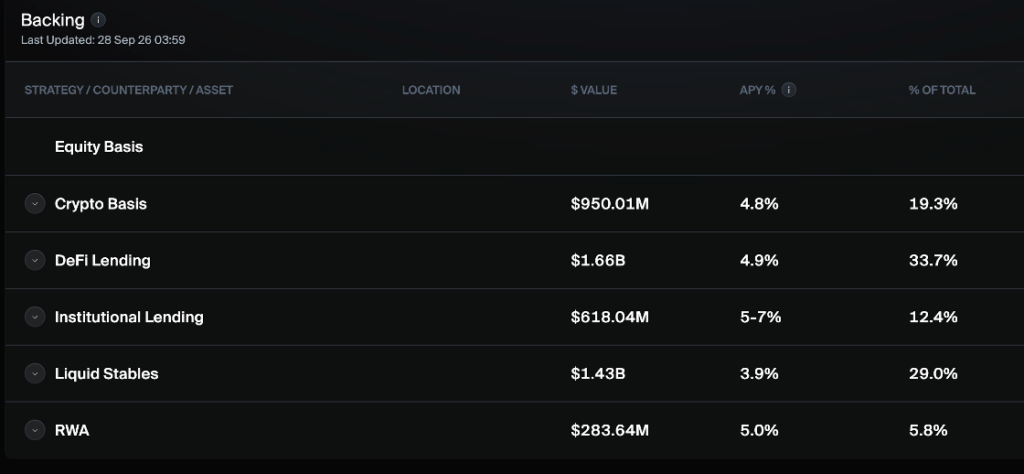
Source: Ethena.fi
The important part is that Ethena is resurfacing the basis trade with stock tokens.
The project announced it will be adding the strategy using tokenized equities listed on Binance, the largest exchange by volume. The strategy will yield about 11% per year when compounded, which is above what Ethena currently realizes elsewhere.
Those two announcements about tokenized stocks happened within days of the CFTC’s remarks. And it’s all happening on the public, permissionless side of the fence.
That’s in stark contrast to what’s happening on the other side of the walled garden.
The New York Stock Exchange made news with its announced partnership with Blockchain.com.
It’s an interesting pairing on paper.
Blockchain.com is one of the oldest wallet providers in digital assets, with a large institutional services business and more than 44 million confirmed accounts.
The idea outlined in the announcement is that those users might eventually access tokenized U.S. stocks and ETFs trading on the NYSE’s planned venue.
That’s worth unpacking …
The NYSE isn’t putting stocks on a public blockchain. It’s building a digital alternative trading system. A separate, NYSE-operated market where tokenized versions of listed stocks would trade around the clock, on infrastructure the exchange controls.
It’s the incumbent’s version of tokenization, one that keeps the gatekeeper at his post.
But what’s more interesting here is that the partnership is a memorandum of understanding. It’s a document that says two companies agree to explore something.
There is no confirmed ticker list. No fee schedule. No custody model. No launch date. No stated timeline.
It’s the type of thing that happens when a business like the NYSE needs to “just do something.”
The press release exists so the exchange can say it’s participating in the trend … without really committing to much.
Compare that to the news from Aave/Coinbase and Ethena/Binance. Those two partnerships are moving toward tokenization fast and in size.
This comparison gets to the heart of what’s about to happen in this new vs. old regime battle …
The projects building on public and permissionless rails are shipping solutions in days.
Public rails are about reducing friction. Coinbase is using a lending solution that already exists. Ethena is using a funding rate mechanism that’s already available.
Public blockchain projects are not about creating an ecosystem that maintains the gatekeeper. They’re about building atop existing solutions. And wherever friction exists, innovation slows down.
That’s why these private-network solutions – Project Agorá, the DTCC’s ledger, Swift’s upgrade, and the NYSE’s alternative trading system – will get beaten. Each one must coordinate members and committees, and get other entities to adopt its system.
They’re just too slow and cumbersome, in other words.
The old guard is competing to build the new gatekeeper that the market uses … and the result will be to abandon gatekeepers altogether.
Public blockchains will win.
And the most important piece of the puzzle is that the regulator has signaled the direction.
The new system is here … whether the gatekeepers want it or not.
Your Pulse on Crypto,
Ben Lilly
Editor, Chain of Thought
Add Brownstone Research as your preferred source on Google to see our latest stories in your feed.
 Add as a preferred source
Read the latest insights from the world of high technology.
Blockchains are infrastructure built for machines. And now the machines are here.

If the cycle holds, we’ll look back at this moment in the fall of 2029 and realize that was...

Companies such as Anthropic and OpenAI are screaming at the top of their lungs, “Regulate us!”