




Crypto’s Point of No Return
Get these assets so entrenched, so dug in, that no future administration can rip them out without creating systemic...



Companies such as Anthropic and OpenAI are screaming at the top of their lungs, “Regulate us!”

In March 2019, Mark Zuckerberg requested something that, on the surface, seemed unthinkable.
He wanted the government to regulate him.
On March 30, he published an op-ed in the pages of The Washington Post. Titled “Four Ideas to Regulate the Internet,” he outlined various regulatory ideas for his company, then called Facebook.
I say this appears unthinkable because the knee-jerk reaction of most people is that regulation is an obstacle for businesses. The real truth is that regulation is an obstacle for some businesses.
Maybe Zuckerberg meant what he wrote, that the internet and social media companies need more guardrails. But his proposals would have had a convenient effect. They would have inhibited future competition for Facebook.
You likely know this as a regulatory moat. At a certain scale, adhering to regulations becomes so time- and resource-intensive that smaller competitors never bother to enter the arena. And it leaves the well-capitalized incumbents protected from disruption.
If that sounds familiar, it’s because the frontier AI labs are pulling the same maneuver …
Like Zuckerberg in 2019, companies such as Anthropic and OpenAI are screaming at the top of their lungs, “Regulate us!”
The stated concern this time is the supposed existential threat posed by artificial intelligence (it could kill us all, apparently).
Maybe these executives really believe that. But at the same time, these teams have spent hundreds of billions of dollars on development. And that work was then distilled or “stolen” by China-based labs.
These labs then release open-weight models to the world. These are very capable models that are similar in performance for a fraction of the cost.
It’s cutting into the margins of Anthropic and OpenAI. And bringing down the regulatory hammer would likely put a stop to it. At the very least, it would slow things down.
In this future, AI is a permissioned tool. Whether you have access will depend on who you work for, where you live, and what you want to use it for.
The question is whether the frontier labs can pull it off.
Because, as you’ll see today, many models are already live on public blockchains. And the latest developments give us an idea of just how fast they’re progressing.

What if you could PROFIT when your bills go up? Sounds crazy… But hedge fund legend Larry Benedict has given his readers a chance at gains like $8,704 in six days… from one ticker that could pay you when your bills rise. Click to get the FREE ticker.

Beginning at 10 a.m. ET tomorrow, a new form of AI could potentially quadruple your portfolio by foreseeing the future prices of 2,334 stocks, to the penny, with 85% backtested accuracy. It has opened the most lucrative investment vehicle in TradeSmith’s 21-year history, which has officially crushed the 2026 market by 218%, as of August. You can even chat with it! Try it now, free of charge.
Fogo is a layer-one blockchain with a founding team from Citadel, Jump, JPMorgan, and Morgan Stanley. Its goal was to create best-in-class trading infrastructure.
The pitch: ultra-low latency. Its developer network showed impressive vanity metrics such as 46,000 transactions per second at 20-millisecond blocks.
The team raised $8 million in a community round on the crowdfunding site Echo back in January 2025, launched its public testnet at the end of March, and has been building since.
The team is attempting to do what Hyperliquid did for onchain trading on an Ethereum-compatible network, but for the Solana ecosystem.
This trading background is made more interesting given the team’s recent showcase of what is called Baranos AI.
Baranos AI is not a trading tool or infrastructure for a financial primitive. It’s a project that is running a large language model with its inference tied to the Fogo chain.
It’s currently a live demo on testnet.
The chain’s high speed is a great fit for tackling the onchain LLM problem.
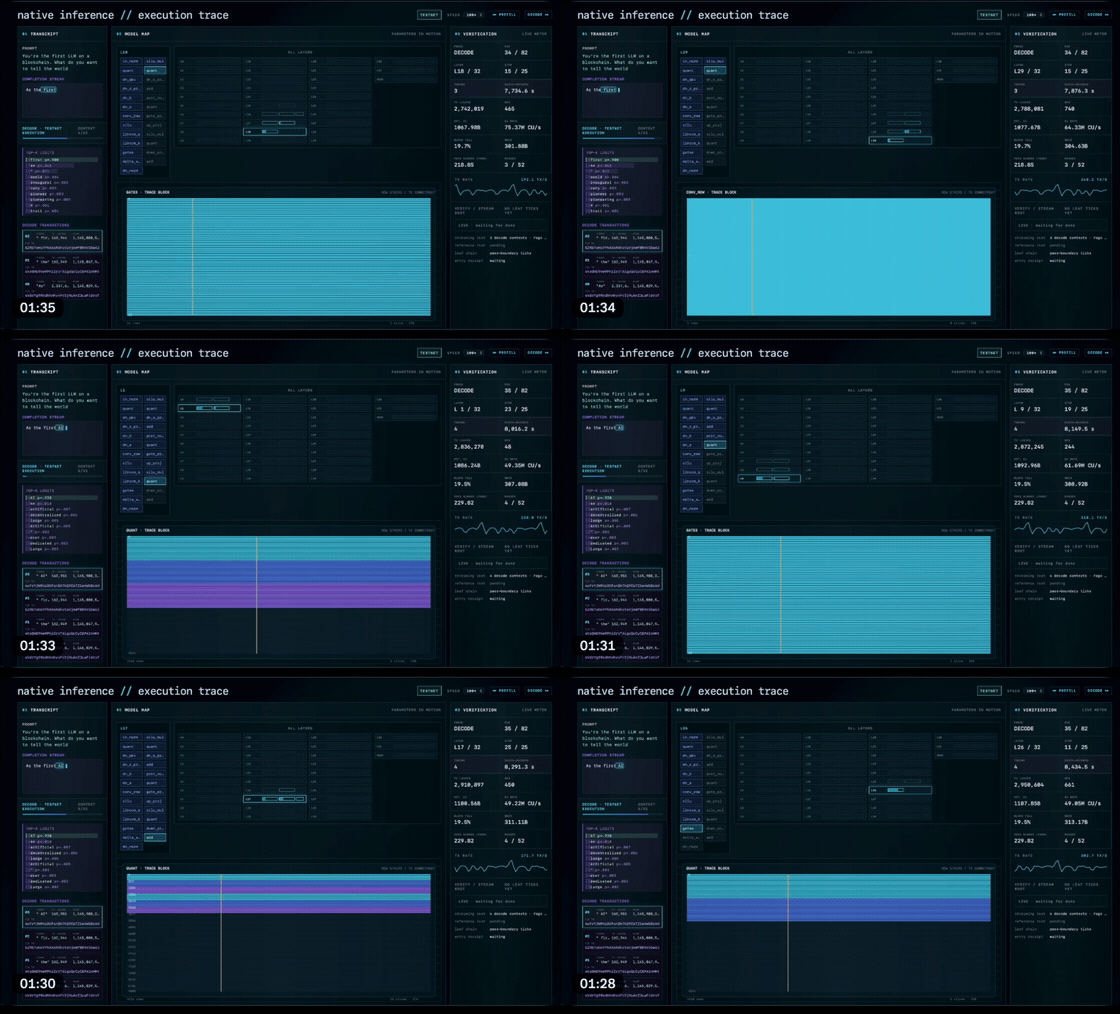
An interesting feature: Once a user submits a prompt, they can watch the execution unfold letter by letter.
Here is a picture of the LLM responding to the prompt, “You’re the first LLM on a blockchain. What do you want to tell the world.”
The LLM responded with “As the first AI on a blockchain, I wouldn’t just be a tool for computation – I’d be a **verifiable truth-teller**.”
Source: X.com @0xdoug
The response was far from instantaneous. It likely took over four hours.
But that’s not what is important.
The model is not some toy or science experiment. It was Qwen3.5-4B, a decent-sized model that could theoretically be fine-tuned for useful work.
What’s also important is how the team pulled it off.
The model doesn’t work by running a computation inside a block. That computation happens mostly offchain. What moves onchain is a proof of the model’s weights and that a specific input produced a specific output. It’s showing what went in, what the model was, and what came out.
It’s verification that gets stored on the immutable blockchain. Meaning other protocols or transactions can leverage this verification for their own needs. It’s creating an LLM solution that can be used as bits and pieces of far bigger solutions.
A simple example would be the result of an NFL game. The LLM would relay the result and provide the proof, and the bets would settle instantly.
All verifiable, transparent.
It’s a unique setup for running LLMs in a blockchain setting. It’s one a blockchain like Fogo is well equipped to tackle.
And while Baranos is still very new, it’s suggesting that moving LLMs to a permissionless environment is gaining traction.
And there’s one more project worth checking in on.
Regular readers will remember our essay Researchers Put a Brain Onchain.
That was our first look at Gas Killerz, the team that used an onchain LLM with Ethereum’s Sepolia testnet.
Quick refresher on what they did …
The team took Qwen3-0.6B and stored its weights onchain in a smart contract.
Meaning the weights (you can think of them as the model itself) literally live onchain. Deploying those weights as code cost the team 171.97 ETH in testnet gas.
At the going rate of about $2,700 per ETH, that works out to somewhere in the ballpark of $460,000.
Not cheap.
Now where things get somewhat wild is the fact that the “thinking” of the LLM doesn’t run as a transaction. It can’t.
At roughly 25 billion gas per token (essentially a letter or two), no real chain could process it. More importantly, nobody would spend the amount of ETH it would require.
So instead, a router simulates the transaction offchain using the onchain weights. Three independent operators re-simulate it and sign the same result. The piece that lands onchain is a signed transaction that records the answer.
A novel solution, but there are limitations.
The output for a few words may take more than 35 minutes. But that’s where the team’s most recent update is interesting.
Gas Killerz docs tease a sharded consumer design in which inference itself runs when a user calls for an LLM output via an offchain contract “call.” It’s a unique solution that helps with speed. If it ships, the 35-minute wait disappears.
The bottleneck stops being “can we do this at all?” and becomes “how big a model can we afford to deploy?”
Neither of these projects is ready for prime time. As I just showed, there are real hurdles that need to be worked out.
But the trend lines are clear …
This is the public blockchain economy running autonomously without permission.
It’s the permissionless agentic economy that we keep touching on. And it’s poised to grow precisely because the frontier labs are trying to steer development toward regulatory capture.
Open and verifiable versus closed and permissioned.
This might be one of the biggest battles of good versus evil we’ll ever see in technology.
More to come …
Your Pulse on Crypto.
Ben Lilly
Editor, Chain of Thought
Add Brownstone Research as your preferred source on Google to see our latest stories in your feed.
 Add as a preferred source
Read the latest insights from the world of high technology.
Get these assets so entrenched, so dug in, that no future administration can rip them out without creating systemic...

There’s plenty of blame to go around, and I’m more than happy to name names.