







The (Temporary) Death of CLARITY
There’s plenty of blame to go around, and I’m more than happy to name names.
Managing Editor’s Note: Tonight, Jeff is airing his Super IPO Summit where he’ll unveil a strategy to help everyday investors profit from what’s shaping up to be a historic IPO season… One that doesn’t involve chasing the stocks higher on IPO day.
He’ll also share three companies he has his eye on that are tied to three major upcoming IPOs – Anthropic, OpenAI, and one that’s barely on anyone’s radar despite the scale of the opportunity.
You can go here to automatically add your name to the guest list…
Sometimes, all an analyst can offer is a good, old-fashioned rant …
And after months of dancing around it, there is some comfort in finally just saying it …
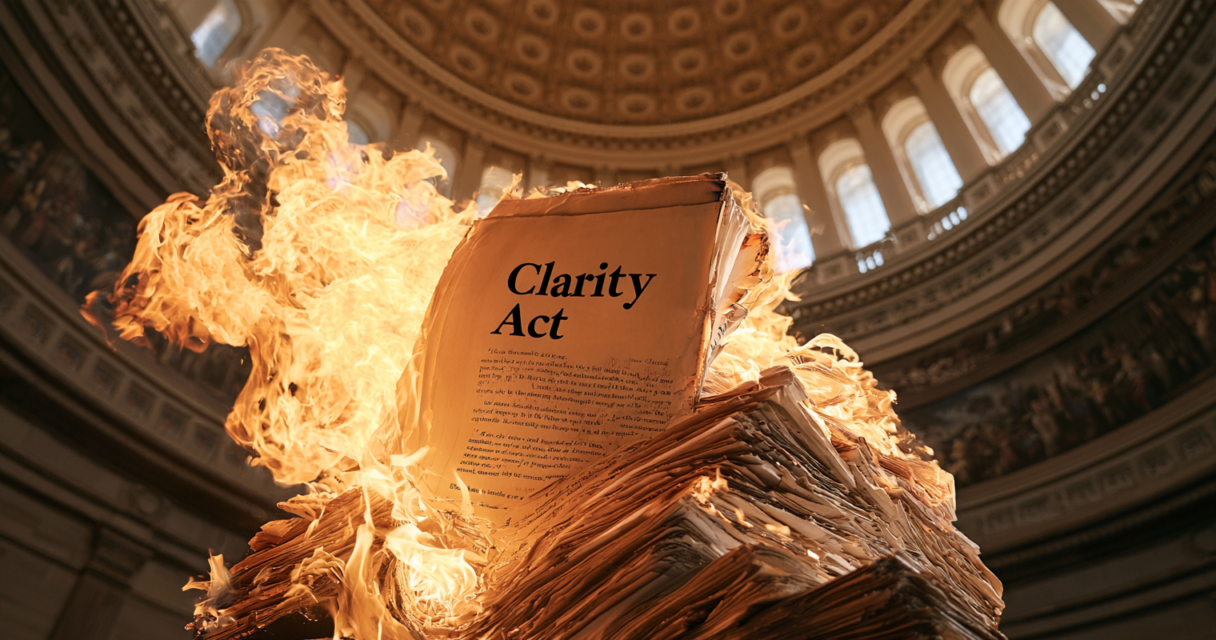
CLARITY has been a sh*tshow.
The bill failed to pass its cloture vote in the Senate yesterday.
Not because it was bad. Not because it would fail to foster financial innovation. Not because it wouldn’t help solve the million obstacles that have plagued digital assets for decades.
It failed because of selfishness on the part of the president and cynicism on the part of Democrats.
That’s it.
As a reminder, cloture is a formal parliamentary procedure to end debate and bring the various parties to a vote on a piece of legislation. It exists to avoid any stall tactics that might arise at the last minute.
The CLARITY Act had passed the House of Representatives in July 2025 and was finally close to a Senate floor vote. The inability to get 60 votes in favor of cloture meant the bill won’t see the floor in the immediate future.
Many countries across the globe were looking toward the United States to draft digital asset policy that others could mirror.
America had an opportunity to finally (finally!) move past the era of regulation by enforcement under SEC Chair Gary Gensler and Operation Chokepoint 2.0, which held the industry back.
And we didn’t do it …
There’s plenty of blame to go around, and I’m more than happy to name names.
Recommended Links

Jeff Brown: “If I Could Only Buy One AI Stock, This Would Be It”
Its patented tech can produce intelligence up to 1,000 times FASTER than regular AI… And it’s the same size Nvidia was back in 2016, before it exploded high enough to turn $5,000 into an entire retirement nest egg of $1.89 million. Click here because this could be the only stock you need to retire.

The Secret IPO Signal That Would Have Created 16,334% Average Peak Gains Across the 25 Biggest IPOs in History
This “secret signal” appears before every big IPO... And it has generated some of the biggest pre-IPO trades in history. The big news is, anyone can make these trades from any regular brokerage account – starting with as little as $50. Now, on Wednesday, September 16, at 8 p.m. ET, Silicon Valley legend Jeff Brown and a former Wall Street IPO insider will demonstrate it on camera – and show you their #1 pre-IPO trades for the multi-trillion Anthropic IPO, the trillion-dollar OpenAI IPO, and one more IPO that could be more profitable than both combined. Register for the Super IPO Summit here...
The President Kept TAKEing
Let’s start with the president … What were you thinking?!
With regard to digital assets, the Trump administration has been frustrating.
On the one hand, the administration has helped usher in a regulatory regime that is supportive, constructive, and fair. That’s a big step up from the regime of a few years ago, which used lawsuits as a first-response enforcement tactic.
On the other hand, the president’s own dealings in some corners of crypto have been eyebrow-raising, to say the least. Those dealings only helped to undo much of the good work being done and give his opponents ammunition to hammer the industry.
We’ve written about this before in Trump Keeps TAKEing.
The president’s adviser on digital assets, Patrick Witt, called this a “failure of American leadership.”
He meant the Democrats (and we’ll get to them in a minute), but he might as well have been describing the president.
Were he not launching memecoins and business ventures while also pushing digital asset legislation, the Democrats wouldn’t have a leg to stand on.
Recall that Trump disclosed more than $1 billion in crypto income in 2025. More than $550 million of it from World Liberty Financial. The figure was an elephant in every negotiating room.
And the Democrats were not shy about it in their comments after cloture …
Senator Gallego, after the vote:
All President Trump wants is for the Senate to give him time to crime, and I won’t support any piece of legislation that enables him … This legislation failed squarely because Republicans refuse to say no to the president.
Then there’s Senator Warnock:
I don’t think Democrats should advance a bill that doesn’t deal with these opportunities for corruption we’re seeing in real time.
Finally, Senator Warren, on the final ethics language, said it was a “weak fig leaf that will do nothing to stop [Trump] from making his next $1.4 billion in crypto profits.”
Make no mistake, I’m an advocate of the innovation-first policies of this administration. No president has moved with such speed and earnestness to fulfill his campaign promises around crypto as this one has.
But I’ve spent more than a decade researching, investing, and building in this industry. During that time, I’ve been a critic of those who drag the entire ecosystem down with their self-dealings. It’s Crypto’s Ugly Secret.
The fact is that the compromise around ethics language went to the White House on July 30. And the administration sat on it for six weeks and only accepted the language on Sunday, Sept. 13.
The eleventh hour isn’t a figure of speech. Once the administration finally put forward something it could agree to, it was too late to garner the support needed going into cloture.
Now, before readers accuse me of being overly critical of the president, allow me to train the cannons across the aisle.
Two Sides to Every Negotiation
Democrats deserve their share of the blame. Arguably, they deserve most of it.
To understand why the blame tilts their way, you need one number — 126. That’s how many substantive changes Republicans made to the bill at Democrats’ request, per Senator Tim Scott’s office.
One hundred twenty-six asks. One hundred twenty-six changes.
But here’s where things get even more suspicious. Many of the changes were on the same issues. Which points to one thing.
Democrats were continually moving the goalposts on what was acceptable.
When the party you are negotiating with keeps wanting more on the items you’ve already conceded, it is clear nothing will ever be enough.
This is not negotiating in good faith.
This was true even on the ethics deal itself.
The president agreed to language far closer to the Democratic position than most people close to the situation expected. And still it wasn’t enough.
The president shouldn’t have put himself in that position. But it’s clear the Democrats were never really interested in finding a solution. They just wanted a weapon to bludgeon the administration with going into midterms.
In fact, over the final weekend, Republicans conceded more. We’re talking protections for noncustodial blockchain developers, miners, and validators … A Treasury circuit breaker on stablecoin yield … And more language that waters down DeFi further.
Scott’s team called Sunday’s draft their “last, best, and final” offer.
Democrats responded Monday night asking for even more.
Enough already.
Their terms were met, repeatedly, and the asks kept coming.
This was a cynical move dressed up as principle. And they knew it at the time.
If Democrats were serious about protecting investors or preserving the integrity of the financial markets, then 198 of them wouldn’t have voted against the Stop Insider Trading Act.
Senator Lummis said the quiet part out loud: “Senate Democrats proved they were never truly serious about protecting consumers and preserving American leadership.”
It was just a game.
And, I guess, Democrats “won.”
America and its ability to foster innovation and maintain its lead in financial markets lost.
What Happens Next
Now, with that out of the way, let’s talk about what happens next.
Because, contrary to popular opinion, CLARITY isn’t dead.
In fact, the senators who killed the bill are already saying it isn’t dead.
Senator Alsobrooks, who voted no: “No, it’s not going to die.” Senator Warner confirmed Democrats “working on this in good faith are sending a counterproposal.”
There are no counterproposals drafted on a dead bill.
Here’s the other hint …
Senator Tillis publicly backed the ethics package the morning of the vote.
Then he switched his vote from yea to nay at the last moment.
This is one of those parliamentary nuances that matter. Voting with the prevailing side preserves the right to reconsideration. It keeps cloture alive for another day.
In fact, Tillis commented afterward, “This is not the end for the Clarity Act. We’ve made substantial bipartisan progress in large part because of the White House.”
The fact is that the CLARITY Act is looking at movement in the lame-duck session. When midterms end and the need for political ammunition subsides, the bill might find new life. Remember the GENIUS Act: it failed cloture in May 2025, then became law by July 2025.
This is not dead.
But here’s the fact …
We no longer need the CLARITY Act as much as we needed it a year ago when this process started.
The SEC and CFTC are ready to roll out rulemakings that push the industry forward … with or without Congress.
SEC Chair Paul Atkins said within hours of the vote, “With or without that legislation, this Administration will deliver for American investors and technological innovators.”
His innovation exemption for tokenized securities — reportedly pulled back just ahead of the vote to avoid stepping on the Senate — is loaded and waiting.
The SEC’s proposed Regulation Crypto Assets is in its comment period. The CFTC has vowed to “move swiftly,” with spot crypto trading now live on regulated futures exchanges and a tokenized-collateral pilot for BTC, ETH, and USDC underway. And the DTCC’s tokenization engine goes live in October with every major bank integrated.
The agencies will finish what the CLARITY Act started.
Be ready for some unexpected catalysts in the weeks to come. And don’t be surprised if the market reacts positively when they happen.
Your Pulse on Crypto,
Ben Lilly
Editor, Chain of Thought
More stories like this
Read the latest insights from the world of high technology.
-
-

This Could Make or Break CLARITY in 2026
If CLARITY stalls, for whatever reason, the industry will look to its fallback plan...
-

The Repricing Nobody Is Modeling
It’s prying open the door. And once it opens, it won’t close.