



The Agentic Bank Run
If Apollo is right, a bank run is coming. But it won’t be the panicked, lines-around-the-block variety...



Central authorities already have a tight grip on your finances. Now, they look to be coming for your mind.
It’s 10:30 p.m.
Your child, unable to sleep, climbs out of bed to find you.
You notice a strange rash that wasn’t there yesterday.
You open the AI chat application on your phone, type, “What is this rash on my kid’s knee?”, and send a picture of the irritated skin as a message.
The follow-up questions seem innocent and helpful.
Questions like “Where has he or she been over the last 48 hours?”
“Have there been prior episodes like this?”
“Does your family have a history with skin conditions?”
You answer the questions dutifully.
In a few minutes, the AI arrives at a diagnosis: The turf field from soccer practice is the likely culprit. An ointment should do the trick.
You’re happy. Your child feels better. And everybody goes back to bed.
But here’s something you probably don’t know…
Once that conversation closes… The AI knows what city and likely field your kid plays soccer on, that they are 10 years old, and other tidbits of family history.
It will never forget.
Combined with other conversations in your history, the AI is already forming a knowledge graph of your entire family. It is building a profile on you that intelligence agencies could only dream of.
Before you know it…
The AI is suggesting a particular brand of turf cleats, soccer academy classes during the upcoming summer, a promotional deal on a new minivan that could make your carpooling experience easier.
Then it gets a little spooky: A notification for a sale on a brand of pet food for a dog you don’t have… but one you’ve been secretly planning to adopt.
So, how did it know?
The answer: Your interactions with the AI are data fueling an army of algorithms preparing to monetize your life.
It’s eerie, but it’s also not unhelpful.
After all…
Those are good soccer cleats. That is a nice minivan. And, hey, you’ll have to buy dog food soon anyway…
But now imagine if the government had that data.
We’re seeing our very own government become interlinked with these exact tools.
Government agencies are increasingly issuing warrants and subpoenas directly to AI companies to recover chat history, prompts, and user data.
In fact, the U.S. government is expected to convene with the top 12 or 15 AI executives to discuss the industry giving back something to the public. We can think of this as in equity ownership.
As we covered Wednesday, we’re also seeing government agencies weigh in on what models the public can access, which is likely to usher in an era of permissioned AI.
The pattern is telling. The state and AI are becoming interwoven. It’s a pattern digital asset investors know all too well.
Whether you use Venmo, PayPal, Zelle, checks, debit or credit cards, or even ATM services… You are asking permission to engage in finance.
If the government decides your taxes look irregular, it takes just one subpoena to access more information than they need or to freeze your assets entirely.
In 2024, the U.S. government released a report, “Financial Surveillance in the United States: How the Federal Government Weaponized the Bank Secrecy Act to Spy on Americans” that revealed how federal law enforcement was obtaining unchecked access to private financial data.
Then there was Operation Choke Point 2.0, the name given to the Biden administration’s efforts to target and debank the digital asset ecosystem.
These are just two recent examples of the state peering into financial transactions of innocent parties without the right to do so.
This observation, that traditional finance is permissioned and centralized, is at the heart of the open and decentralized ethos of digital assets.
It’s not a discussion on protecting criminals. It’s about preserving your freedom and your right to privacy.
Central authorities already have a tight grip on your finances. Now, they look to be coming for your mind.
History is checkered with these abuses. As far back as the 1940s to 1970s, there were government-backed efforts to read all telegrams being sent or received by citizens in what was called project SHAMROCK.
At its height, 150,000 messages were printed and analyzed by the NSA in a month.
The project wasn’t exposed until 35 years after its inception, revealing one of the largest government interception programs affecting Americans.
Telegrams are one thing. Your thoughts, collected and compiled by an AI, are quite another. It’s enough to warrant a call for the separation of mind and state.
That’s the rallying cry of one AI company that is focused on ensuring its product doesn’t enable spying on its users.
It’s called Venice. And it’s a project Permissionless Investor subscribers know well. They’re up nearly 300% with the investment since February.
As Jeff and I wrote to subscribers in February:
The project’s flagship large language model (LLM) is called Venice Uncensored. It offers the same core capabilities as the other AI platforms you’re already familiar with. It has text generation, image creation, code assistance, video generation, and live web search.
The main difference is that it has no content filters shaped by political pressure, ideological bias, or advertiser preferences.
What’s more, if you prefer to use frontier models, Venice offers those as well. Anthropic’s Claude Opus 4.6, OpenAI’s GPT-5.2, Meta’s Llama 4, xAI’s Grok, Google’s Gemini, and others are all available from a single interface. And it does it while preserving your privacy.
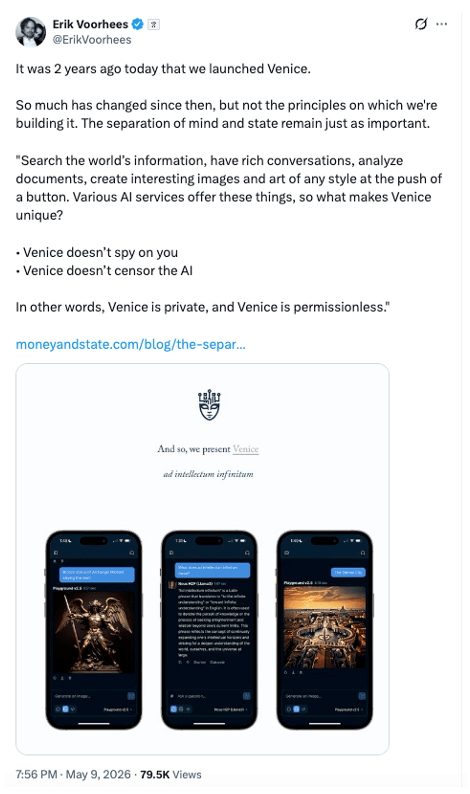
Source: x.com/ErikVoorhees
The idea of separating the mind and state is strong.
We covered on Wednesday how new forms of decentralized training are improving at a remarkable speed.
Open models are catching up to closed models. And new products like Venice.ai are already focused on preserving privacy for their users with verifiable guarantees via cryptographic solutions.
It’s a trend that suggests we’re about to see a wave of innovation at the nexus of AI and crypto.
Specifically, we’re going to see greater use of things like zero knowledge proofs, IP address hopping networks, and permissionless model training.
These are all technology solutions that exist throughout the cryptocurrency industry. But their applications have been spread across things like payments, internet browsing, and data storage.
We will now see the convergence of these technologies redirected at one of the biggest tech races of our generation.
This isn’t something far off into the future.
It’s happening today, and discussions around it are getting loud.
Just yesterday, this diagram was produced to help investors get familiar with the entities competing in the sector.
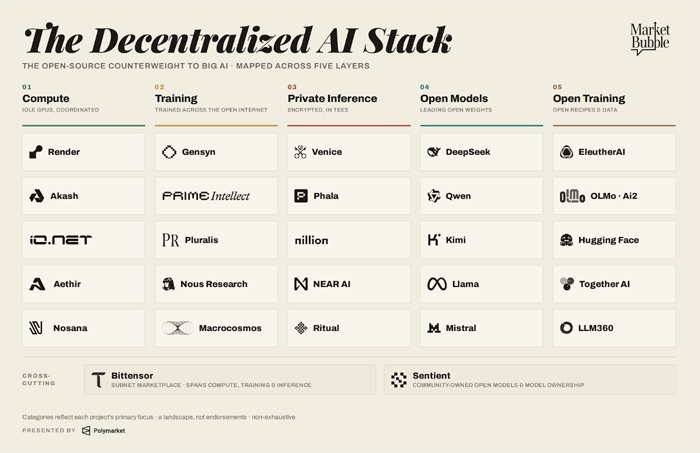
Source: x.com/marketbubble
This is just the tip of the iceberg.
There is a wave of projects coming online that have been building for years. The amount of technology that has been created over the years is about to be repurposed for decentralized AI.
The race is on to separate the state from your mind.
Your Pulse on Crypto,
Ben Lilly
Editor, Chain of Thought
Add Brownstone Research as your preferred source on Google to see our latest stories in your feed.
 Add as a preferred source
Read the latest insights from the world of high technology.
If Apollo is right, a bank run is coming. But it won’t be the panicked, lines-around-the-block variety...

The old guard is competing to build the new gatekeeper that the market uses … and the result will...

Blockchains are infrastructure built for machines. And now the machines are here.