

You’ve Been Here Before
Investors looked back at that period and wished they had bought more.


Many of us don’t realize how dependent we are on big, centralized systems…
Editor’s note: Jeff Brown has issued a “red alert,” and the window to act on it is short. His M.A.G.I. Phase II strategy session goes live Tuesday, November 24, at 8 p.m. ET. Jeff says a document Elon Musk quietly filed with the Texas Department of Licensing and Regulation sets Phase II in motion. And the consequences for investors and tech will be massive. Get all the details and reserve your seat with one click right here.
Hurricane Maria swept over Puerto Rico in 2017.
In its wake was the largest blackout in U.S. history. Some areas waited almost a year for power to return.
The failure was possible only because the utility was a single point of failure.
The exception was Casa Pueblo.
It was an environmental group in the mountain town of Adjuntas. It first installed solar panels in 1999 and was entirely off the grid just months before Maria.
Its resilience made it a focal point in Puerto Rico. When people tried to send aid, the group asked for solar lamps. Not money, but the ability to source energy independently.
What happened in the years after was interesting…
In 2017, Puerto Rico had about 8,000 rooftop solar installations. By 2024, that number swelled to more than 117,000. More than 10% of households became less reliant on the utility. Installers were adding about 3,000 new systems each month.
Homes, clinics, and schools ditched the centralized energy grid for solar panels and batteries.
The island became more resilient because centralized power failed.
Many of us don’t realize how dependent we are on big, centralized systems. We don’t think about it because, when everything works, we don’t need to. Then, one day, we’re forced to.
This was on full display on Monday…
Customers at JPMorgan Chase, Bank of America, U.S. Bank, Truist, Wells Fargo, Capital One, and even payment services such as Zelle reported widespread outages, according to Downdetector.
Even Apple Pay, Cash App, and others drew reports.
A JPMorgan Chase spokesperson called it a technical issue. Some transactions were taking longer than usual, the spokesperson said, but customers still had access to their accounts and funds.
But that wasn’t the whole truth.
Many Chase customers reported seeing this message: “Some services aren’t available. We’re working on them. Please try back later.”
To me, that doesn’t sound like customers had access.
Worse, most banks simply denied the issue. Bank of America claimed its systems operated normally throughout the day…
The public was being gaslit.
When your account reads $0 or you can’t get in online, that’s not access. That’s a serious issue.
There’s no telling how much this will affect customers…
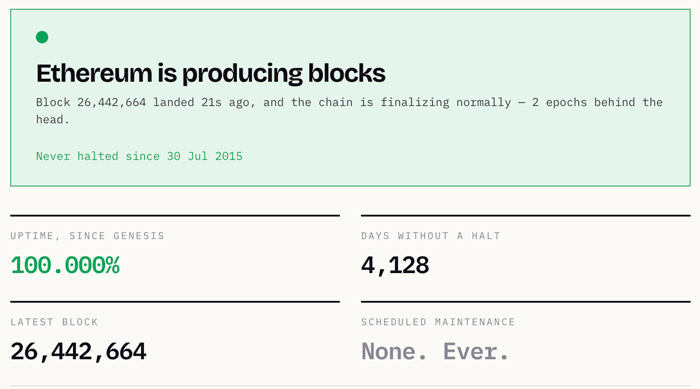
But throughout the ordeal, one system ran flawlessly. It’s a payment system that anybody can access any time of day (even weekends), that can send dollars anywhere in the world, and that doesn’t rely on some bank to operate.
It’s this one:
Source: ethereumuptime.com
Yes, Ethereum. And it’s not alone.
Bitcoin and many other networks ran as expected. And that’s the point.
Their nodes and validation services are spread across the globe. A few go down with no issues. There is no single point of failure.
There are nearly one million active validators on Ethereum. Taking down such a network requires an attack across the globe all at once – and that assumes even mesh networks and GPS solutions fail too.
If that ever happened, we would have much bigger problems than ensuring a global payment goes through.
It’s a testament to the resilience of distributed networks. You’d think, especially after the outage, that the banks would be all-in on this idea.
And they are… at least their version of it.

Jeff Brown says Musk's new filing in Texas unleashes what Elon himself calls "an infinite money glitch." On Tuesday, November 24, at 8 p.m. ET, he'll show you how to prepare and name one essential supplier, completely free. Register in a single click.

After SpaceX placed a series of orders with one little-known supplier, its shares surged more than 1,000%. Now Larry Benedict believes Elon’s latest plan could ignite another overlooked company. See the ticker before the crowd catches on.
Project Faro was just announced.
It’s a project backed by 21 banks and financial institutions. Backers include Goldman Sachs, Citigroup, Deutsche Bank, Fidelity, and others.
The group has committed about $270 million toward the first five years of operations. Its goal is a U.S. dollar stablecoin launch in 2027, with longer-term expansion into other G7 currencies such as the euro.
The idea is to ensure the banks govern the stablecoin’s issuance and operations.
This is the same group pushing hard for permissioned systems and walled gardens. The same permissioned systems that went down this week.
Permissioned systems lack the setup behind the resilience that withstood the outages.
Wall Street is advocating a watered-down version that can be touted as innovation, while making no substantial changes to a failing system.
This is a joke.
And it’s not even the worst part…
Recall the essay where we discussed the Canton Network seeing its first tokenized stocks trade on its systems.
There was no consensus on how much traded or how many dollars moved. That’s because we are simply given an API and must trust it’s accurate.
This goes against public, decentralized, and permissionless blockchains… With these more resilient systems, we can ask an AI to check the chain and confirm a transaction went through.
If these banks were running on public rails this week, guess what… We wouldn’t need to ask them whether there was an outage. It would be visible to all.
Perhaps that’s what they fear… That we can’t be lied to.
And that’s why January 2027 will be the beginning of the end for many of them.
Puerto Rico showed a population that wanted more resilience after a crisis.
If AI is going to cause more technically complex hacks and outages like the one we saw this week, why wouldn’t we opt in to a better system?
That’s what is coming.
The GENIUS Act takes effect in January. It’s the law that regulates U.S. dollar stablecoins. For the first time, we’ll see a compliant new payment solution. It also marks the first time customers can opt in to a new financial system.
One that won’t gaslight you while hoarding the yield.
Public, decentralized, and permissionless technology isn’t just a feel-good saying. It’s the future. One that is more resilient, free, and ours.
We should be excited. We’re about to build a financial system that’s ours.
Not the centralized, top-down approach we’ve known all our lives.
Your Pulse on Crypto,
Ben Lilly
Editor, Chain of Thought
Add Brownstone Research as your preferred source on Google to see our latest stories in your feed.
 Add as a preferred source
Read the latest insights from the world of high technology.
Investors looked back at that period and wished they had bought more.

Crypto investors are surveying the meadow. And all they see are wolves…