





You Got to Let the Benz Drive
We are applying yesterday’s rules to tomorrow’s solutions, and calling it progress.

From The Editor
Editor’s note: What if the most interesting tech trade right now costs less than $1 per contract? Jeff Brown and Larry Benedict call them “Penny Tech Trades,” and on Wednesday, November 11th at 8 p.m. Eastern, they will trade their own money live on camera for the first time.
One on Nvidia went from 2 cents to $1 in 2 days, while the stock was down. Larry’s closed trades stand at 10 winners out of 11. And on Wednesday, you will see how the trades work, how to get set up in about three minutes, and every attendee receives free trades. Reserve your seat with one click right here.
A boy walked down the road 60 yards ahead, holding a red flag.
It was Britain in the 1860s.
Parliament had decided the safest way for a self-propelled vehicle to move down a public road was to make sure it never traveled faster than 2 miles per hour through a village. And someone on foot had to walk out front holding a red flag to warn whoever was coming.
The rule was the Locomotive Act of 1865.
It was written for traction engines, the coal-burning steam machines that weighed as much as 14 tons and hauled farm equipment between fields.
The concern was horses. A steam engine hissing down a lane could spook a team pulling a carriage, and a spooked team could kill someone. It was a safety rule, and in the 1860s it made sense.
But technology kept doing what it does best – improving.
Benz and Daimler in Germany, and Panhard and Peugeot in France, began building gasoline cars in the late 1880s and early 1890s. They weighed a fraction of a ton, not 14.
And on January 28, 1896, a man named Walter Arnold drove an imported Benz through the village of Paddock Wood in Kent at a blistering 8 miles per hour. There was no flag and nobody walking ahead. A policeman on a bicycle eventually chased him down, and Arnold became the first person fined for speeding.
His defense was that his vehicle did not exist when the law was written. He lost.
Here is the part that matters…
Parliament did not admit the law was built for a different machine and start over. It carved out an exception for the smaller vehicle.
The old rules stayed on the books.
In retrospect, the whole response was silly. The rules were written for a 14-ton steam tractor. The thing on the road was a half-ton Benz. But when technology outruns its rules, the government’s instinct is to patch, not rewrite.
That instinct is on display again.
The race to tokenize U.S. stocks is going full steam ahead. The government’s response is to insist that someone still walk ahead, holding a red flag.
Years from now, that instinct will seem as foolish as the Locomotive Act of the 19th century.
Here’s why…
The First Failure
We’ve written about OKXICE before. It is a 50/50 joint venture between the crypto exchange OKX and Intercontinental Exchange, the parent of the New York Stock Exchange.
The two filed to operate a tokenized securities venue, or TSV, on OKX’s own layer-two chain, X Layer, under the exemption the SEC issued September 17.
The latest update came in OKXICE’s public notice, updated November 5. Sixty-seven issuers have now formally objected to having their shares tokenized on the venue, including 56 of the 62 companies in the original lineup. Apple, Nvidia, Microsoft, Amazon, Tesla, and Meta are all on the list.
Palantir, S&P Global, and Super Micro joined on November 5.
The six that have not objected are Strategy, Coinbase, Robinhood, Circle, Securitize, and BitGo. Every one of them is tied to crypto. So there will be stocks on OKXICE, but the selection will be thin.
We anticipated this. We already laid out why the first group of venues would likely get it wrong.
X Layer is a chain with little activity and less liquidity. OKXICE has disclosed that neither it nor its affiliates will provide liquidity to its pools, so outside market makers must show up with both stock tokens and stablecoins.
There is no network effect in listing a stock on an exchange nobody is using. But that’s OK.
The first movers were always going to be a demonstration, not a market. The other venue in the race has now accomplished that.
Recommended Links

AI Boom or Bubble? Either Way, ONE Ticker Could Deliver YEARS of Gains
Fortune says Wall Street is debating whether we’re in an AI boom or a bubble. But hedge fund legend Larry Benedict says it makes no difference whether AI stocks skyrocket or crash. Either way, one three-letter ticker he’s watching could hand everyday Americans a chance to pocket YEARS of gains in a matter of days… over and over again. All thanks to a major event in Washington, which just triggered an accelerated wealth-building window. Click here to get Larry’s three-letter ticker FREE before December 9.

Why You Must See Jeff Brown & Larry Benedict Trading Their Own Money on Camera This Veterans Day
Three reasons:
- You'll watch them trade their own money, on camera. Nothing like this has been done before.
- You'll get four “Penny Tech Trades” free. They've never been shared before, and each one costs less than $1 per contract.
- You'll have the chance to claim a year of trading's research ($5,000 worth) free.
It all happens Wednesday, November 11, at 8 p.m. ET, on an exclusive website. The event is free, but availability is limited. Save your seat with a single click here.
Canton Claims It Happened
On November 4, the first tokenized U.S. stock traded under the SEC’s exemption – on the Canton Network.
Canton is a layer-one network built by Digital Asset. It calls itself public, but it is run by a set of approved “super validators,” a club that includes Goldman Sachs, the London Stock Exchange Group, and Paxos.
Those validators hold the chain’s history.
You and I cannot spin up a node and read it. It’s not just privacy – it’s privacy guarded by a select few.
The stock-trading venue on the Canton Network is TSV LLC.
The first stock to trade on the venue was Canton Strategic Holdings (Nasdaq: CNTN).
Yes, similar name, different product.
Canton Strategic Holdings is a public company that raised $545 million in November 2025 to buy Canton Coin, the network’s native token, which trades as CC.
It holds about 3.3 billion CC and runs a super validator, which earns it more CC. So there are two ways to get Canton exposure. You can buy CC, which pays for transactions on the network, or buy CNTN, a treasury company that holds CC and operates a super validator.
Keep in mind that Digital Asset is not affiliated with, and has not sponsored or endorsed, the operations of Canton Strategic Holdings Inc.
If I could say one thing about dual token-and-stock structures like this, it’s to avoid them. Investors want a simple way to gain exposure. A stock named after a network, holding the network’s token, disclaimed by the network’s creator, is not simple.
It feels intentionally confusing rather than built for the investor.
Stepping down from the soapbox, let’s get to the trade…
Press releases this week said the first equity trade took place under the SEC’s innovation exemption.
I wanted to see the transaction with my own eyes.
On a public chain, you open a block explorer and look. But on Canton, there’s no such thing.
The trades on TSV LLC are not published to any ledger you or I can read. The super validators have the record.
But to satisfy the SEC, a venue must make its trades public.
TSV LLC does this through an API. So I pulled it.
I found a handful of purchases settled in USDCx, Circle’s USDC on Canton.
The sizes look like tests. Round numbers, small tickets, a burst of activity, and then nothing.
The press coverage couldn’t even agree on what happened. CryptoBriefing reported roughly 14,461 shares for about $30,296 at $2.08 a share. Crypto.news reported that the company did not disclose share counts, prices, or total value.
Here’s what I found:
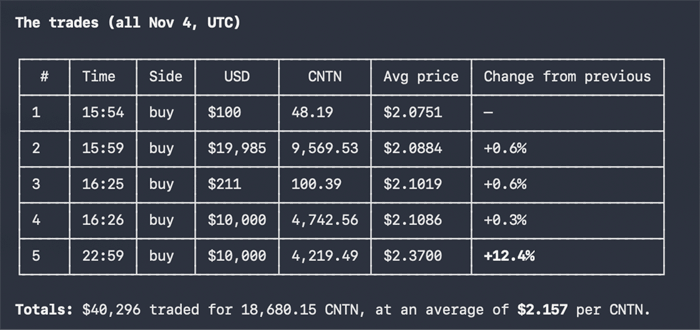
There’s no consensus here, and it certainly doesn’t seem like an upgrade to the existing system to me. Then there’s the red-flag-60-yards-ahead detail.
Those few trades ran straight into the SEC’s ceiling. The exemption limits how much of any stock can trade on a venue each day to a fraction of its average daily volume on the regular market: 0.25% for the largest stocks and 2.5% for everything else.
CNTN averages about 758,000 shares a day on Nasdaq. At 2.5%, the venue can handle roughly 19,000 shares of CNTN per day. At $2 a share, that is about $40,000.
Five test trades hit the cap. Forty thousand dollars of capital, in what is supposed to become a global market, and the machine is already at its limit.
Part of this is that CNTN trades thinly. But that is the point. The rule was written to keep tokenized trading small relative to the legacy market. It can never become the market with these limits. The moment it gains momentum, it hits the ceiling.
Is this what we should expect more of?
The Rules Are Old
The innovation exemption is starting to look like the Locomotives on Highways Act of 1896.
Look at what the exemption requires.
- Permissioned participants only.
- Volume capped relative to the legacy market.
- A 30-day window for issuers to veto the tokenization of their own freely traded shares.
- A five-year sunset.
Every condition exists to protect the structure of the market we already have. The venues are building to those conditions, and the conditions guarantee they stay small.
This is why OKXICE and TSV LLC are destined to fail no matter how well they execute. The rules were not written to let the technology thrive. They were written to make sure the technology doesn’t go faster than 2 miles per hour.
It will also put the focus on a piece of the old system that can actually innovate: the transfer agent.
Transfer agents keep the official record of who owns a company’s shares. On September 1, the SEC proposed letting that record live on a blockchain – the first rewrite of its transfer agent rules since the early 1980s.
Fairmint, the SEC-registered transfer agent in the Canton trade, is the first we have seen do it under the exemption. It recorded the shares directly onto an onchain register, and from that moment the token was the share, not a receipt for one sitting in a vault somewhere.
We have been saying this for a while. Native issuance onchain, with the transfer agent writing the record, is how tokenized stocks get into the market without a derivative in the middle.
The outstanding question is where those shares then trade.
It cannot be the same entity that issues them. That is too much capture in one place, and it is how you end up with another walled garden.
It needs to be decentralized. That is a tall order under today’s rules. But the market has repeatedly told us what it prefers.
Uniswap and Aave did not win because they had the best licenses. They won because they were open source and public, and anyone could plug in.
The market then decided whether each was an improvement.
Someone will need to come to market with a novel structure that pairs a registered transfer agent with a venue that is open rather than permissioned. And it all needs to be compliant.
That is the design that will break the trend.
Until then, we are watching innovation get throttled. The technology is being adopted elsewhere and keeps iterating.
In the United States, we are applying yesterday’s rules to tomorrow’s solutions, and calling it progress. It’s disheartening, but it won’t last forever.
Eventually, you just got to let the Benz drive.
Your Pulse on Crypto,
Ben Lilly
Editor, Chain of Thought
Continue following Brownstone Research
Add Brownstone Research as your preferred source on Google to see our latest stories in your feed.
 Add as a preferred source
More stories like this
Read the latest insights from the world of high technology.
-
-

The Great Crypto Heist
Why do exchanges keep getting hacked? And what lessons should we take away from this?
-

The Midterm Playbook for Crypto
Like it or not, decisions made in Washington directly affect the digital asset industry. So, we should talk about...