




Dark Money Against Tokenization
These networks do more than elect politicians. They shape policy. And every so often one of them shows its...


Like it or not, decisions made in Washington directly affect the digital asset industry. So, we should talk about it.
Ben’s Note: As we prepare to publish today’s edition, we’re also sorting through the details of the Binance hack, which looks to be the largest crypto heist in the history of the industry. Subscribers to our premium digital asset research services—Permissionless Investor and Neural Net Profits—should expect a detailed update later today. I’ll also have more to say on the topic in these pages next week. Please stand by.
He stood on the flight deck of the USS Abraham Lincoln and addressed the nation.
Above him hung a banner. It read simply “Mission Accomplished.”
That was May 1, 2003.
Six months earlier, President George W. Bush and the Republican Party had pulled off something that almost never happens.
In the 2002 midterms, they picked up eight House seats, two Senate seats, and hundreds of seats in state legislatures.
September 11 was still fresh. Bush’s approval rating sat in the low 60s on Election Day – unusually high for a president two years into his term. It helped his party defy the odds.
What made the 2002 election historic was not the war, and it was not the seat count.
It was that the president’s party gained seats in the House at all.
Since 1934, the party holding the White House has lost House seats in every midterm but three: 1934, 1998, and 2002. The average loss is about 27 seats.
In the two modern cases, the president was unusually popular. Bill Clinton’s approval was in the mid-60s during the 1998 cycle, much like Bush’s in 2002.
Donald Trump doesn’t have that luxury…
His approval has run between 31% and 35% in polls over the last two weeks. Reuters had him at 31% on October 20, a record low for his second term.
I suppose anything could happen. But if history is any guide, the president’s party is set to lose ground in Congress next week.
The House sits at 217 Republicans and 212 Democrats, with one independent and five vacancies. Forecasters give Democrats an 80% to 94% chance of taking the majority, with projected gains ranging from a dozen seats to the mid-20s.
The Senate is closer.
Republicans hold it 53-47, and Democrats need a net gain of four. Decision Desk HQ puts their odds at 58%. Kalshi is at 65%. Polymarket has bounced between 63% and 68% through October.
Six races will likely decide it: Ohio, Texas, Iowa, Maine, Alaska, and Michigan.
Of those, Ohio matters most to this industry.
In 2024, crypto’s super PAC network spent roughly $40 million to unseat Sherrod Brown, then chair of the Senate Banking Committee and one of the industry’s most consistent critics. He lost to Bernie Moreno.
Now he’s back, running against Republican Sen. Jon Husted in a special election for the seat J.D. Vance vacated. We’ll get into why that matters in a moment.
This is not a political letter. But like it or not, decisions made in Washington directly affect the digital asset industry. So we should talk about it.
For now, change in Washington looks imminent. And with crypto rules being rewritten by the week, it is worth knowing what kind of change to expect from the people shaping them.
Let’s walk through next week.
Midterms matter because the majority sets the agenda. The party in control decides which bills get floor time and which sit in a drawer.
It also builds the committees.
The majority holds every chairmanship and sets each committee’s partisan ratio. That structure decides which bills get a hearing, which get marked up, and which never see daylight.
For crypto, four committees matter.
They are the Senate Banking, Senate Agriculture, House Financial Services, and House Agriculture committees.
Banking and Financial Services handle the securities side. The two Agriculture committees oversee the Commodity Futures Trading Commission (CFTC), which is why they end up with jurisdiction over Bitcoin and other digital commodities.
If Democrats take the Senate, Sen. Elizabeth Warren becomes chair of Senate Banking.
This is the woman who made “building an anti-crypto army” a centerpiece of her 2024 reelection campaign.
So, not great…
If Warren holds the gavel, CLARITY is dead.
Her Democratic colleague, Sen. Angela Alsobrooks of Maryland, spelled it out. Asked whether a Democratic-controlled Congress would prioritize the CLARITY Act, she answered, “Absolutely not.”
Ron Hammond, head of policy at Wintermute, put it bluntly to The Block this week: “You can say that she will pretty much kill any positive or even helpful things for the industry.”
Warren’s first target is not hard to guess.
The Office of the Comptroller of the Currency (OCC) has approved or conditionally approved 21 national trust bank charters under this administration, at least 13 of them to crypto companies.
Coinbase, Ripple, Circle, Paxos, BitGo, Stripe, Crypto.com’s parent, and Fidelity Digital Assets are among the recipients. The Bank Policy Institute, whose board includes executives from JPMorgan, Goldman Sachs, and Bank of America, has said it is likely to sue. So expect the banks to get Warren all fired up over this in 2027.
Warren already wrote to Comptroller of the Currency Jonathan Gould in May, demanding the full applications and any communications with the White House.
As chair, she gets subpoena power. That’s why the traditional banking lobby will be in her corner in 2027.
The other three committees would change hands too. Amy Klobuchar would likely chair Senate Agriculture, unless Brown wins Ohio. Brown’s seniority could put him in that chair instead, freezing anything that comes out of House Agriculture.
On the House side, Maxine Waters is the presumptive Financial Services chair, with Sean Casten and Bill Foster challenging her for the job. Casten would be the most aggressive of the three on oversight. House Agriculture is up for grabs: Angie Craig is leaving the House, and Shontel Brown and Jim Costa are vying for the top Democratic spot.
But none of those outcomes is as consequential as Warren getting the Banking gavel.
It’s also worth noting which advocates are leaving D.C.

SpaceX orders sent supplier Filtronic soaring more than 1,000%. Now former $900 million hedge-fund manager Larry Benedict believes one American company could be next. Get the ticker (free) before Wall Street catches on.

Beginning November 5, a new AI Super Chip 50 times faster than Nvidia’s could launch an AI bull market bigger than any yet and cause 5 little-known stocks to replace the Magnificent 7. Man who recommended Nvidia before it rose 35,000% posts details here – including why you could make 10 times your money if you get positioned by Nov. 5.
Two Republican senators who shaped the current crypto framework are not on the ballot.
Cynthia Lummis of Wyoming announced in December 2025 that she would not seek reelection. Thom Tillis of North Carolina announced the same in June 2025, a day after Trump threatened to back a primary challenger.
Lummis is the bigger loss.
She chairs the Banking Committee’s digital assets subcommittee, co-authored the first serious attempt at a market structure bill with Kirsten Gillibrand in 2022, sponsored the strategic Bitcoin reserve bill, and was a lead co-sponsor of the GENIUS Act.
For the last five years, she has been part of every digital asset policy conversation in Washington.
Tillis was the dealmaker on stablecoin yield, the single issue that stalled the CLARITY Act for most of this year. He also voted no on the CLARITY Act’s cloture motion so he could move to reconsider the vote later if needed.
Put it all together, and the takeaway is simple: Do not be optimistic about the CLARITY Act in 2027.
If it does pass, it will happen in the lame-duck session between Election Day and the new Congress in January.
Even Sen. Alsobrooks allowed for that possibility. But I’m not getting my hopes up.
Instead, expect more from the SEC and CFTC. The two agencies signed a memorandum of understanding in March and published a joint token taxonomy that sorts digital assets into five categories. Then, in September, the SEC issued its innovation exemption.
The agencies have moved faster in the last few months than Congress has in five years, and their work does not require a floor vote.
That is where policy progress will come from through 2027 – the regulators, not the legislators.
The real question is what this does to price.
Bitcoin had recently been holding around $80,000.
That’s where it sat when the CLARITY Act failed cloture on September 15.
But over the last month, the market has tilted bearish.
We can see it in Bitcoin skew, a metric we’ve covered several times before. Skew measures what options traders will pay for puts relative to calls. When the reading is positive by our convention, the market is paying more for downside protection than for upside exposure. That means it expects lower prices.
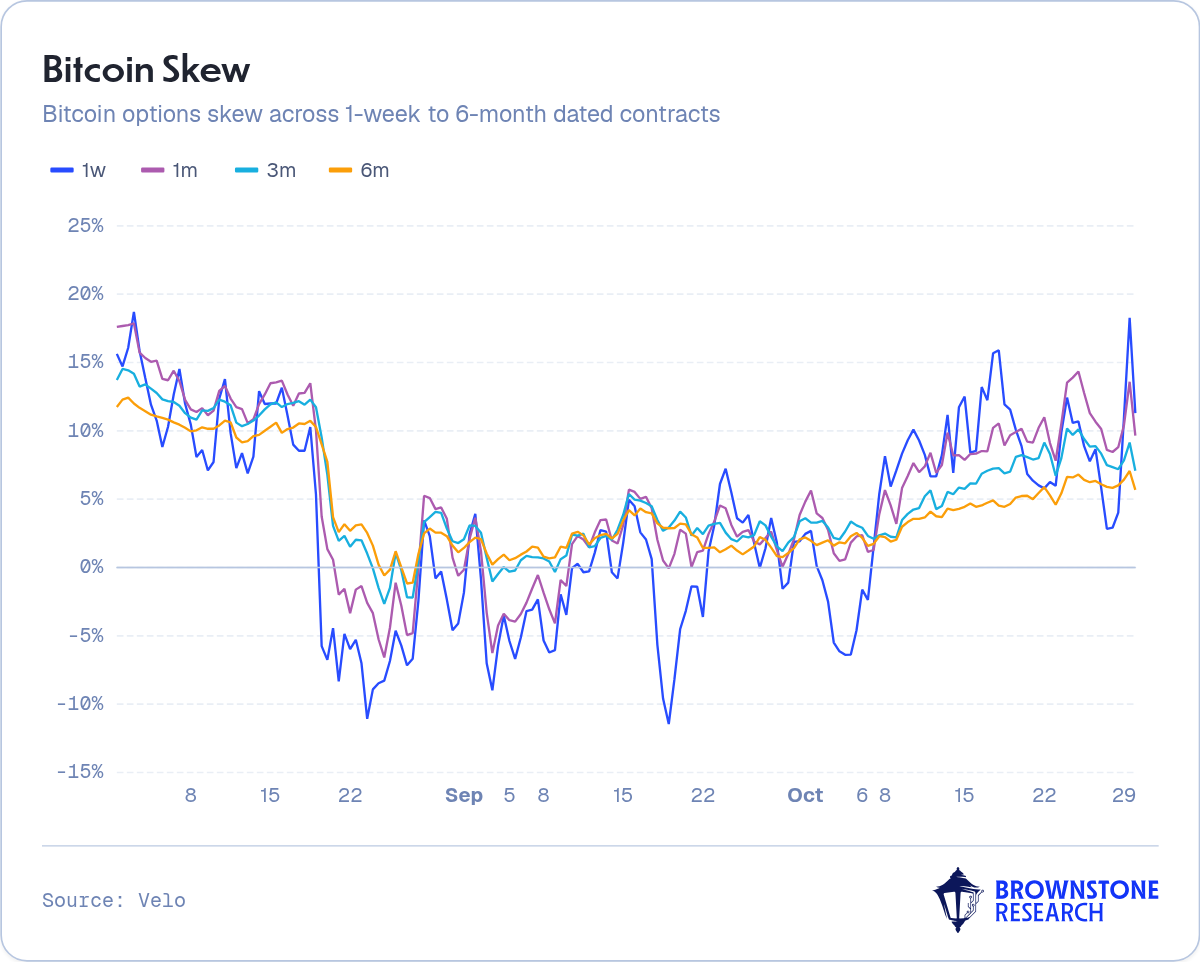
So I would not be surprised to see price go soft on the election results.
The headlines will read as negative for crypto because a Democratic Senate and a Warren-led Banking Committee are bad for the legislative agenda.
The 200-day moving average sits near $70,000, and that is a reasonable place to expect a bid if price works lower.
I do not expect a breakdown below that.
Tokenization is moving faster than at any point in this industry’s history – on regulatory rails that no election changes.
There is also the calendar…
In Bitcoin Will Hit $251,000, we walked through the four-year cycle and showed that Bitcoin’s bear-market lows have landed 513 to 542 days before the next halving in each of the last three cycles.
With the next halving estimated for April 2028, that window puts the cycle low right around the midterms.
History says that from next week forward, prices should march higher over the next couple of years. The election might make headlines as a bad moment for crypto.
But the cycle says it’ll be a buying opportunity.
Your Pulse on Crypto,
Ben Lilly
Editor, Chain of Thought
Add Brownstone Research as your preferred source on Google to see our latest stories in your feed.
 Add as a preferred source
Read the latest insights from the world of high technology.
These networks do more than elect politicians. They shape policy. And every so often one of them shows its...

The venue that wins tokenized stocks will make buying tokenized shares easy and aid the user in choosing which...

The dream of every central bank critic could be coming true – we might actually end the Fed.