




Wall Street’s “Blockbuster Moment”
JPMorgan can keep both pieces of infrastructure as long as it likes. But customers will decide where to do...


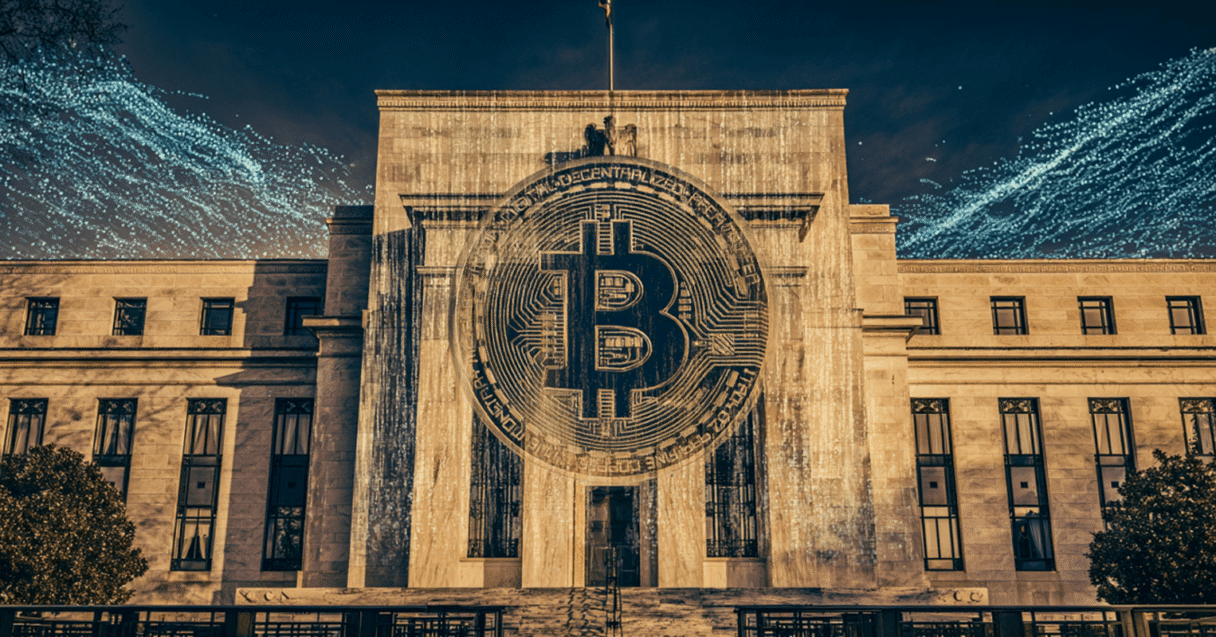
The dream of every central bank critic could be coming true – we might actually end the Fed.
Editor’s Note: Don’t forget to sign up for Jeff Brown’s strategy session next Wednesday at 10 a.m. ET.
He’s discussing the details of a California-based company’s “AI superchip” that he believes is set to shake up the AI industry… potentially causing previous winners in the AI space to fall hard and sending a new crop of AI stocks higher. Just go here to sign up.
In 1898, Swedish economist Knut Wicksell published a book, “Interest and Prices.”
In it, he argued that every economy has two interest rates.
The first is the money rate. This is what banks charge on loans. It’s also the rate the Fed influences when it hikes or cuts the fed funds rate.
When this rate rises, so do the rates for mortgages, business loans, and everything in between.
But there’s also another rate…
Wicksell called it “the natural rate.” It’s the return people expect from putting capital to productive use.
The relationship between the two is what matters.
If you expect to earn 10% over the next year, a 5% borrowing cost looks cheap. So you borrow and spend.
The spending pushes prices and wages up, which makes the next investment look even better. It’s a flywheel, and it spins as long as the natural rate stays above the money rate.
It also works in reverse. If the money rate is above the natural rate, borrowing, spending, and investing slow. After all, you wouldn’t borrow at 10% if you expected to earn 5%.
That’s useful context for what I’ll show you today.
In sum, the dream of every central bank critic could be coming true – we might actually end the Fed.
And if it happens, it won’t be by congressional decree. It will be because the proliferation of stablecoins, tokenized assets, and lending protocols makes the Fed’s tools obsolete.
A bold claim.
But let me show you…
The Fed likes to think it has tight control over the American economy. There’s some truth to that. The Fed has levers it can pull to cool or heat up the economy – hiking and cutting rates, expanding and shrinking its balance sheet.
But the Fed’s power comes from the effectiveness of the transmission mechanism – the chain of cause and effect that produces a desired outcome.
If the Fed wants to tamp down inflation, it might hike its key rate. Because other rates key off it, longer-term rates should rise, too. Borrowing becomes more expensive. People do less of it. Inflation eases.
In theory, that’s the transmission mechanism.
But the Fed’s policies “work” only if the market listens.
What happens when the market ignores the Fed?
The European Central Bank (ECB) recently published a 73-page working paper called “DeFi-ying the Fed? Monetary policy transmission to stablecoin deposit rates.”
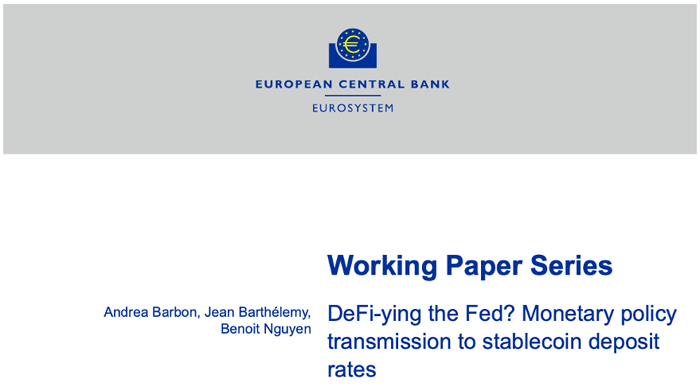
The authors open by asking whether the Fed’s rate decisions carry through to interest rates on U.S. dollar stablecoins.
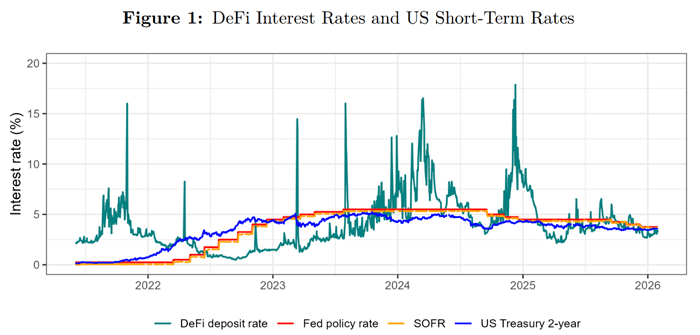
The authors pulled five years of data from Aave, the largest decentralized finance (DeFi) lending protocol, covering USDC, USDT, and DAI across its v2 and v3 versions on Ethereum. They then charted the rates against every Fed move from January 2021 to January 2026.
What they found should have been a bigger story.
Between March 2022 and July 2023, the Fed raised rates 11 times, a total of 525 basis points. DeFi rates went the other direction, falling from 2.5% to 0.5%.
Then, between September and December 2024, the Fed cut rates by 100 basis points.
DeFi rates tripled, from 3% to 9%.
Put another way, for these assets, the Fed’s transmission mechanism looks broken. The Fed can do what it wants… digital assets aren’t listening.
The authors concluded, “While we document a substantial disconnect between U.S. risk-free rates and stablecoin deposit rates, our findings nonetheless show that U.S. monetary policy significantly influences stablecoin lending rates through quantities lent and borrowed in DeFi lending protocols.”
The authors went looking for what drives these rates, and they found it.
They just had no clue what “it” was.
The gap between DeFi rates and Fed rates is highly correlated with the price of Bitcoin.
Borrowing climbs when traders expect Bitcoin and Ether to rise, because they borrow stablecoins to buy more. It falls when they expect losses, because they unwind their loans.
The paper’s own model has a variable for the expected return on risky crypto assets, and that variable, not the fed funds rate, dominates the short-run outcome.
They label this the “leverage channel” – a friction that can “delay, weaken, or even invert” the transmission of monetary policy.
Wicksell would have used a different word.
What they found is a natural rate.
Beginning on October 28, a radical new form of AI could handle everyday tasks for millions of people and send one California company up 1,000%. Hailed by Nvidia's CEO as "the new computer," this AI agent could book your appointments, fight your insurance-claim battles, and more. A new AI superchip 50 times faster than Nvidia's could dominate the story. Find the full details here.
When the Pentagon bought into MP Materials, the stock doubled in weeks. Washington took a stake in Intel, and it’s more than tripled since. The government fast-tracked Oklo, and it ran as much as 3,523% in about a year. Now Jeff Brown expects President Trump to take a personal stake in a brand-new energy company on December 18. Jeff will give you the name and ticker symbol for FREE, in this video.
Think about what Aave’s interest rate actually is.
Borrowers show up when they believe the return on what they’re buying exceeds the cost of borrowing. Lenders show up when the rate on offer beats their alternatives.
The protocol adjusts the rate algorithmically, block by block, based on how much of the pool is in use. Nobody votes. Nobody holds a press conference.
If the market thinks it can earn 10%, it will borrow at 8%.
If expectations collapse, borrowing stops and the rate falls to whatever lenders will accept.
In late 2024, when expectations for crypto returns surged after the election, borrowers piled in and the rate tripled while the Fed was cutting.
In 2022, as leverage was flushed out of the system and halving analysis projected lower returns, rates fell to half a percent while the Fed hiked at its fastest pace in 40 years.
The flywheel runs exactly as Wicksell described.
When expected returns rise above the borrowing rate, liquidity floods in to lend and to leverage. As prices rise, secondary effects follow. Startup funding climbs. Hiring picks up. Wages follow. Most people never see this cycle. I can tell you firsthand it’s real.
And the Fed doesn’t control it.
All of that is interesting, but the phenomenon is still contained within the digital asset ecosystem, a relatively small corner of the investing universe.
And that’s true… for now.
We are tokenizing stocks, Treasuries, real estate, funds, and private credit.
The addressable market is every financial asset on earth. Tokenized assets excluding stablecoins passed $46 billion this fall. Stablecoins themselves are around $300 billion. Aave alone holds about $31 billion in deposits with $12 billion lent out.
Yes, that’s minuscule next to the Treasury market, but the growth of onchain tokenized assets is accelerating. And if Scott Bessent has his way, it’ll keep accelerating.
Every dollar that moves onchain is another dollar whose borrowing cost can be set by a natural rate.
Your mortgage today is priced off the 10-year Treasury, which the Fed influences.
Now picture the home itself as a token.
If your home is a token, why can’t you borrow against it on a DeFi protocol?
And if you can, here’s a better question: What rate would you pay?
The answer won’t come from the Fed. It will be set by the expected return on that asset – the same way Aave, Morpho, Euler, and other lending protocols set rates now.
This is what happens when we tokenize assets and move them onchain. In turn, we free the economy from arbitrary rate setting.
The ECB paper hints at this. It asks, “What would be the critical size of DeFi beyond which it would represent an interest rate controllability challenge?”
Translation: How long until central bankers lose control altogether?
Central banks’ powers are waning, even if they haven’t quite realized it yet.
The Fed can do what it wants.
Increasingly, the market’s not listening…
Your Pulse on Crypto,
Ben Lilly
Editor, Chain of Thought
Add Brownstone Research as your preferred source on Google to see our latest stories in your feed.
 Add as a preferred source
Read the latest insights from the world of high technology.
JPMorgan can keep both pieces of infrastructure as long as it likes. But customers will decide where to do...

The bank realizes it needs to compete in the future of finance, and it’s one where agents roam freely...