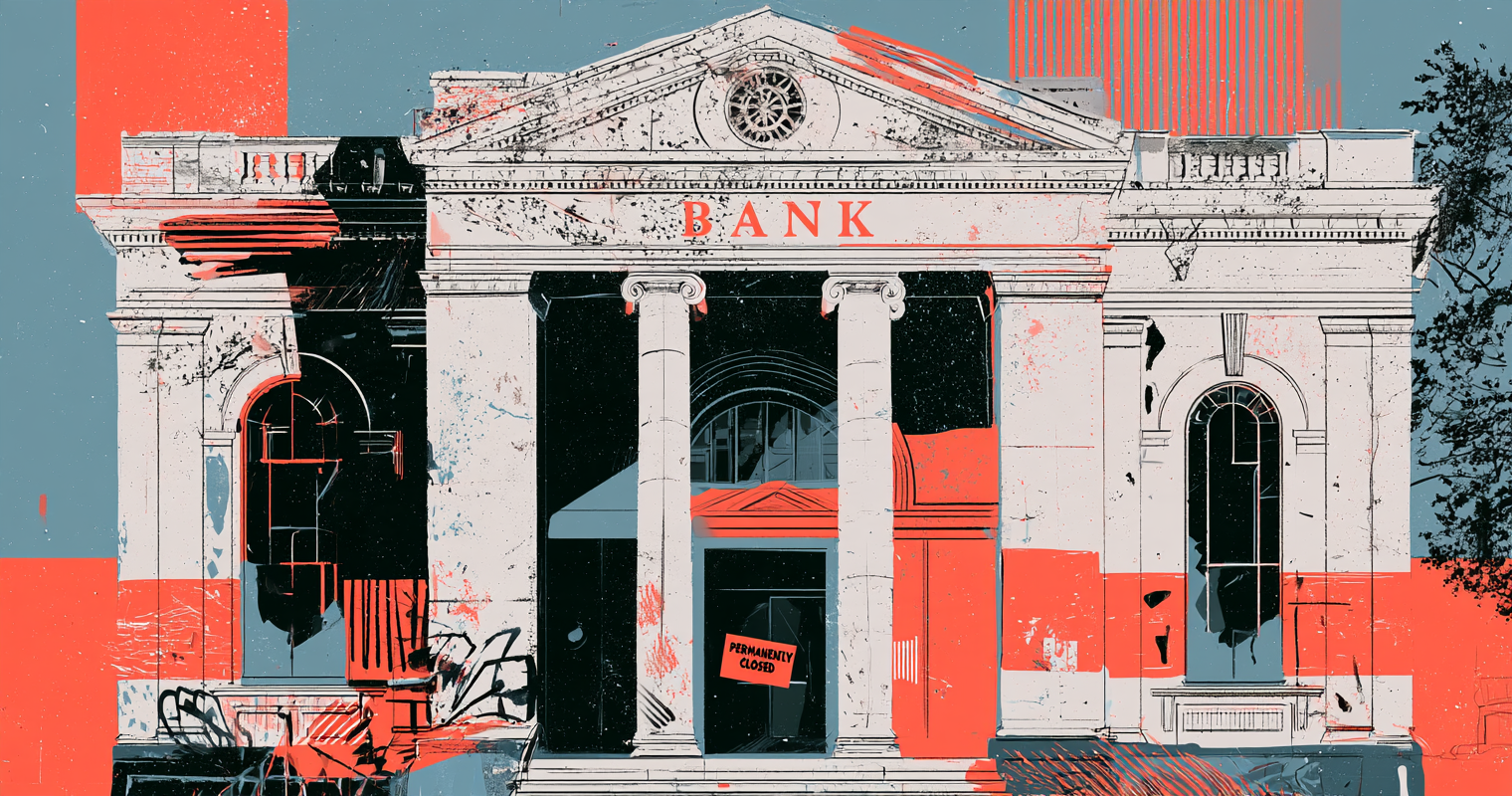






What Scares a Bank?
Expect more mudslinging as January approaches

What scares a bank?
It’s not deposits leaving its vaults…
What really scares them is you finding out how dirty they are.
Everett Stern learned that 15 years ago…
Banks are the gatekeepers of the current financial system. As gatekeepers, they’re supposed to keep bad actors out.
But more often than not, for sanctioned individuals, terrorist organizations, or drug cartels, the banks are open for business.
Everett Stern learned that as a junior compliance officer at HSBC.
He wasn’t a high-level executive with special access to client accounts. He was a lower-level employee. Yet from his vantage point, he saw billions of dollars move to drug cartels, sanctioned regimes, and terrorist organizations.
One detail of the whole affair: According to a Justice Department statement at the time, drug cartel couriers would deposit hundreds of thousands of dollars at HSBC Mexico branches. They carried the cash in boxes exactly the same size as the teller windows. Despite the obvious red flag, the bank dutifully accepted the cash.
Once the details became clear, Stern did something that most in his position wouldn’t.
He blew the whistle.
He shared his concerns with the bank. Unsurprisingly, nothing happened.
So, he escalated it, bringing his concerns and evidence to the FBI, the CIA, and the SEC. The result was a $1.92 billion settlement in 2012. It was the largest money-laundering penalty ever levied against a bank at the time.
But here’s the interesting part…
Nobody went to jail.
No banker was charged with a crime.
Shareholders simply paid the fine, while bonuses and salaries continued as usual. My guess is the activity uncovered was only the portion visible to a junior officer. The tip of an iceberg the public never saw.
This story matters today because of news fresh out of the Office of the Comptroller of the Currency (OCC), the regulator that supervises America’s national banks.
The Gatekeepers Get Fined
Let’s start with Bank of America.
The OCC and the Financial Crimes Enforcement Network (FinCEN), the Treasury’s anti-money-laundering arm, recently assessed a $1.2 billion penalty against the bank.
The reasons – anti-money-laundering failures and sanctions violations spanning programs on Iran, Russia, narcotics, and global terrorism.
Step back for a moment. We’re talking about countries that the U.S. is currently at war with.
And the second-largest bank in the United States, an institution that processes trillions of dollars in transactions around the globe, helped them move money.
You’d think BofA’s position atop the banking world means it’s held to the highest standards. And that, as the second-largest bank in the U.S., it feels a hint of patriotism.
But no… This isn’t the bank’s first failure.
Back in 2024, the OCC cited Bank of America for deficiencies in its Bank Secrecy Act and anti-money-laundering programs. These are the systems banks are legally required to run to flag dirty money.
Regulators viewed the problems as widespread internal breakdowns. And the bank failed to fix them.
As a result, Bank of America failed to report more than $5 billion in suspicious activity, including flows tied to Chinese money-laundering networks and illicit finance along the southwest border.
It also let potential trade-based money laundering pass through. In effect, the bank’s deficient systems left trillions of dollars in transactions inadequately monitored.
Disgusting. But that wasn’t all…
The OCC went after American Express, issuing a $350 million penalty against American Express National Bank for similar failures in its anti-money-laundering program, including shortfalls in flagging and reporting laundering activity.
But beyond the fines, what should we expect?
As with HSBC, don’t expect any executive to serve time, miss an annual bonus, or pay a dime personally.
Shareholders will foot the bill.
And the OCC didn’t stop there. It fired another shot at the banking industry.
The Other Report
This week, the OCC released a report on debanking at large banks.
This is the practice of denying or cutting off banking services to lawful customers.
The findings come from a review of the nine largest national banks: JPMorgan Chase, Bank of America, Citibank, Wells Fargo, U.S. Bank, Capital One, PNC Bank, TD Bank, and BMO.
The report concluded that all nine maintained policies at some point between 2020 and September 2025 that denied or limited access to banking services based on a customer’s lawful business activities.
Among the targeted categories – digital assets.
This confirms what the crypto industry long believed but could never prove.
It was dubbed Operation Chokepoint 2.0.
The theory held that banks were quietly working to choke off digital asset and stablecoin businesses from the financial system. They didn’t want these businesses to exist, and as gatekeepers, they could simply decide those businesses’ fate.
Turns out this conspiracy was real.
In some ways, it’s incredible that many crypto businesses survived such an environment at all.
But here’s the thing…
Given how banks operate, maybe the real worry was never that yield-bearing stablecoins would pull deposits out of checking accounts.
Perhaps it’s something more sinister.
Because here’s the hard truth about public blockchains…
Recommended Links

Elon Musk… A Total Fraud?
Just a few years ago, they laughed at him… And said that what Elon was planning to do was impossible. In 2018, the New York Post even called Elon “a total fraud”... But I just caught his new technology on camera (click here to see it)... And it proves the media was 100% wrong about Elon.

This is the next million-dollar AI trade (not an AI stock)
Some of these AI assets are already taking off for gains of 200%, 318%, and 467%, all in 30 days or less. One returned 46 times more money than the #1 AI stock of the year… Which is why Jeff is now recommending his TOP FIVE plays (click here to see the details).
Built-In Safeguards
If you’re committing crimes, don’t use them.
Every transaction is stored forever, visible to anybody. Firms such as Chainalysis and TRM Labs have built sophisticated tracing tools on top of that permanent record. Hackers have been identified and funds recovered precisely because the criminals were using a blockchain. The privacy that illicit finance depends on simply isn’t there.
Run with that for a moment…
If the financial system migrates to stablecoins and public rails, bank activity becomes visible in a way it has never been. The next HSBC wouldn’t need a junior compliance officer in the right seat at the right time. The evidence would be immutable, timestamped, and public.
Anybody with AI tooling and an internet connection could be a compliance officer from the comfort of home.
Everett Stern was just a junior officer. A man with a limited vantage point. We never learned how deep that rabbit hole went.
On a public ledger, the depth of the rabbit hole can be excavated.
Perhaps that’s what banks are really worried about. They no longer get to determine who gains access to the financial system. They no longer control what regulators can see.
And they appear to feel threatened.
Slinging Mud
The timing is no coincidence.
Comments on the GENIUS Act’s implementing rules are due October 19. The banks know it.
So, it’s no surprise that the Wall Street Journal just dropped a story on Bo Hines, the former official who helped push the GENIUS Act over the line at the White House.
Hines served as executive director of the President’s Council of Advisers on Digital Assets.
The story alleges that a firm in which Hines held a one-third stake collected about $6.3 million from Tether, the largest stablecoin issuer, while the GENIUS Act moved through Congress.
Days after leaving government, Hines became a Tether adviser and later CEO of Tether’s U.S. division.
I’m not here to condone or condemn his behavior. We don’t have both sides of the story. Hines’ former firm denies he knew about or profited from the Tether business while in government, and no charges or ethics referrals have been filed.
What I do know is that the timing is interesting.
Banks don’t want stablecoins. They are fighting to stop them.
Meanwhile, the current administration is pushing hard to get stablecoins into circulation and woven into the financial industry.
When that happens, banks lose their privileged seat in the Treasury markets. They lose the yield they’ve been keeping on your deposits. And they become far less important as gatekeepers of the financial system.
The Bo Hines story follows the same playbook that worked against the CLARITY Act and the president’s crypto interests.
It seems banks will run the same playbook again as the GENIUS Act approaches its January 2027 effective date.
This fight is far from over. Expect more OCC penalties, expect more Wall Street Journal pieces, and expect more mudslinging as January approaches.
But make no mistake…
Stablecoins are coming. They’re a national priority.
Your Pulse on Crypto,
Ben Lilly
Editor, Chain of Thought
Continue following Brownstone Research
Add Brownstone Research as your preferred source on Google to see our latest stories in your feed.
 Add as a preferred source
More stories like this
Read the latest insights from the world of high technology.
-
-

Suddenly, the Pond is Covered
It’s a good way to visualize how big, consequential changes can sneak up on you.
-