



Why the Fed Might Actually End
The dream of every central bank critic could be coming true – we might actually end the Fed.


The venue that wins tokenized stocks will make buying tokenized shares easy and aid the user in choosing which protocols to use next.

Editor’s Note: Don’t forget to sign up for Jeff’s AI Super Chip event this week…
He’s getting into the details of the California-based company that’s developed a chip that’s 50x more powerful than NVIDIA’s…
And could shake up the AI industry and spawn a new class of AI companies that could soar this year.
Just go here to sign up.
Google wanted you to leave its website as fast as possible.
That was the company’s mentality in the 1990s. Search was growing… and quickly becoming the preferred way to navigate the internet.
But Google’s strategy ran counter to what the first movers were doing.
The big websites of the day were sandboxes…
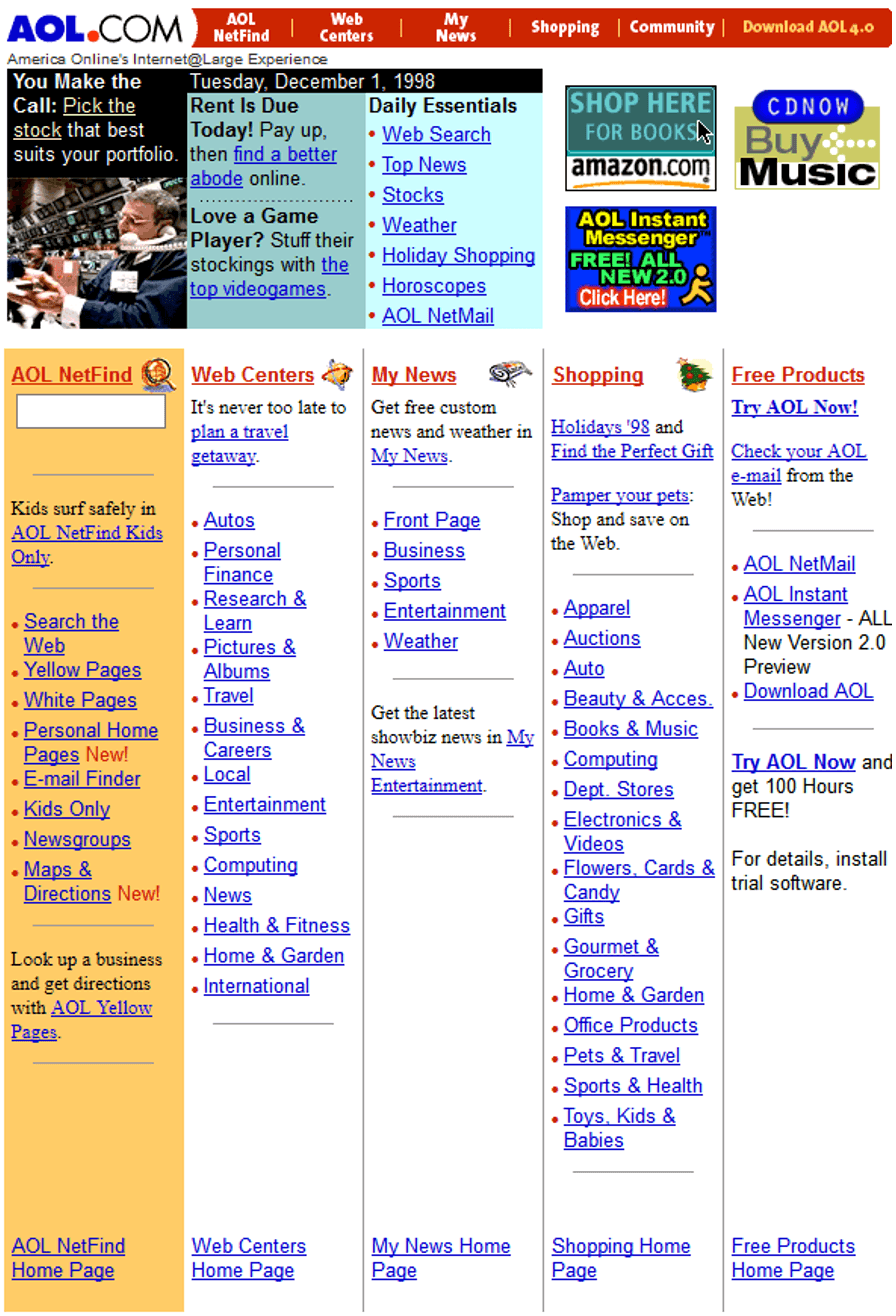
Yahoo, Excite, Lycos, and AOL all operated with a shopping-mall mentality. Search was just a feature. The real goal was to route you toward the portal’s own mail, news, stock quotes, and horoscopes.
The longer you stayed, the more banner ads you saw. The more ads, the more revenue. They were after stickiness.
As a result, these websites looked… crowded.
Source: webdesignmuseum.org
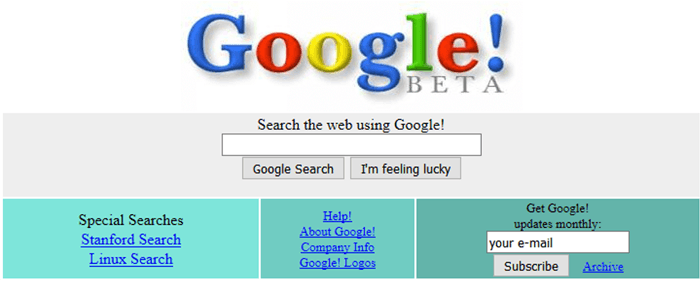
Google showed up in 1998 as an underdog.
It had a different idea: Give the user exactly what they wanted and get them out the door. The homepage was a white box and two buttons, both still there today.
Source: webdesignmuseum.org
Years later, Larry Page put it simply: “We want to get you out of Google and to the right place as fast as possible.”
The faster you left, the better Google did its job. And the better it did its job, the more likely you were to come back.
Before long, Google became everyone’s first stop online. In time, it became the $3.9 trillion behemoth it is today.
Google’s advantage was that it came late to search. Its competitors were stuck in a dated mindset – trying to lock the user into their ecosystems with a barrage of “stuff.”
The first movers lost because they wanted you to stay in their sandbox. Google won because it built a gateway.
Keep that in mind for what I’m about to show you.
OKXICE is a joint venture between crypto exchange OKX and Intercontinental Exchange, the parent of the New York Stock Exchange.
On October 4, it published notice that it intends to operate a tokenized securities venue, or TSV, under the SEC’s new innovation exemption.
We covered the mechanics in Suddenly, the Pond is Covered.
As a refresher, the exemption, issued September 17, lets a venue trade tokenized versions of listed U.S. stocks around the clock for five years without registering as an exchange – as long as it meets a list of conditions.
One of those conditions concerns the companies themselves. A venue must give a public company 30 days’ written notice before listing a tokenized version of its shares. If the company objects within those 30 days, the venue cannot list it. Silence means the stock can go live.
OKXICE’s October 4 notice named 63 tickers representing 62 companies. That started the clock… and it runs out next week.
As of October 23, objections had come from 22 companies: Microsoft, Alphabet, Goldman Sachs, Wells Fargo, Cisco, Broadcom, Qualcomm, Caterpillar, McDonald’s, UnitedHealth, Verizon, Moderna, Arm, Intuit, Marvell, CoreWeave, AppLovin, Rocket Lab, Western Digital, Applied Digital, Applied Optoelectronics, and Cerebras.
Nasdaq separately said it would keep its own shares off any tokenized venue, citing fragmentation and investor protection.
Why would a company object to having its shares tokenized and traded?
Applied Optoelectronics told The Wall Street Journal it did not know how tokenization would affect its share price, liquidity, or volatility, and worried that investors might think the company had endorsed the token.
That’s understandable.
Onchain solutions are uncharted territory. Public companies are risk-averse by design. If management cannot explain to the board how a tokenized share helps existing holders, the safest answer is no.
Andrew Cuomo (yes, that Andrew Cuomo) is OKXICE’s co-chairman. He called the hesitation “a very natural response” and said the venture “always anticipated” that “many companies would want to wait and see how it goes rather than be the first to participate.”
He’s right.
On the surface, 22 objections look bad. But I suspect many of these companies will change their minds soon.
Once tokenized shares start changing hands on a U.S.-regulated venue in November, the advantages will become obvious. It will be a zero-to-one moment. For the first time, there will be real data on what happens when a listed stock trades onchain under American rules.
How the token price tracks the exchange price overnight or on the weekend, how liquidity behaves when the traditional exchanges are closed, and whether dividends and votes flow through cleanly – all of it will be on display.
And OKXICE won’t be alone.
A new “AI Superchip” 50 times faster than Nvidia's could launch an AI bull market bigger than any we've seen yet and cause five little-known stocks to replace the Magnificent Seven. The man who recommended Nvidia before it rose 35,000% reveals the details here – including how you could make 10 times your money if you position yourself by October 28.

A brand-new machine could make 70% of America’s oil imports unnecessary. Forget about the Strait of Hormuz. Or the Middle East, altogether. We’ll never have to rely on oil again. Google, Nvidia, and Goldman Sachs are pouring money into this breakthrough. And Jeff Brown names the stock behind it – free – in this video.
Two other firms have filed TSV notices with the SEC. Together, the three are the first movers.
And all three have the same problem.
OKXICE is running its venue on X Layer, an Ethereum layer-two chain that OKX built on the OP Stack – the same open-source software behind Coinbase’s Base.
To keep it simple, let’s call it OKXICE’s chain.
You do not need to understand layer-twos in detail. What matters is a single component called the sequencer.
The sequencer receives every transaction, decides which ones to include, puts them in order, builds the block, and publishes the data. If multiple orders for the same tokenized stock arrive at the same instant, the sequencer decides which gets filled first.
In other words, one company controls the chain.
The second venue belongs to Perpetuals.com, run by former FTX Europe chief Patrick Gruhn. The company filed its TSV notice on October 14 and plans to trade on Kronos X Public, another Ethereum-compatible layer-two.
Like X Layer, it will launch with a single sequencer run by its creator.
This matters because the SEC’s innovation exemption is explicit:
The venue’s smart contracts must be “auditable, public, and deployed on a public, permissionless distributed ledger.” The order says permissionless generally means that “anyone can read or write to the distributed ledger without authorization.” These two pieces are crucial.
That’s because they also affect the third venue, TSV LLC, which filed September 23 and plans to use the Canton Network.
Canton flies in the face of the permissionless requirement by design.
It is a privacy-focused network run by a set of approved super validators, a club that includes Goldman Sachs, London Stock Exchange Group, and Paxos.
To put it plainly: Not everyone can take part. In fact, not everyone can even see what’s happening on the chain.
That’s Canton’s selling point to banks.
But it’s the opposite of what the SEC wants.
The SEC is asking for public, permissionless rails for one reason: neutrality.
I hope regulators hold the line. That’s what gets us a more open system rather than the status quo.
But even if the SEC relents on this point, these three setups are destined to fail…
Like AOL and Yahoo in the early days of the internet, these three first movers are building sandboxes.
Each one runs its venue on a chain its own corporate group built.
As in the 1990s, the plan is to get the user on the chain and keep them there.
They’ll do it by layering on lending, derivatives, and other services to capture more transaction volume. OKXICE’s Cuomo even called it “a sandbox.”
As if we haven’t already learned this lesson…
What the user wants is less friction.
Buy a tokenized share, then take it wherever it is most useful. Post it as collateral on Aave. Pair it in a liquidity pool to earn yield. Hold it in a wallet the venue does not control. Move it to another chain where a new opportunity springs up. Let your AI agent move it without being blocked by the banks.
The venue that wins tokenized stocks will make buying tokenized shares easy and aid the user in choosing which protocols to use next.
A gateway. Not a sandbox.
And like Google, this venue won’t be a first mover.
But once it arrives, tokenization will move faster than most people expect.
Expect to see it in the weeks and months ahead.
Your Pulse on Crypto,
Ben Lilly
Editor, Chain of Thought
Add Brownstone Research as your preferred source on Google to see our latest stories in your feed.
 Add as a preferred source
Read the latest insights from the world of high technology.
The dream of every central bank critic could be coming true – we might actually end the Fed.

JPMorgan can keep both pieces of infrastructure as long as it likes. But customers will decide where to do...
The bank realizes it needs to compete in the future of finance, and it’s one where agents roam freely...