



When the Banks Went Dark
Many of us don’t realize how dependent we are on big, centralized systems…


Open capital markets are often more accurate and more efficient than we give them credit for.
Editor’s note: Jeff Brown has issued what he calls a “red alert.” The reason is a document Elon Musk quietly filed with the Texas Department of Licensing and Regulation, which Jeff says is setting a major tech trend in motion. He will explain it live on Tuesday, November 24, at 8 p.m. ET, in his “M.A.G.I. Phase II” strategy session. Get more details and reserve your seat with one click right here.
Anthropic began trading on August 19 at about $102 per share.
Read that again.
August 19. Three months before shares began to trade on the Nasdaq.
Three months before Dario and Daniela Amodei rang the opening bell at the Nasdaq and the stock opened at $111.50.
Well before the closing bell recorded Anthropic’s first close of $97.17.
Well before Anthropic published a lockup schedule that lets employees sell up to 315 million shares on day one and expands the number of shares that can trade by more than 13 times over the next year, all while index funds are forced to buy.
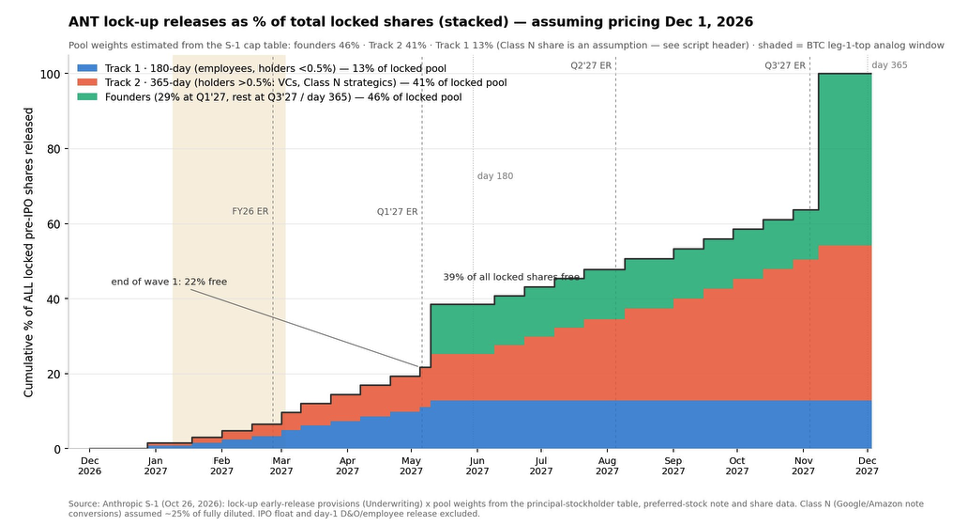
Source:X.com @insider0x | Anthropic S-1
And well before the initial public offering itself, which raised $81.3 billion at $83 per share and valued the company at $1.5 trillion, making it the largest IPO in history by capital raised.
Given everything that happened between August and this week, it is remarkable that the August price was right on the mark.
Two days before the listing, the price in that market was $98. The stock closed its first day at $97.17.
It’s a testament to something we tend to forget. Open capital markets are often more accurate and more efficient than we give them credit for.
Which raises the question: What market am I even talking about?
Where was Anthropic trading at $102 per share three months before any of this week’s excitement?
Hyperliquid is a blockchain we have covered several times in Chain of Thought.
It’s the chain where SpaceX began trading in May, well before its June 12 IPO. It’s also where Cerebras Systems, the company behind the dinner-plate-sized wafer-scale chips, started trading before its May 14 listing.
The pre-IPO trading for SpaceX, Cerebras, and Anthropic on Hyperliquid wasn’t backed by the stock itself. Instead, it was a synthetic perpetual contract that allows investors to speculate on the company’s value before the IPO goes live. And as we saw, that value matched the actual share price.
Hyperliquid is a public and permissionless layer-one blockchain. It is best known for an ultra-fast spot and perpetual futures market built on a central limit order book, the same structure the Nasdaq uses.
In a typical brokerage account you never see the order book. You see a price and a button. On Hyperliquid you see every bid and every ask, stacked by size, for anyone who cares to look.
This is what the order book for Anthropic looked like on Hyperliquid this morning, before the Nasdaq opened.
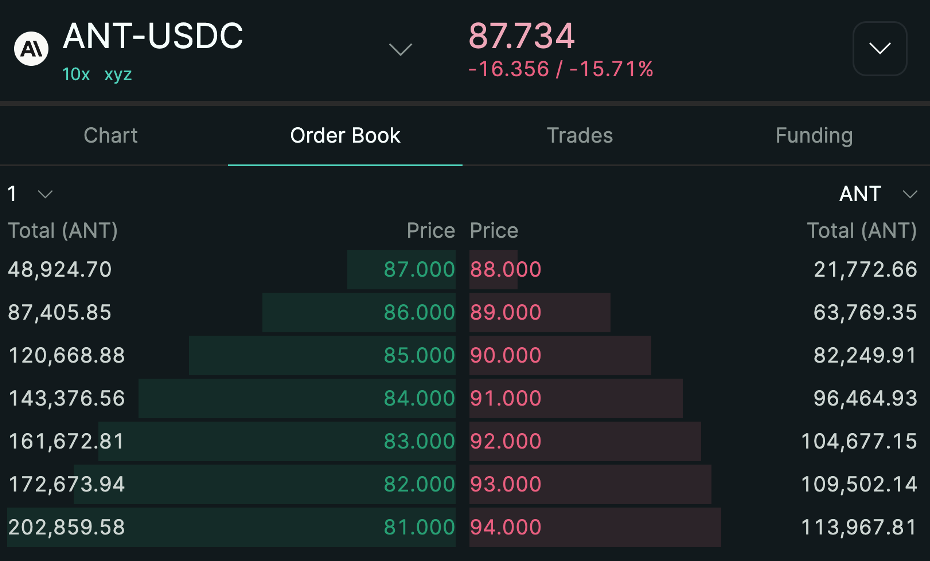
Source: app.hyperliquid.xyz
You can also see every trade that prints, the tape, along with open interest, funding, and other metrics. All of it is available to anyone, with no data fee and no privileged access. It’s permissionless.
And so is the Anthropic market itself, which makes it worth breaking down.
Just over a year ago, in October 2025, Hyperliquid shipped an upgrade called HIP-3, short for Hyperliquid Improvement Proposal 3. It introduced permissionless deployment of perpetual futures markets.
Here is what that means…
Anyone who stakes 500,000 HYPE tokens to the network can launch their own exchange on Hyperliquid and list whatever markets they want. We call them deployers.
The deployer is responsible for the price oracle, the margin rules, and the liquidity, and keeps a share of the trading fees. If it misbehaves, the network’s validators can slash its stake.
It would be as if the Nasdaq or the New York Stock Exchange could list its products on Hyperliquid tomorrow by posting a bond or stake. No application. No unwritten pay-to-play arrangement.
Imagine it for a moment… Exchanges competing on the same blockchain to win users.
That is the opposite onchain model the traditional exchanges are pursuing, which we wrote about last week in “Adults in the Room.” Those are permissioned, walled-garden solutions. Hyperliquid defies the incumbents and represents a different paradigm for capital markets.
And the Anthropic IPO just showed how efficient it can be.
During Phase I of "M.A.G.I" you could have made 360x your money on Jeff Brown's calls. Jeff now says Musk's new Texas filing sets Phase II in motion. On Tuesday, November 24, at 8 p.m. ET, he shows you how to prepare. Register in a single click.
Elon Musk just released a drawing of his newest project… what he calls “the largest and most valuable building on Earth.” Right in the middle sits a thin circle most people never noticed. Jeff Brown believes it’s the key to Elon’s entire masterplan… and the “1,000x return” Elon himself predicted. See what the circle means – and get a free Elon stock – in this video.
A deployer called Entropy launched the first Anthropic market in August. Its markets trade under the prefix “io.”
Entropy was founded by traders from Citadel Securities, Optiver, and Millennium. It lists global equities, commodities, and indices, along with novel products such as long-dated pre-IPO equities. Anthropic was one of them.
Entropy’s contract is quoted as the company’s total valuation rather than a share price. The first trade on August 19 printed at $1.797 trillion. Divide that by the roughly 17.6 billion fully diluted shares in the prospectus and you get about $102 per share.
Remember, this was the only liquid place in the world to express a view on what Anthropic was worth.
And as we said, the pricing turned out to be accurate.
But Entropy was not alone.
Trade.xyz, the deployer we covered when SpaceX was trading pre-IPO, launched its own Anthropic market on October 26, the same day Anthropic filed its S-1. Its contract is quoted per share. It closed its first day at $114.35. Consider that the stock opened on the Nasdaq at $111.50, hit a high of $115.10, and ended the day at $97.17. A market launched three weeks before the IPO landed inside the first day’s range.
Then a third deployer, Paragon, listed its own Anthropic market the following day, October 27. It is a smaller market, but it is a third one.
That is what open capital markets look like. Deployers that find the best liquidity, offer the best product, and run the most reliable service become the destination for pre-IPO trading.
Compare that with the system we have.
The Nasdaq decides who gets to list. That applies whether a company wants to IPO, list directly, or merge with a SPAC. Getting there is expensive. Underwriting fees, exchange listing charges, legal and advisory bills, the ongoing cost of being a public company – it all adds up.
The Nasdaq’s entry fee alone is $325,000. Anthropic paid its 22 underwriters roughly $550 million, with Goldman Sachs and Morgan Stanley collecting about $113 million apiece.
That is not a sign of efficient markets. It is a sign of bloat. Middlemen and gatekeepers extracting a toll from the plumbing of capital formation.
Hyperliquid and the other onchain venues remove those margins.
The pre-IPO markets are impressive. But Hyperliquid’s markets are perpetual futures. They are derivatives, not shares.
For tokens that represent actual Anthropic stock, we look to Securitize, Coinbase, Robinhood, Ondo, Backpack, Dinari, and Kraken’s xStocks, among others.
Each launched a tokenized version of Anthropic within hours of the Nasdaq open. Securitize and Backpack went live on Solana within 35 minutes of the first trade. By the end of the day, Anthropic was transacting on Solana, Base, BNB Chain, Ethereum, and Robinhood Chain. Roughly $106 million of it traded onchain on day one.
That is a rounding error next to the Nasdaq, where 846 million shares changed hands. But it is day one, and the structures differ.
Here is where the game changes…
These tokens can be bought on decentralized exchanges such as Uniswap and Aerodrome. For an asset to trade on those protocols, someone must create a pool, which is a pair of assets sitting in a smart contract that the market can trade in and out of. Anyone can supply assets to the pool and, in exchange, collect the trading fees.
Take Robinhood’s deployment of Uniswap on Robinhood Chain.
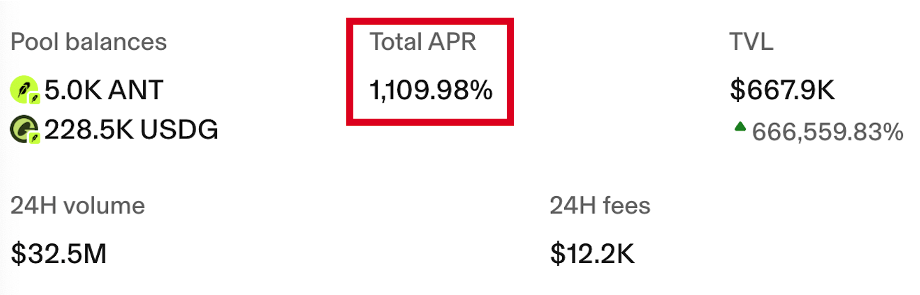
The ANT/USDG market there is a pool of tokenized Anthropic shares and USDG, the dollar stablecoin issued by Paxos. It is one of several pools for the token, and most users never trade with it directly. They use a router that scans every pool and finds the best price.
Over the last 24 hours, this one pool handled $32.5 million in volume. That volume generated about $12,200 in fees for the people who supplied the assets. And it did so on about $440,000 of capital sitting in the pool.
The result:
Source: app.uniswap.org/explore
Annualize the fees against the capital in the pool and the yield works out to more than 1,000%.
Yes, seriously.
Of course, that yield won’t last forever.
The first day of a new token comes with outsized volume. Anthropic was no exception, and the yield will come down as volume normalizes and more capital enters the pool.
This is also a Uniswap v3 pool, which uses concentrated liquidity. Suppliers choose a price range for their capital, and they earn fees only while the price sits inside it. Anthropic fell from $115 to $87 in its first 24 hours. Anyone who set a range near the open was out of range by the next morning, holding only Anthropic tokens and earning nothing. Capturing those eye-popping numbers means re-centering your position constantly. It is the job of a market maker, not a passive saver.
But do not be discouraged.
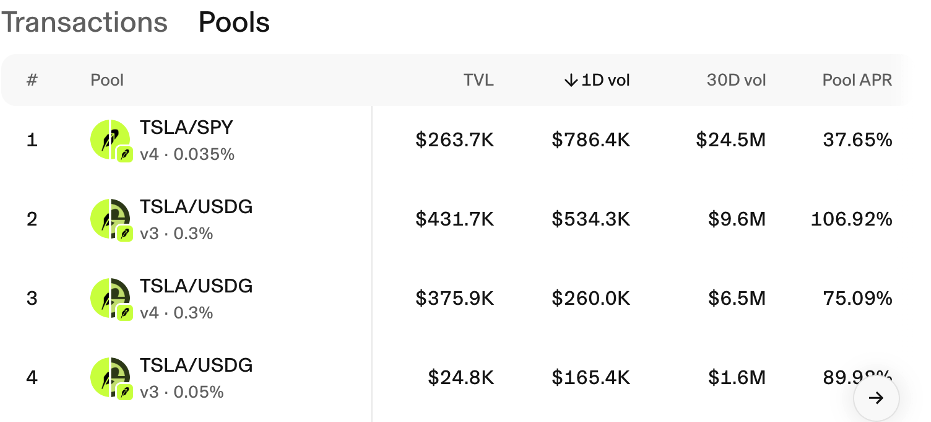
Here are the pools for Tesla’s tokenized shares on the same chain. The yields on the right-hand side, months after launch, are still healthy.
Source: app.uniswap.org/explore
Best of all, because all of this lives on public blockchains, new products will package this yield for everyday investors without asking them to manage ranges like a market maker.
Which means the most efficient place to hold a stock will no longer be a brokerage account. It will be onchain.
The 3% to 4% dividend yield will become a relic. We are looking at a world where a tokenized share earns a double-digit yield, and anything less is a sign you are still in the old system.
The future is permissionless. Let’s get on with it.
Your Pulse on Crypto,
Ben Lilly
Editor, Chain of Thought
Add Brownstone Research as your preferred source on Google to see our latest stories in your feed.
 Add as a preferred source
Read the latest insights from the world of high technology.
Many of us don’t realize how dependent we are on big, centralized systems…

Investors looked back at that period and wished they had bought more.

Crypto investors are surveying the meadow. And all they see are wolves…