



Why I’m Skipping the Anthropic IPO
Anthropic’s IPO could be the biggest ever, at up to $2 trillion. Here’s why you may want to sit...


The AI bears are interpreting weakness in stock prices as weakness in the AI revolution.

Editor’s Note: Today, we’re sharing an essay from our colleague Jason Bodner. As Jason shows below, investors are making a big mistake—confusing sagging AI stocks with weak AI demand. Read on for Jason’s insight.
I’ve never been a cryptocurrency guy. Longtime readers know I’ve been open about that.
But I’ve watched markets long enough to recognize a familiar pattern…
Whenever cryptos collapse, headlines declare the experiment over. Investors lose fortunes, speculative projects disappear, and skeptics celebrate. They even have a name for these periods: crypto winters.
The crashes of 2018 and 2022 were brutal, with Bitcoin losing more than 80% and 75%, respectively. Yet after both collapses, Bitcoin recovered and set new all-time highs. Plenty of individual crypto projects failed along the way, but the broader market survived.
A similar disconnect is developing in artificial intelligence. Once again, I think the bears are confusing market prices with technological progress.
Wall Street is nervous about AI.
The world’s largest technology companies are spending enormous sums on data centers, processors, networks, and electricity. Investors understandably want to know when those investments will pay off.
Fair enough…
Companies can’t spend hundreds of billions indefinitely without generating attractive returns (even though Amazon did).
But questioning AI stock valuations isn’t the same as questioning AI demand. Right now, investors are confusing the two.
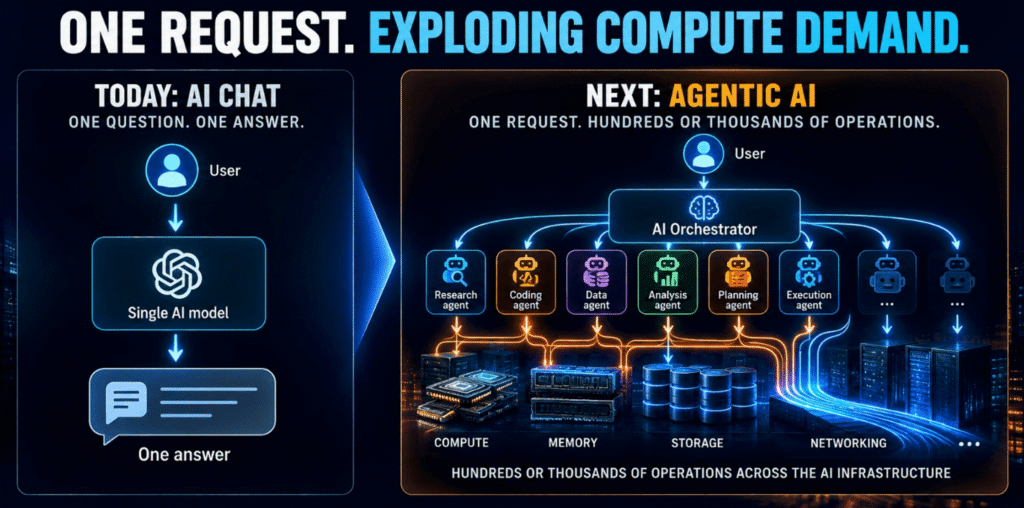
Most people experience AI by asking ChatGPT a question and waiting for an answer. For them, it’s a better search engine. That’s it.
Agentic AI changes that equation.
Imagine assigning an AI agent to research an industry, analyze competitors, review financial statements, and prepare a presentation. It might deploy several specialized agents, each making dozens or hundreds of requests to models and databases.
Suddenly, one person’s request generates enormous computing activity.
And that’s where the economics get interesting.
AI skeptics point out that the cost of using AI is falling fast. They’re right. Models are becoming more efficient, competition is increasing, and the cost of processing AI activity, measured in tokens, has roughly halved in recent months.
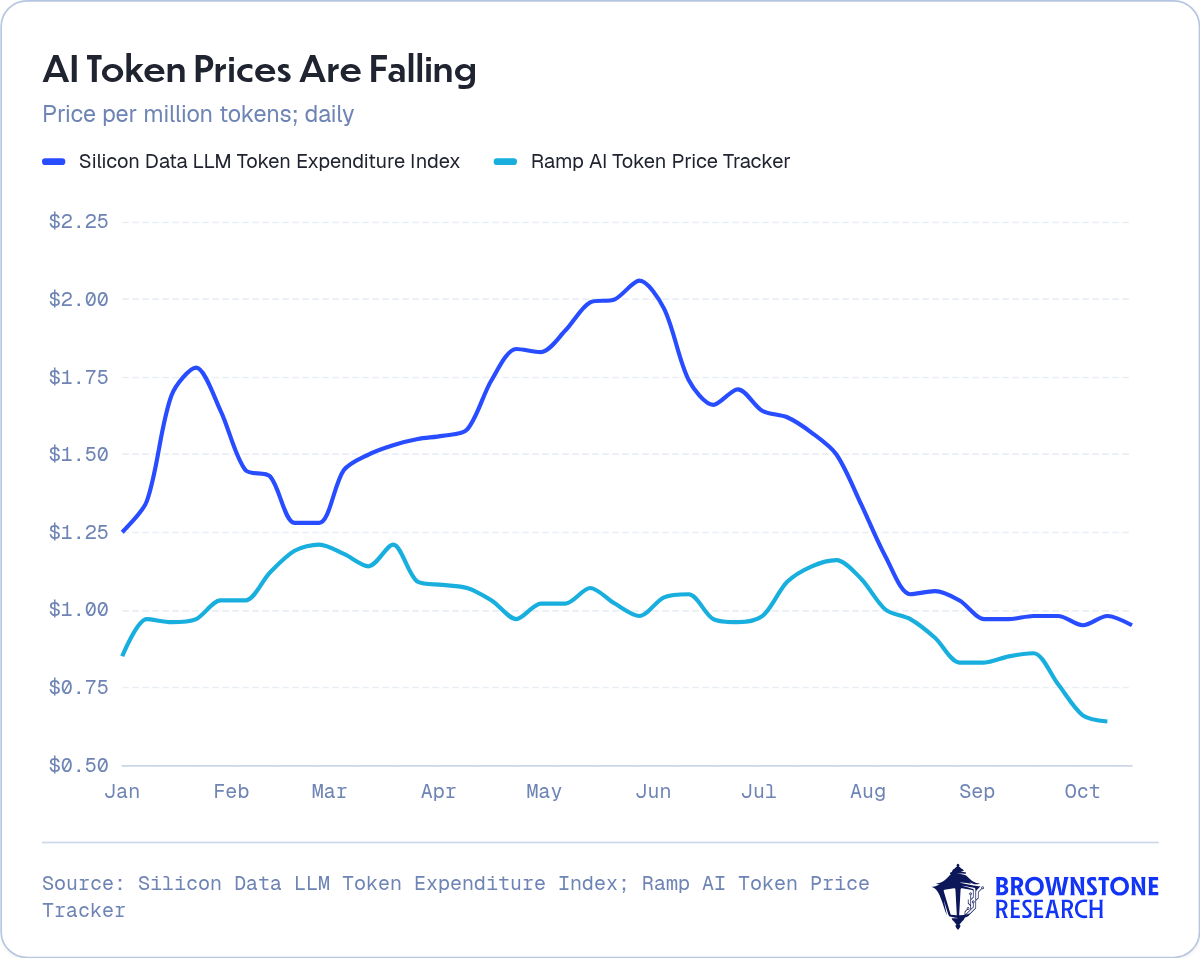
But cheaper doesn’t necessarily mean a smaller market.
Think about cloud computing. As computing costs fell, startups could launch without expensive servers, businesses could analyze larger datasets, and software companies could offer services that were previously uneconomical.
Cheaper computing created more demand for computing.
AI will likely follow a similar path.
Suppose an AI task becomes 80% cheaper. Businesses can now afford to automate processes that weren’t worth the expense. Multiply that across millions of companies and billions of tasks.
And unlike chatbots, AI agents can work continuously, coordinating with other agents without someone initiating every request.
The result is that the cost of intelligence could fall dramatically while total spending on intelligence continues to rise.
Nothing is guaranteed. AI companies still need profitable business models. But investors focused only on falling processing costs may be missing an explosion in consumption.

Jeff Brown and CNBC’s “The Prophet” have the same warning for November 5. A new AI stock could make you 1,000% with a chip 50 times faster than Nvidia’s. Watch them unveil and demonstrate a historic AI breakthrough that could replace the Magnificent 7, cause a deeper sell-off, and create a new order in the market. See it here (includes 3 free recommendations).
When the Pentagon bought into MP Materials, the stock doubled in weeks. Washington took a stake in Intel, and it’s more than tripled since. The government fast-tracked Oklo, and it ran as much as 3,523% in about a year. Now Jeff Brown expects President Trump to take a personal stake in a brand-new energy company on December 18. Jeff will give you the name and ticker symbol for FREE, in this video.
If AI’s future is so promising, why are the stocks getting destroyed?
I believe much of the answer lies in market mechanics, not falling demand.
Consider VARA, a technology-focused investment fund that reportedly gained nearly 200% through June before losing 44% in July. The fund managed roughly $26.4 billion at the end of June, and its positions overlapped heavily with other technology portfolios, including Leopold Aschenbrenner’s Situational Awareness fund, which saw its own disorderly unwind in July.
Unconfirmed rumors have VARA facing deleveraging in October…
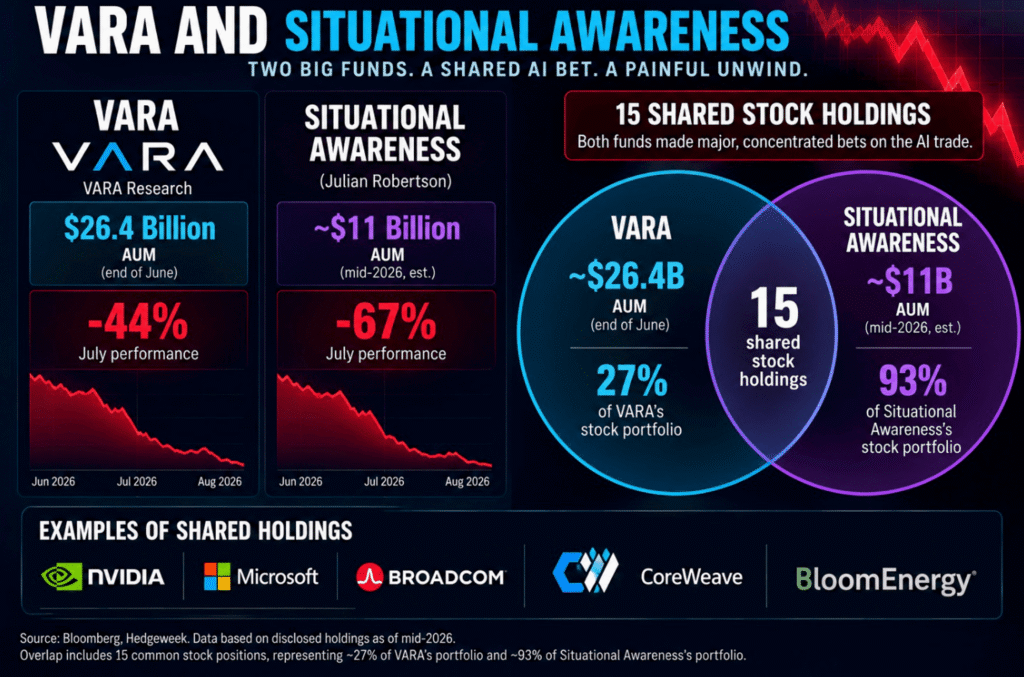
When enormous amounts of capital crowd into similar stocks, unwinding those positions can get ugly.
Goldman Sachs prime-brokerage data showed about $20 billion in technology-stock selling over two weeks. Technology-focused hedge funds lost roughly 10% in October through October 22, while Asia-focused funds lost about 9%.
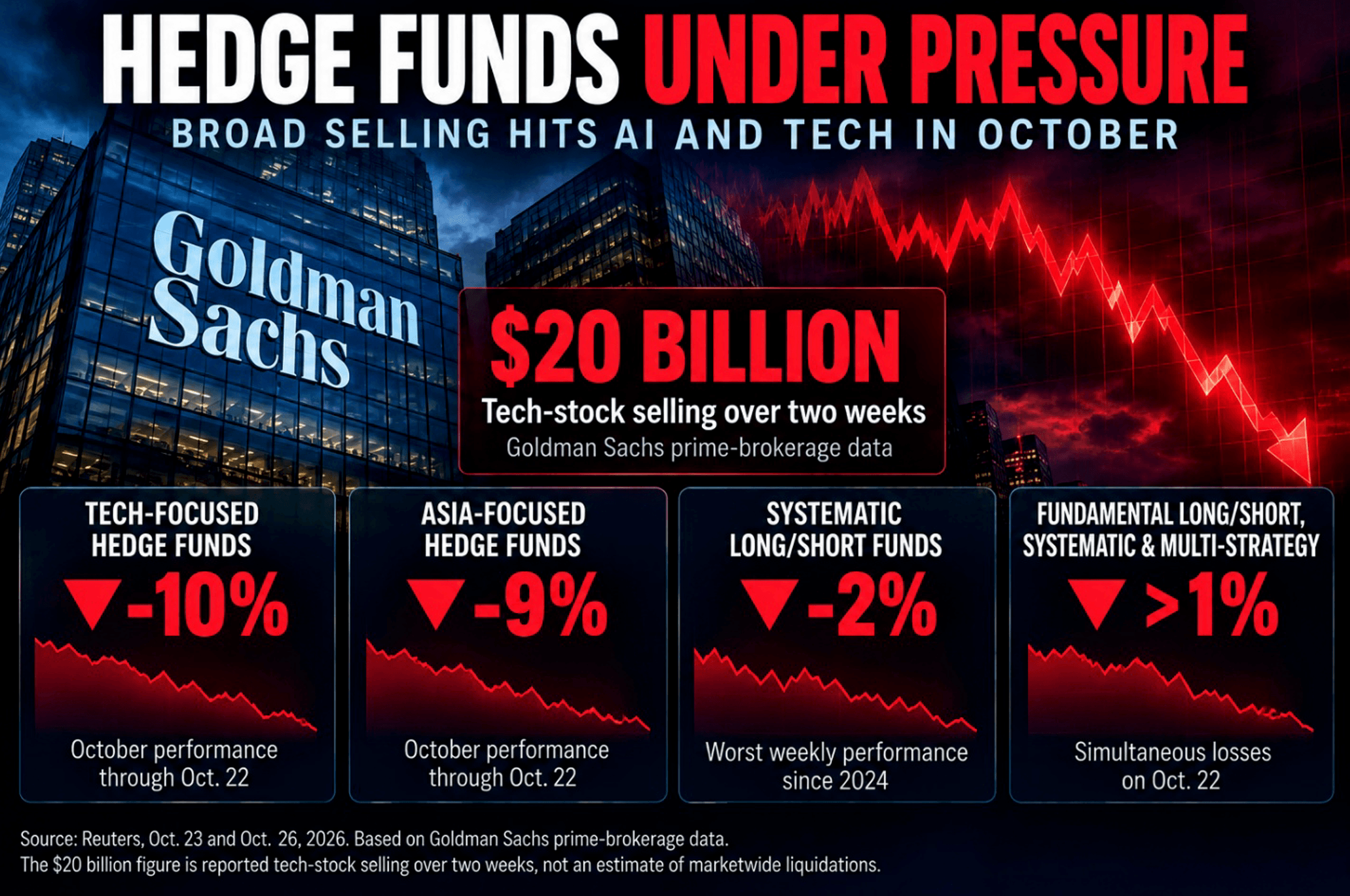
That’s serious selling pressure from professional investors, not just nervous retail traders. After talking with plenty of family and friends, I haven’t found a single person who’s sold out of leading AI stocks.
Leverage makes things worse. FINRA margin debt fell from $1.50 trillion in June to $1.42 trillion in July, then rebounded to $1.48 trillion by September.
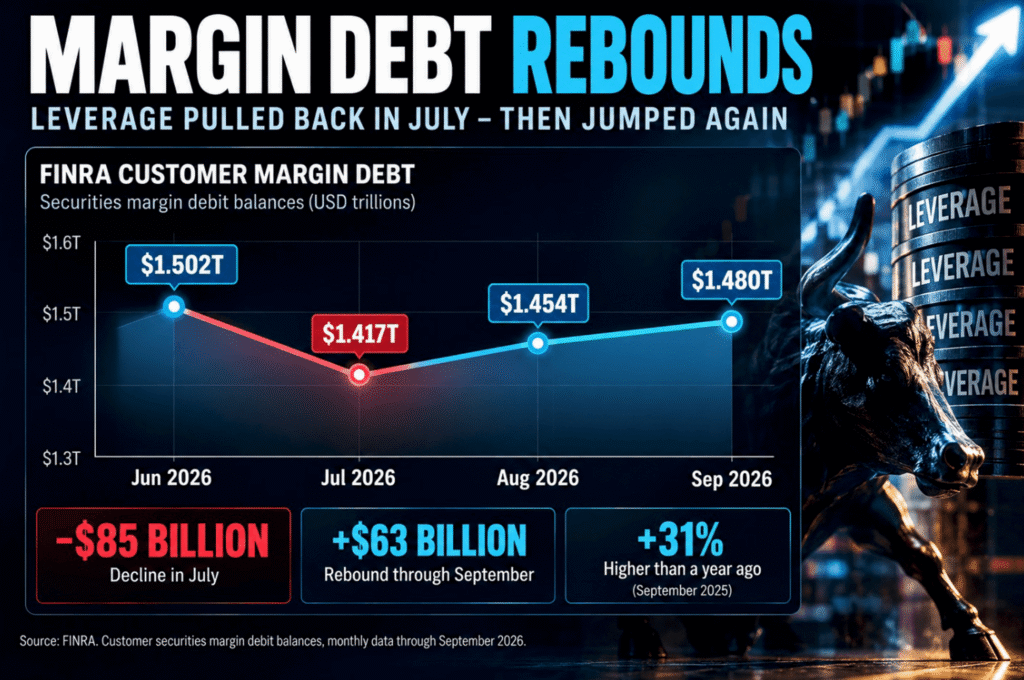
When leveraged positions come under pressure, investors must sell what they can, not what they’d like. Even the strongest companies can suffer.
Then there’s the political calendar and the Federal Reserve. Midterm elections bring uncertainty, while shifting interest-rate expectations affect growth-stock valuations and financing costs.
But history offers perspective.
Since 1946, the S&P 500 has risen in the 12 months following every midterm election, averaging about 15%.
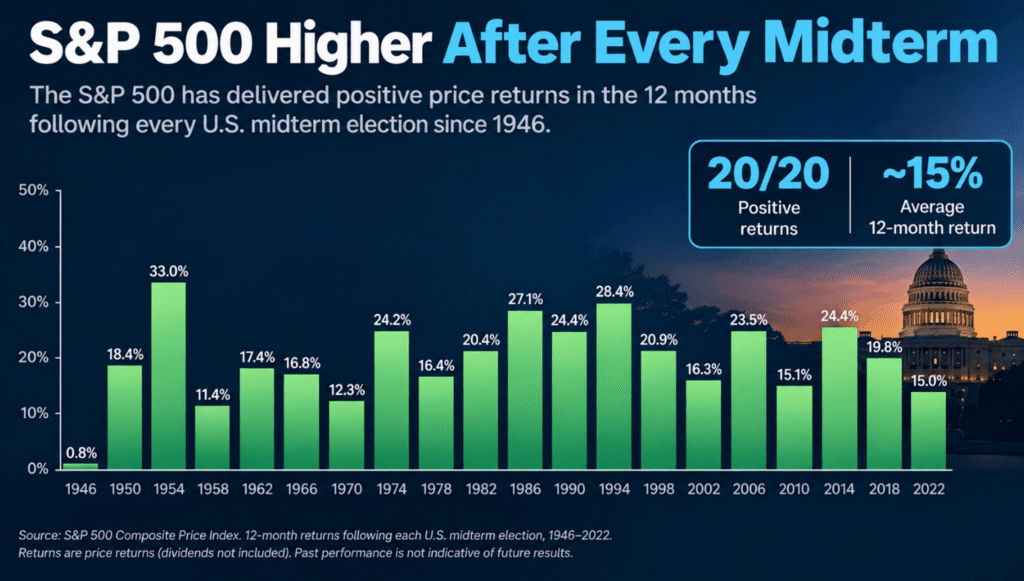
None of that guarantees another rally. But market volatility isn’t necessarily evidence of economic deterioration. Since 1950, the S&P 500 has recorded more than 1,500 all-time highs despite wars, recessions, inflation, and financial crises.
Crowded positioning, deleveraging, elections, and interest-rate uncertainty can push stocks lower even when their businesses keep growing.
The AI bears are interpreting weakness in stock prices as weakness in the AI revolution.
Those aren’t the same thing.
When markets get volatile, I return to the data. And recent AI earnings tell a different story from the stock prices.
Take Micron Technology (MU), a major supplier of AI memory. Its latest quarterly revenue reached a record $54.2 billion, with operating cash flow approaching $44 billion. CEO Sanjay Mehrotra said more than 75% of 2027 production is already committed, with customer discussions extending into 2028 and long-term agreements reaching 2031.
That’s extraordinary visibility into future demand.
Corning (GLW) just reported optical communications revenue of $2.38 billion, up 44%. Generative AI sales more than doubled, while adjusted earnings of $0.91 per share beat Wall Street’s $0.88 estimate.
And Lam Research (LRCX), which I own, reported quarterly revenue of $8.22 billion, up 22% sequentially, with adjusted earnings per share climbing 21%.
These aren’t promises about what AI might accomplish five years from now. They’re revenues, earnings, and cash flows being generated today.
And yet, all three are down over the past month:
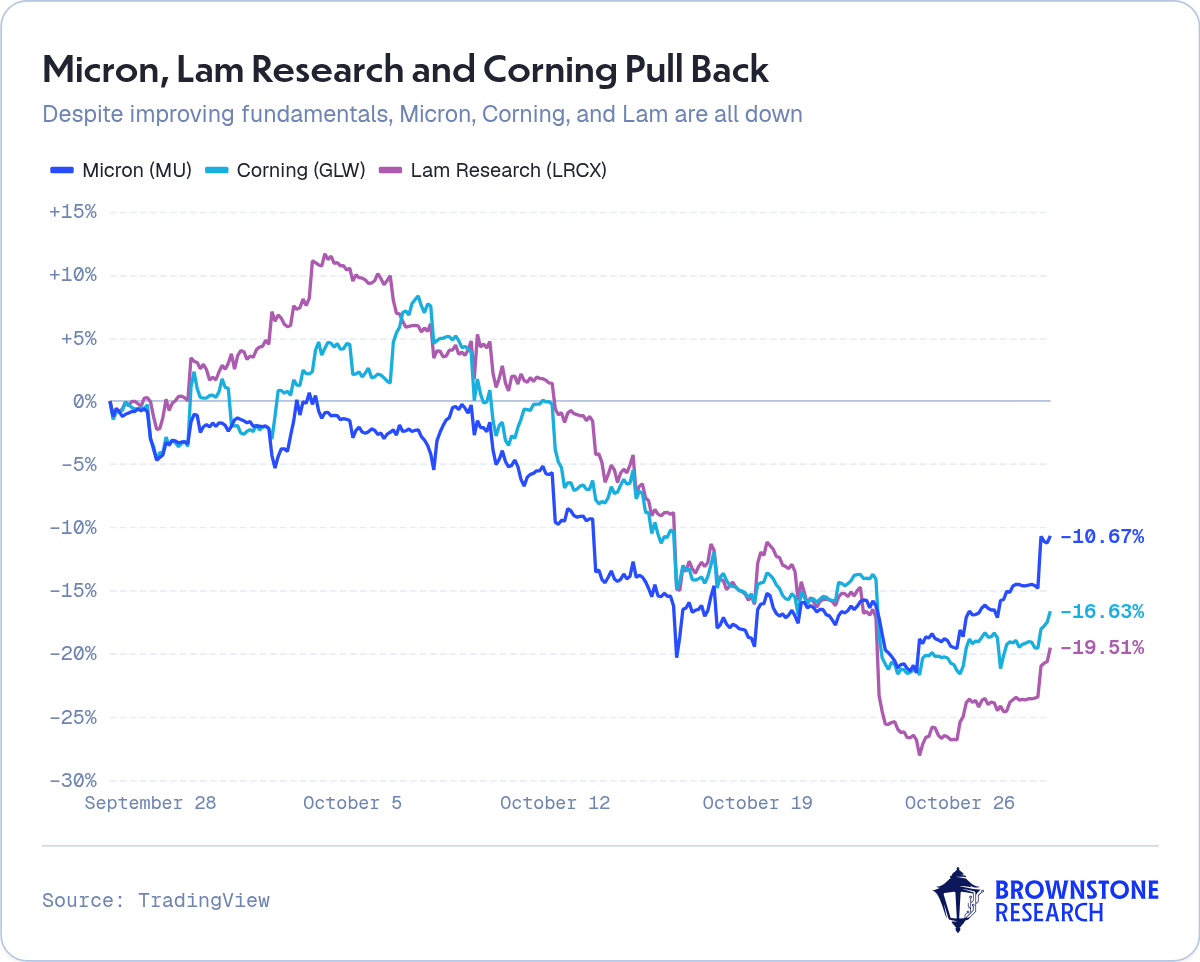
Of course, not every AI stock is cheap, and some companies will struggle to earn acceptable returns. But when the businesses supplying this revolution keep delivering growth, a broad sell-off doesn’t convince me the investment thesis is broken.
Stock prices reflect what investors will pay today. Earnings tell us what’s happening inside the businesses.
Meanwhile, AI keeps getting cheaper, more capable, and more autonomous. Agents could multiply computing demand far beyond today’s chatbot usage, and the infrastructure supporting them still needs to be built.
I believe the AI revolution is alive and well. The technology is advancing, demand is growing, and the companies building its infrastructure are delivering real revenues and profits. None of that disappears because hedge funds are deleveraging or Wall Street is nervous about interest rates.
In a few months, investors may look back on this supposed AI winter as a missed opportunity. Because while stock prices have fallen, the businesses behind many of them have moved in exactly the opposite direction.
And sooner or later, I believe the market will recognize that difference.
Regards,
Jason Bodner
Add Brownstone Research as your preferred source on Google to see our latest stories in your feed.
 Add as a preferred source
Read the latest insights from the world of high technology.
Anthropic’s IPO could be the biggest ever, at up to $2 trillion. Here’s why you may want to sit...

Assuming that the reactor can be used for both energy production and the transmutation of mercury-198 into gold-197, the...

Tesla and SpaceX have now formed special committees to evaluate a potential merger between these two Elon Musk-led powerhouses.