



The Largest Merger in History
Tesla and SpaceX have now formed special committees to evaluate a potential merger between these two Elon Musk-led powerhouses.


Assuming that the reactor can be used for both energy production and the transmutation of mercury-198 into gold-197, the economics of building out nuclear fusion reactors become that much more attractive
Managing Editor’s Note: Don’t forget to sign up for Jeff’s AI Super Chip event this Wednesday…
He’s getting into the details of the California-based company that’s developed a chip that’s 50x more powerful than NVIDIA’s…
And could shake up the AI industry and spawn a new class of AI companies that could soar this year.
Just go here to sign up.
The idea is at least 2,000 years old.
Use alchemy to turn a heavy metal such as lead or mercury into gold. It’s alluring for obvious reasons. Take a cheap metal and turn it into a fortune. It’s also been a failure for anybody who’s ever tried.
On the surface, it seems an easy task. After all, mercury has 80 protons in its nucleus. Gold has 79 protons.
Just drop a proton and voila, gold!
Of course, easier said than done. Chemists can rearrange electrons with relative ease. But removing a proton requires a different kind of reaction.
In the 2015 to 2018 time frame, there was something of a breakthrough in Meyrin, Switzerland, at CERN (Conseil Europeen pour la Recherche Nucleaire – European Council for Nuclear Research), the home of the Large Hadron Collider (LHC).
Scientists used the LHC to create two beams of bare lead nuclei that had been stripped of all their electrons, accelerated to 99.999993% of the speed of light. These two beams passed extremely close to each other, creating ultra-peripheral collisions. The electromagnetic fields created by the two beams and their proximity to one another would occasionally knock out three protons from a lead nucleus, which has 82 protons, leaving just 79 protons, which is gold.
Across the four major experiments at CERN, about 86 billion gold nuclei were made through these particle interactions. This equates to about 29 trillionths of a gram.
Obviously, it is an insignificant amount of gold. Worse yet, the gold nuclei only lasted a fraction of a second, so there wasn’t even the tiniest sliver of remaining economic byproduct.
Another big issue of transmutation, turning lead into gold, is the cost of doing so. If it could be done, would the economics make any sense?
In the case of using the LHC at CERN, it costs about $1 billion a year just to operate the collider, and during peak operations, the collider requires around 120 megawatts to conduct an experiment.
Mining and processing gold the old-fashioned way, out of the ground, costs a tiny fraction of what it would cost to do so using CERN, assuming such particle interactions could be used to induce a stable form of gold. Economically, using the LHC makes no sense at all.
But that doesn’t mean transmutation is not economically possible. In fact, an up-and-coming nuclear fusion company may have just shown us the way.
A new “AI Superchip” 50 times faster than Nvidia's could launch an AI bull market bigger than any we've seen yet and cause five little-known stocks to replace the Magnificent Seven. The man who recommended Nvidia before it rose 35,000% reveals the details here – including how you could make 10 times your money if you position yourself by October 28.

On December 18, President Trump could take a personal stake in a brand-new energy company. Google, Nvidia, and Goldman Sachs already own a piece. It’s going public very soon… but you can get beforehand, thanks to a unique setup. Jeff Brown shows you how with as little as $500 – and names the stock, for free, in this video.
In August 2025, I took note of an interesting scientific paper written on chrysopoeia – the transmutation of base metals into gold. It even caught the attention of one of my clever subscribers to The Bleeding Edge, who wrote in to ask me about it. I addressed his question in the September 5, 2025, AMA – Turning Mercury Into Gold.
Of course, it was just an interesting paper at the time; it still had to be proven. And this month, Marathon Fusion appears to have proven that such a reaction is possible.
Marathon Fusion is a small, private nuclear fusion startup pursuing a unique approach to compact nuclear fusion. Its fusion reactor fires a beam of deuterium (hydrogen-2) ions into a solid lithium tritide barrier. Those ions fuse with tritium (hydrogen-3), creating helium-4 and releasing a neutron carrying about 14 million electron volts (14 MeV) of energy.
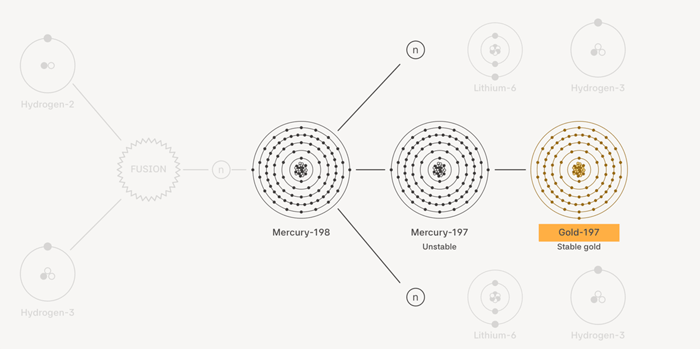
Marathon Fusion Creates Gold From Mercury-198 | Source: Marathon Fusion
In Marathon’s reaction, the neutron released from the fusion of deuterium and tritium is used to irradiate a stable isotope of mercury, mercury-198. That reaction causes mercury-198 to release two neutrons, which transforms mercury-198 into unstable mercury-197, which decays into gold-197, a stable form of gold.
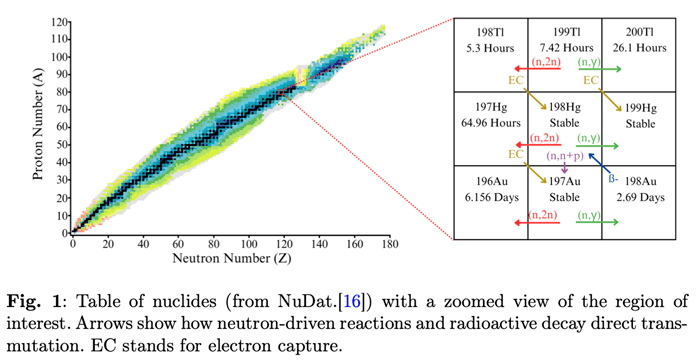
198Hg Stable to 197Au Stable | Source: Marathon Fusion
The announcement made by Marathon Fusion on October 21 indicated that, by using its nuclear fusion reaction, it transmuted mercury into stable gold at 10 times the record that CERN set with the Large Hadron Collider.
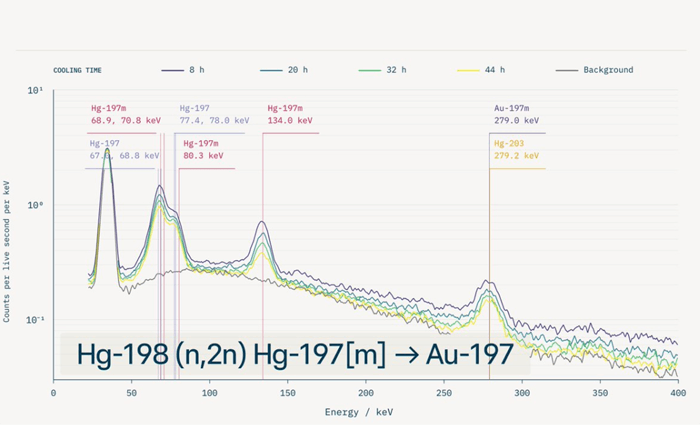
Source: Marathon Fusion
Obviously, 10 times 29 trillionths of a gram of gold is still an insignificant amount. But the process clearly has the potential to scale. Unsurprisingly, it caused many to question the potential impact on the price of gold.
After all, if a nuclear fusion reactor can produce both cheap, clean energy AND a stable form of gold as a byproduct, there most certainly could be an impact on the price of gold at scale.
And there is precedent. Natural diamonds have lost about half their value over the past five years, primarily due to the rise in lab-grown diamonds, which in 2025 already made up 61% of all diamonds used in engagement rings. Could the same thing happen to gold?
As always, the context matters to understand the impact.
Marathon’s 2025 paper on this subject theorized that it could create gold-197 at a rate of about 2 metric tons per gigawatt thermal per year using its fusion reactor design coupled with mercury-198.
The reason this is so interesting is that, assuming that the reactor can be used for both energy production and the transmutation of mercury-198 into gold-197, the economics of building out nuclear fusion reactors become that much more attractive.
But there is some nuance worth understanding. There were two key economic practicalities that I pointed out in last September’s AMA on this topic, namely that:
In other words, the gold produced would not be immediately usable. It would take almost seven years before it could be sold.
And considering that annual gold production by the mining industry in 2025 was about 3,670 metric tons, 2 metric tons of additional production wouldn’t impact the price of gold at all.
But if a hundred 1-gigawatt fusion reactors were commissioned with the same gold-producing reactions, that would amount to 200 metric tons of new gold production a year, amounting to about 5.4% of 2025 gold production.
There would be an impact, but not to a large degree.
The real value of this transmutation of mercury to gold is to positively change the economics of building and operating nuclear fusion reactors.
While the primary output of fusion reactors is certainly limitless clean energy, these reactions also could produce radioactive isotopes for medical applications and gold, which enable a fusion operator to experience better economics due to multiple revenue streams.
So, for my subscribers who love gold, fear not – it will be at least a decade before this kind of alchemy will have any material impact on the price of gold.
Jeff
Add Brownstone Research as your preferred source on Google to see our latest stories in your feed.
 Add as a preferred source
Read the latest insights from the world of high technology.
Tesla and SpaceX have now formed special committees to evaluate a potential merger between these two Elon Musk-led powerhouses.
This isn't about simply recreating the old system on new infrastructure…

As companies give digital workers more responsibility, protecting their systems becomes part of the cost of putting AI to...