



AI Is a Double-Edged Sword
AI can be used to bring about a world of incredible productivity and abundance, or it can be used...


Two nuclear fusion companies just landed CHIPS Act awards. Here’s why fusion needs its own semiconductor supply chain…

Having spent a large portion of my career as a high-tech executive in the semiconductor industry, I have to say…
What’s happened in the last few years caught me off guard – in a good way.
The exponential growth in semiconductor performance – and the accelerating rate of technological change – is not what surprised me, though.
After all, that’s what I research and write about nearly every day.
What surprised me is how quickly the industry has moved to reshore production of the semiconductor supply chain.
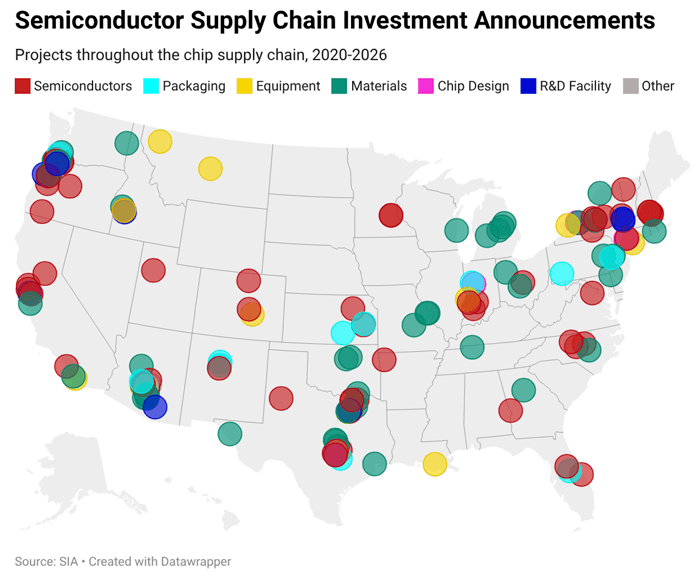
Supported by U.S. government policies like the Advanced Manufacturing Investment Credit and the CHIPS and Science Act, private investment in U.S.-based semiconductor supply chain investments reached $828 billion by September.
And it won’t be long before that number tops $1 trillion.
Source: Semiconductor Industry Association
And as we can see in the image above, the investment isn’t overweighted in states well-known to have semiconductor technology infrastructure – like California, Texas, and New York.
The investment is spread throughout the country, with most states having some kind of semiconductor supply chain investment.
And it’s not just in semiconductor manufacturing but in packaging, semiconductor equipment, materials, chip design, and research and development facilities.
I have to say, this is exciting.
There is no other economic market on Earth that leverages investment in technology better than the U.S.
Not only is the U.S. home to the most efficient financial markets, but it is also home to the most incredible technology research and commercialization.
This latest bout of reshoring seems fitting.
After all, semiconductors and the semiconductor industry were invented in the U.S., with roots that trace all the way back to 1947 at Bell Labs in New Jersey.
The next big jump occurred in the late ’50s, with Texas Instruments (TI) in Texas and Fairchild Semiconductor in California. That is the origin story of what is now known as Silicon Valley.
Oddly enough, it didn’t take long for the industry to begin to offshore parts of the semiconductor supply chain.
In the ’60s, processes like semiconductor assembly, testing, and packaging moved quickly to China.
This kind of work at the time was labor-intensive and low-skilled, making the dramatically lower costs of labor in China attractive.
By the ’70s and ’80s, more complex tasks in the semiconductor supply chain moved offshore, like wafer fabrication, as well as some of the more commodity semiconductor production like memory, transistors, and diodes.
This is what led to the creation of Taiwan Semiconductor Manufacturing (TSM) in the late ’80s, which has since become the most advanced semiconductor manufacturing company in history.
While design, R&D, and intellectual property remained in the U.S., with very few exceptions, the manufacturing prowess had shifted to Asia, specifically to Japan, Taiwan, South Korea, Singapore, and China.
All of that is now changing.
The newfound movement to rebuild U.S. supply chains began in 2017…
And oddly enough, it was the manufactured pandemic that created the needed awareness of how fragile U.S. supply chains had become.
Today, trillions of dollars of domestic and foreign direct investment into U.S.-based manufacturing have been committed, with many of these new, advanced automated factories already in operation.
I was reminded of these developments and the U.S. economic policy last month, due to what I believe to be the two most interesting awards made under the CHIPS and Science Act.
The awards went to two nuclear fusion companies, Helion Energy and Commonwealth Fusion Systems.
If you did a double take after reading that, not to worry. I did the same when I read the headlines.
Why are two nuclear fusion companies receiving funding under the CHIPS and Science Act, which is supposed to be about semiconductors?

Man who called bottom of the 2020 crash to the exact day and recommended 7 stocks that all went on to double is now unveiling his newest prediction for the stock market. An AI Super Chip 50 times faster than Nvidia’s could soon create a new order in the market. See his writeup, and why you could make 10 times your money if you get positioned by November 5.

After SpaceX placed a series of orders with one little-known supplier, its shares surged more than 1,000%. Now Larry Benedict believes Elon’s latest plan could ignite another overlooked company. See the ticker before the crowd catches on.
Helion Energy announced that it had signed a letter of intent for a $175 million award from the CHIPS Act to support high-voltage semiconductor research and development in the U.S.
What makes the deal so relevant is that the semiconductors they will be developing will be designed for commercial nuclear fusion energy.

Orion Nuclear Fusion Power Plant, Chelan County, WA | Source: Helion Energy
Helion also announced that, on the back of the $175 million deal – led by the U.S. Department of Commerce – is an additional $50 million private investment into Helion.
This investment will support the eventual semiconductor manufacturing and packaging here in the U.S.
I call this a “deal” because this isn’t just a government grant. It’s not free money.
The U.S. government, and thus U.S. taxpayers, are receiving $175 million of equity in Helion Energy’s most recent Series G funding round at a $15 billion pre-money valuation.
Along very similar lines, Commonwealth Fusion Systems also has a letter of intent under the same program from the Department of Commerce for $85 million for nuclear fusion-related semiconductor development.
Commonwealth’s deal also includes the same kind of equity provision in exchange for the “investment” into Commonwealth, presumably at the $9 billion pre-money valuation of Commonwealth’s August funding round.

SPARC, October 2026 | Source: Commonwealth Fusion Systems
Commonwealth needs power silicon carbide (SiC) semiconductors capable of supporting power supplies that can ramp up to 50 kiloamps of power in seconds – in order to power Commonwealth’s pulsed magnets used in its Tokamak fusion reactor design.
It also needs radio frequency power generators to heat its fusion fuel for fusion reactions.
There also needs to be radiation-hardened semiconductors to run a nuclear fusion reaction. The fusion of deuterium and tritium produces a neutron, which is a form of ionizing radiation that can be difficult on electronic components.
This is why the two CHIPS awards make so much sense.
After all, there are no commercialized nuclear fusion reactors on the market yet, which means that the supply chain to support the nuclear fusion industry hasn’t been well established yet.
These awards are meant to accelerate the establishment of that supply chain.
It’s common sense to think that this radically new form of clean energy production will have unique semiconductor requirements needed to address the high-voltage requirements of these fusion reactors, with the reliability and efficiency needed for commercial energy production.
Helion and Commonwealth are two of the most promising companies in nuclear fusion, as they are on a near-term path toward demonstrating limitless clean energy production and commercializing that technology for the next generation of clean energy production.
Helion has raised $1.53 billion to date. It is on track to commission its first commercial fusion reactor in 2028 – to support a power purchase agreement that it signed with Microsoft (MSFT) years ago.
And Commonwealth plans to “turn on” its SPARC prototype fusion reactor in 2027, demonstrating the first nuclear fusion reactor capable of sustained operation and producing more energy than is required to operate the reactor.
Commonwealth has already raised $3.95 billion to date and has enough capital to get SPARC operational.
The next 12 months are going to be absolutely incredible in the nuclear fusion industry.
Clean energy for all.
We have so much to look forward to,
Jeff
Add Brownstone Research as your preferred source on Google to see our latest stories in your feed.
 Add as a preferred source
Read the latest insights from the world of high technology.
AI can be used to bring about a world of incredible productivity and abundance, or it can be used...

These networks do more than elect politicians. They shape policy. And every so often one of them shows its...

The AI bears are interpreting weakness in stock prices as weakness in the AI revolution.