

From Drones…to Laptops?
This product niche was right there for a company like Dell (DELL) or IBM (IBM) to run with. Yet...


Kalshi hit a record $98 billion in October volume. Here’s how prediction markets went from academic experiment to a major driver of retail trading revenue…

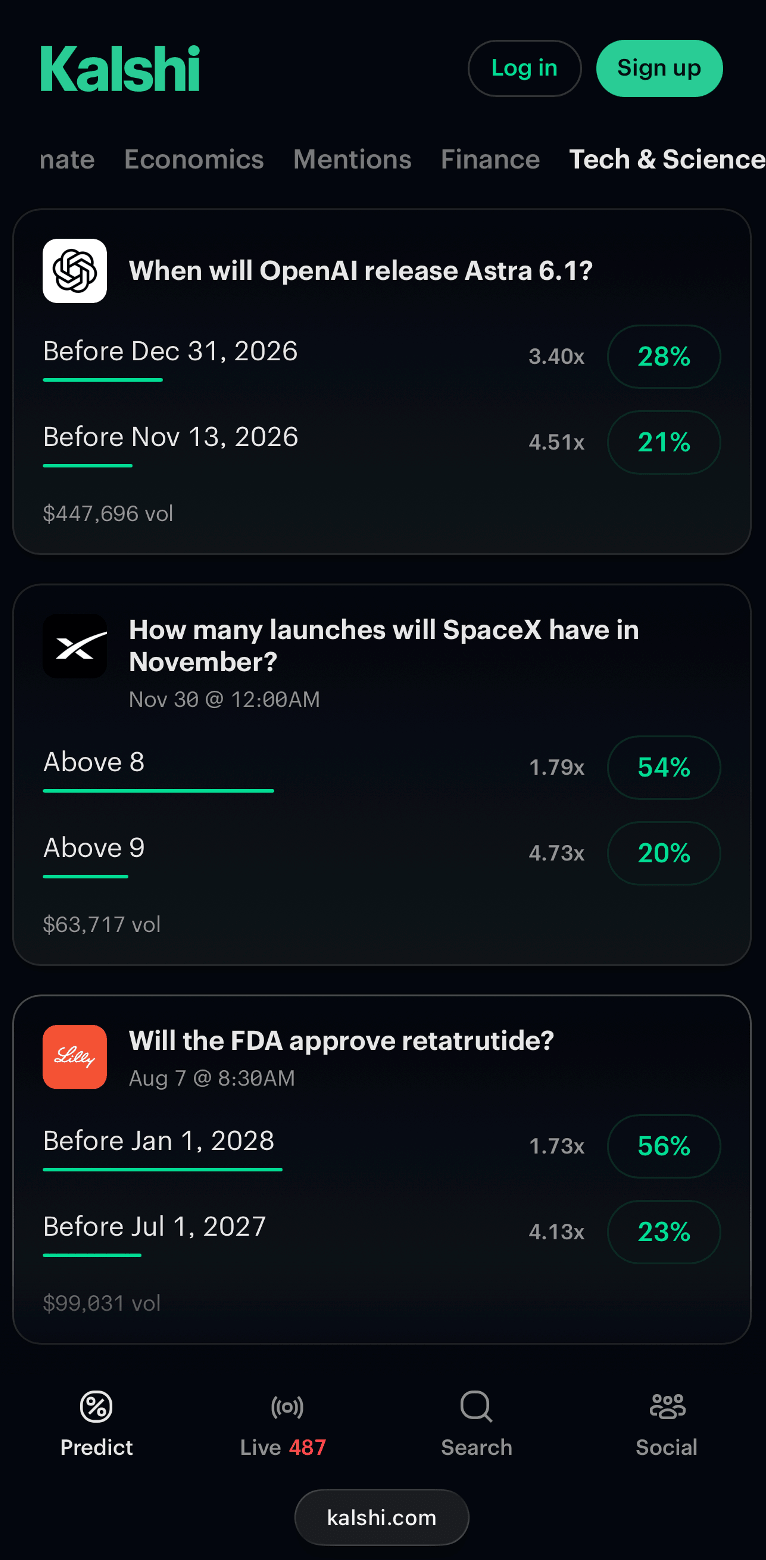
“How many Senate seats will Republicans hold after the Midterms?”
“How many launches will SpaceX have in November?”
“Will a Chinese AI model be #1 this year?
“S&P close price end of 2026?”
“U.S. gas prices this week?”
The questions above are just a small sampling of “event”-based trades taking place today, November 4th, 2026.
There are hundreds of others…
And the amount of money trading on the potential outcomes will shock you.
But before we get to that, it’s worth exploring where the world’s hottest new financial market came from.
The idea of crowd-sourced prediction markets has been around for decades, if not centuries.
Unlike pure betting or gambling, the concept is that at a large enough scale, the wisdom of the crowds can be a strong mechanism for predicting the outcomes of future events.
The modern era of prediction markets began in 1988, when a few University of Iowa professors launched what became known as the Iowa Electronic Markets (IEM).
Originally, it was a real-money futures market focused on the outcomes of presidential elections.
It later expanded to other political, economic, and corporate events.
The IEM has been fairly limited to the academic community, partly due to its imposing small position limits of $500 in order to avoid regulatory scrutiny from the CFTC, as it has been designed largely as an academic research project.
However, what the team in Iowa discovered was that even these small, thinly traded markets among the academic community could actually produce forecasts that were competitive with or better than traditional polls.
While the IEM was never intended to be commercialized, there was clearly interest from the financial markets in doing so.
The potential for this kind of new financial market was too large to ignore.
Intrade innovated and first established a peer-to-peer binary contract exchange in Ireland in 1999, covering events like politics, elections, economic data, sports, and more.
In the U.S., it started to gain attention in the late 2000s and early 2010s, due to accurate predictions in U.S. elections in 2008 and 2012.
As a result, it became the first major prediction market for the public.
Unfortunately, the regulatory environment wasn’t prepared for such uptake, and the Commodity Futures Trading Commission (CFTC) sued Intrade in 2012 based on the fact that it was offering unregistered commodity options on contracts related to gold, currencies, and economic data.
As a result, Intrade collapsed in 2013.
What’s interesting is that the IEM proved the concept academically, then Intrade proved that there was commercial demand for the prediction markets.
The next step was for the private market to develop the technology and engage with the CFTC to develop the regulatory support to commercialize these exciting new financial markets.
And that’s exactly what happened with companies like Kalshi and Robinhood.
It was actually Kalshi that had the breakthrough in November 2020.
That’s when the CFTC issued Kalshi the regulated status as a designated contract market (DCM) for the prediction markets the company was building.
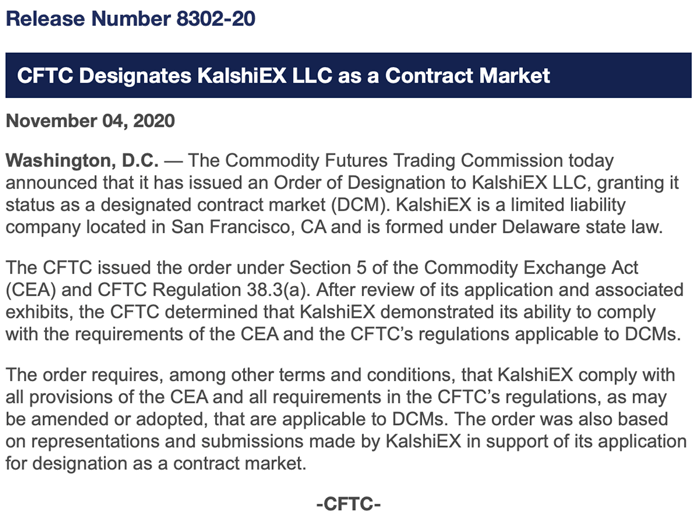
Source: CFTC
Robinhood leveraged Kalshi’s regulatory progress and used its distribution as a regulated broker/distributor to list prediction market contracts. (Robinhood uses Kalshi on the backend to fulfill those contracts.)
And what has happened since 2020 in prediction markets has been nothing short of incredible.
In fact, Robinhood’s third-quarter results landed with an unmistakable signal.
Event contracts – which is its prediction markets business – generated $173 million in revenue. That is more than six times the year-earlier figure, on a record 16.4 billion contracts traded.
For context, equities transaction revenue in the same quarter was $121 million, up a solid 41% year-over-year.
Cryptocurrency transaction revenue fell 55% to $120 million.
You read that right: Robinhood’s prediction market business was significantly larger than both Robinhood’s equities and cryptocurrency-related business.
Total net revenue reached a company record of $1.42 billion, up 12%. The mix underneath is what matters. Prediction markets are no longer a niche market. They are now a material revenue driver for one of the largest retail brokerage platforms in the United States.
Recently, Nvidia's stock went down. But a brand-new kind of trade on Nvidia, costing less than $1 per contract, increased 4,445% (from 2 cents to $1) in just two days. Do you know another trade on Nvidia this year that has increased 40x? On Microsoft, the stock went nowhere for 12 days. “The Penny Tech Trade” increased 952% over two weeks. They're called “Penny Tech Trades.” This Veterans Day, at 8 p.m. ET, Jeff Brown and Larry Benedict will show you exactly how they work, on camera, with their own money. Click here to save your free spot.

A once forgotten American company is about to step into the heart of the race to build the next generation of AI. Larry Benedict believes November 30 could change how Wall Street sees it forever. See the ticker before it makes headlines.
The infrastructure behind much of this incredible activity in prediction markets in the U.S. is Kalshi, the CFTC-regulated event-contract exchange.
Kalshi has grown from an election-focused curiosity into a high-volume venue.
In October 2026, it recorded roughly $98 billion in notional contract volume, its busiest month on record, with daily peaks above $5 billion.
Sports contracts dominate, but non-sports categories – economics, commodities, crypto-related outcomes, and politics – have expanded rapidly.
Kalshi recently raised $1 billion at a $40 billion post-money valuation.
The company has cited annualized trading volume exceeding $1 trillion across its broader product set and claims more than 30 million registered accounts. It accounts for the large majority of regulated prediction-market volume in the U.S.
As mentioned earlier, Robinhood routes a substantial portion of its event-contract flow through Kalshi (and related venues), while also developing its own exchange infrastructure.
The relationship has turned prediction markets from a niche derivatives product into a mainstream retail activity sitting alongside stocks, options, and crypto inside the same app.
These prediction market contracts are regulated by the Commodity Futures Trading Commission (CFTC) as event contracts, a form of swap.
And because the CFTC oversees these contracts federally, Kalshi can offer them nationwide – no need for state-by-state sportsbook licenses required.
Contrary to popular opinion, prediction markets are not just a way to place a quick bet. With the right intelligence and analysis behind them, I view them as real investment and trading contracts.
They are continuous, incentivized forecasting mechanisms. Think of them like forecasting machines that never stop running. And because there’s real money on the line, everyone is kept honest by that incentive.
Prices on liquid contracts (i.e., contracts trading substantial volumes) for elections, economic data releases, Federal Reserve decisions, or commodity outcomes often aggregate information more quickly and accurately than traditional polls or expert panels.
And when those markets reach the volume now seen on Kalshi and Robinhood, they begin to function as real-time probability gauges that institutions, media, and policymakers can observe.
For Robinhood, the economics are straightforward: The platform already has the distribution, the user base, and the trading infrastructure.
Event contracts monetize engagement that might otherwise sit idle between earnings seasons or crypto cycles.
The fact that they have overtaken equities transaction revenue in a single quarter demonstrates how quickly a new product category can scale when it is embedded in an existing retail brokerage experience.
I have researched and followed developments in prediction markets and the underlying technology for decades.
And I have been excited by all the progress, particularly on the regulatory front, that has been made in the last few years.
Prediction markets are now at the early stages of becoming mainstream.
And given the remarkable growth of Kalshi and Robinhood in these new financial markets, it is clear that this is a growth market – and also one that self-directed investors find both exciting and attractive from an investment/trading perspective.
This is precisely why earlier this year, I partnered with hedge fund wizard Larry Benedict – who is part of my team at Brownstone Research and is an absolute legend from Wall Street in trading and risk management.
Larry is the expert that I always turn to when it comes to trading.
Larry and I launched a trading research product called Prediction Profits earlier this year.
And this month, we’ve combined Larry’s trading expertise and market access with my knowledge of growth markets and technology with great success. We’re very excited to bring it to our readers.
Larry is simply brilliant at seeing mispriced prediction market contracts, and we consistently see high-probability trading opportunities where we believe that the “markets” simply haven’t accurately priced in a future outcome.
There is so much opportunity and asymmetry due to the mispricing of outcomes.
Many retail users of prediction markets tend to trade based on “feelings,” or their “gut” rather than rigorous analysis.
That’s why the opportunity is so great, and it’s why we launched this prediction markets research product this year.
There was simply too much investment/trading opportunity to pass up, and we wanted to share this knowledge with our subscribers.
That brings me to something I rarely do here in The Bleeding Edge…
I’d like to extend a special invitation. This coming Wednesday – November 11, Veterans Day, at 8 p.m. ET – Larry Benedict and I are sitting down together for the very first time to trade these prediction markets on camera, with our own money.
No theory. No back-tested hypotheticals. You’ll watch us place real trades in real time – what we buy, where we set our limits, and exactly why we’re doing it.
These are the event contracts tied to the biggest themes and names in technology – where it costs less than a dollar per contract to get in, and you never risk a penny more than you decide to put up.
I want my subscribers to walk away with a deep understanding of how prediction markets work… how easy it is to get started… and how to appropriately manage opportunity with risk when trading.
Larry is one of the sharpest risk managers I’ve ever worked with, and what he’s found in these markets is, in my view, one of the most asymmetric opportunities available to everyday investors right now – precisely because so much of the crowd is still betting on gut instead of analysis.
But I equally appreciate how Larry manages risk. It’s a part of his strategy from the beginning – before he ever places a trade.
And before we wrap up Wednesday night, I’m going to hand you four of these trades from my team. Free. No strings attached.
The whole session is free to attend. All I ask is that you join us on November 11 – because the best way for me to prove any of this to you is to let you watch it happen with your own eyes.
Save your free seat for Wednesday, November 11 at 8 p.m. ET.
Jeff
Add Brownstone Research as your preferred source on Google to see our latest stories in your feed.
 Add as a preferred source
Read the latest insights from the world of high technology.
This product niche was right there for a company like Dell (DELL) or IBM (IBM) to run with. Yet...
Two nuclear fusion companies just landed CHIPS Act awards. Here’s why fusion needs its own semiconductor supply chain…
AI can be used to bring about a world of incredible productivity and abundance, or it can be used...