




Warhounds
I know that this will likely be an uncomfortable subject for many of us. It definitely falls under the...


All of these technological advancements will require metals and materials on a scale we’ve never seen before…

Managing Editor’s Note: For the first time, Jeff and hedge fund legend Larry Benedict are trading their own money on camera, using a brand-new kind of trade that costs less than $1.
They call them “Penny Tech Trades.” And every attendee at their upcoming Penny Tech Profits event gets four of them free. It’s happening on Wednesday, November 11, at 8 p.m. ET.
The event is free, but availability is limited. RSVP “YES” with a single click here.
What an unbelievable week this week. It’s never fun to see this kind of volatility in the market.
The Democrats’ sweep of Congress in the midterm elections really threw the market off, specifically in semiconductors, due to fears of opposition to data centers, oppressive regulations for AI, slowdowns, deceleration, etc.
Naturally, with those fears in mind, semiconductor companies took the brunt of the selloff – the logic being fewer data centers means fewer semiconductors.
The market drop was exacerbated by systematic funds being forced to sell as well. Once key technical levels are breached, these funds close out positions. They don’t trade on fundamentals, just price action, so these movements are artificial in that they don’t represent the future outlook.
The fears that have been stoked are an overreaction. Regardless of the midterms, there will continue to be a pro-energy, pro-economy, and pro-technology regulatory environment for the next two years. That means that investment in AI will continue to accelerate.
And hopefully, the conflict with Iran will get resolved one way or another, gas prices will fall back down quickly, and we’ll get back to accelerating the growth in our economy.
Putting this week aside, the next 12 months are going to be incredible.
Have a wonderful weekend,
Jeff
Hi – I am one of your Unlimited members and am so pleased with your insights and help. Medpace (MEDP) came onto my radar recently. With all that is being done in the biotechnology world and with AI helping predict new and better drugs, would Medpace (MEDP) be a position we would want to invest in?
Again, thank you for your insights. Best regards,
– Greg L.
Hi Greg,
I like your thinking. Medpace (MEDP) is what’s known as a Clinical Research Organization (CRO). A CRO is like a pick-and-shovel play on the biotech industry, and Medpace is well established, as it has been around for decades.
CROs help support pre-clinical research, help design and manage clinical trials, recruit patients for trials, ensure regulatory compliance, and handle data collection and management.
Medpace is a beneficiary of all the investment and growth that is happening in the biopharmaceutical industry right now.
Please understand my comments are meant to be a general overview of my take on Medpace, not individualized investment advice.
As we can see in the chart below, Medpace kicked into high gear in mid-2025, more than doubling from its $300 level to well above $600 today.
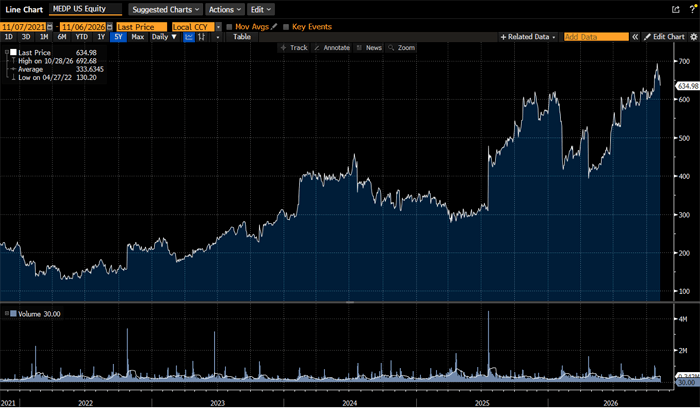
5-year chart of Medpace (MEDP)
This growth is consistent with what has been happening in biopharma, which is not a surprise. The sharp jump in the share price in July 2025 was on the back of its Q2 2025 earnings announcement. Medpace raised its forward guidance on that earnings call, signaling more growth ahead.
This is a very healthy company from a financial perspective: $705 million in cash, limited debt, ~30% gross margins, profitable, and slowly growing free cash flow.
There are two “problems” that are obvious when looking at a company like Medpace from a high-growth perspective. Medpace revenues are only predicted to grow about 6% in 2027 and 8.7% in 2028. It’s healthy and consistent, but not high growth.
The other issue is valuation. Medpace is trading at the high end of its valuation range in terms of EV/Sales and EV/EBITDA. What this means is that Medpace is already priced at the high end of its normal range, so it’s difficult to make an argument that a stock like this would double in the next two years or so. It’s not growing fast enough, and I don’t see a catalyst that would justify dramatically higher valuation multiples.
I hope that helps.

Nvidia is already worth trillions. For shares to double, it would need to add trillions more, which could take years. Meanwhile, hedge fund legend Larry Benedict says one trade on ONE ticker could hand you a chance at YEARS of gains in just days. And you could do it over and over again. All thanks to a series of pre-scheduled events in Washington, which could send billions of dollars surging into the market about every 11 days. Click here to get Larry’s three-letter ticker free before December 9.

A Special Veterans Day Event: Wednesday, November 11, at 8 p.m. ET. For the first time ever, Silicon Valley insider Jeff Brown and hedge fund legend Larry Benedict are trading their own money on camera, using a brand-new kind of trade that costs less than $1. They call them “Penny Tech Trades.” And every attendee gets four of them free. The event is free, but availability is limited. RSVP "YES" with a single click here.
What you are saying about the Critical Assets coverage is exactly what I have been expecting. And you hit the nail on the head when you said there is some overlap. It’s the overlap that I am writing about. Just in the last couple of weeks, there has been a lot of activity on several of the Critical Assets, like uranium sources, LNG, nuclear construction, including SMRs, materials for substrates for the new chips, and Geothermal. Not to ignore Musk’s game to harness the sun with his million satellites and beam back to the surface.
– Jim B.
Hi Jim,
It’s difficult to express the significance of the shift that is happening right now in terms of technological advancement and acceleration. Of course, I research and write about it daily, but this moment in time is so different than anything that we’ve ever experienced before.
And this exponential growth and accelerating rate of change is centered in the U.S., which currently has a supportive regulatory and economic environment ideal for technological acceleration.
A simple example is the AI data center infrastructure buildout. By 2030, some estimates are that the U.S. will need about 230 gigawatts (GW) of additional energy production to support the new infrastructure. However, regulated utilities only have plans to add about 93 GW of capacity during that time.
That’s a 137 GW gap, which is absolutely massive.
Natural gas turbines, which are collocated at the data center sites, will help bridge that gap. But the problem is that the large gas turbines are already ordered through 2030. Anyone placing a new order today has to wait years before they’ll see their turbine.
This is why there is no single solution for energy production. To close the gap, any and all forms of energy production will be utilized until such a time when small modular reactors (SMRs) and nuclear fusion reactors begin to proliferate to support the energy demands.
Fortunately, that is happening right now, and there is an incredible sense of urgency. The Nuclear Regulatory Commission (NRC) and the Department of Energy (DOE) have been transformed over the last two years. The nuclear energy industry is now thriving, with tens of billions in private capital being invested, as there is now regulatory support and a short path toward commercialization.
This is precisely why, to your point, natural gas and uranium have become critically important growth assets to support this more than decade-long boom that we’ll experience. It won’t be long before advanced nuclear reactors are coming online.
One of the nearest-term projects is Aalo Atomics. It is building toward 2027 operations of one of its SMRs, which will power a Crusoe Spark modular data center. Another is the Oklo Aurora plant, which I visited in the early stages of construction at the Idaho National Laboratory. It also has a late 2027/early 2028 timeline for commissioning.
In addition to all of the progress in new energy production and nuclear energy, what Elon Musk is doing with the Terafab will reshape the entire semiconductor industry. The scale of this semiconductor manufacturing facility is hard to comprehend. The picture below is from late September, and it only represents a fraction of the total foundation for what will be built.
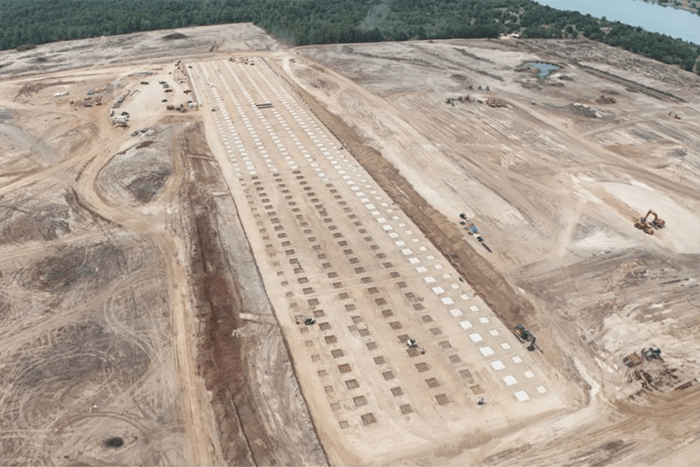
Terafab Construction Site, September 26, 2026 | Source: @JoeTegtmeyer
In addition to that, Tesla (TSLA) is racing ahead, building its new Optimus manufacturing facility, which will have the capacity to manufacture 10 million Optimus units a year.
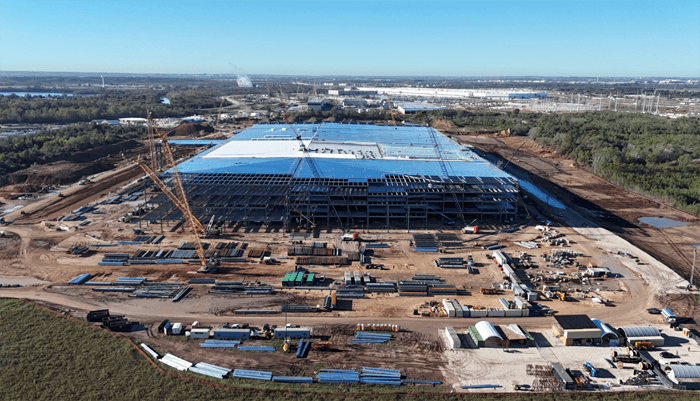
Tesla’s Optimus Manufacturing Site, Austin, TX, Nov. 5, 2026 | Source: @JoeTegtmeyer
These are just two simple examples of the scale that is currently being built to advance our economy. Semiconductors, general-purpose intelligent humanoid robots, and autonomous vehicles are going to be economic drivers unlike anything we’ve seen before.
And SpaceX (SPCX) is on pace to launch as many as 30 Starships a day by 2030. Even if SpaceX only launches 10 a day, it will be transformational.
All of these technological advancements will require metals and materials on a scale we’ve never seen before. And the demand will be entirely driven by what’s happening in technology.
This is why I teamed up with Dave Forest and launched my latest research production focused on energy, mining, and metals – Critical Assets. This sector is now a growth sector, and my expertise – and what Brownstone Research is most well-known for – is research on growth assets. So, we had to have coverage in these exciting industries.
I have read the article How to Profit from the AI Data Center Boom. Why do you associate the stock RAMBUS (RMBS) with data centers rather than with memory chip companies? Thanks.
– Charles R.
Hello Charles,
Rambus is both a fabless semiconductor company and a semiconductor technology company. Rambus has developed intellectual property, specifically for high bandwidth memory (HBM), that companies like Micron, SK Hynix, and Samsung license. Because memory semiconductor companies have to license from Rambus, Rambus is a beneficiary of what’s happening in the memory sector.
Even companies like NVIDIA and AMD, which incorporate memory into their GPU designs, have licensing agreements with Rambus to use their memory technology.
Rambus has a very unique position in the industry, as all the major semiconductor companies that use memory technology have to license from Rambus.
Jeff
Add Brownstone Research as your preferred source on Google to see our latest stories in your feed.
 Add as a preferred source
Read the latest insights from the world of high technology.
I know that this will likely be an uncomfortable subject for many of us. It definitely falls under the...

Kalshi hit a record $98 billion in October volume. Here’s how prediction markets went from academic experiment to a...

This product niche was right there for a company like Dell (DELL) or IBM (IBM) to run with. Yet...