






“Demand Has Gone Parabolic”
As if we needed even more evidence that the AI boom is real and here to stay…

Written by

As if we needed even more evidence that the AI boom is real and here to stay, NVIDIA just dropped another incredible set of numbers in yesterday’s earnings announcement.
- Record revenue for the first quarter (ending April 26, 2026) of $81.6 billion, up 20% from the previous quarter and up 85% year on year
- Record data center revenue for the quarter of $75.2 billion, up 92% year on year
- NVIDIA announced an additional $80 billion share repurchase program
- It increased its quarterly cash dividend from $0.01 per share to $0.25 per share
- NVIDIA guided even higher for its second fiscal quarter
Somewhat surprisingly, the stock was down a few dollars today despite NVIDIA trading at just an EV/EBITDA of 20x the current fiscal year’s forecast EBITDA.
To see the most valuable company in the world – which is generating about $200 billion in free cash flow this year – growing at this pace is just one of the most extraordinary trajectories we’ll see in our lifetimes.
NVIDIA CEO Jensen Huang summed it up simply:
“Demand has gone parabolic.”
And believe it or not, there is more to come.
For my American readers, I hope everyone has a wonderful Memorial Day weekend.
CLARITY Is Critical
I know you are in favor of cryptocurrencies as improved financial tools and as investments. Could you address the issue of digital currency being used to control citizen behavior by inserting code that directs or restricts certain kinds of spending?
Could you also address the issue of requiring the use of Treasury Bills to back the digital currency to continue to allow overspending of the government? Are these issues mentioned in the bills before Congress?
– Thomas K.
Hi Thomas,
This has definitely been a popular subject over the years, but we haven’t received a question on this in a while, so I’m glad you wrote in.
First, I’d just like to make one clarification. I’m a strong believer in blockchain technology as the next generation of financial technology that will drive efficiencies, lower transaction costs, and increase transparency in our financial systems.
And presuming that the digital asset legislation (the CLARITY Act) gets passed – and I am confident it will – then high-quality digital assets will represent compelling investing and trading opportunities. We cover a lot of this sort of thing over at my senior blockchain analyst’s e-letter, Chain of Thought. If that’s of any interest, you can go here to see about signing up.
Your concerns over using digital currencies to control citizen behavior are well justified because they are so well-documented. In fact, this was the well-documented plan put in place by the people who were running the U.S. government during the Biden Administration.
Operation Chokepoint 2.0 was designed to basically shut down the digital assets industry in order to give the U.S. government complete control over any digital currency.
The plan – as documented in Project Hamilton, a joint project between the Federal Reserve Bank of Boston and MIT’s Digital Currency Initiative – developed a central bank digital currency (CBDC) technology that was often referred to as the “digital dollar” or the “fed coin” to be controlled completely by the U.S. government.
And the Biden Administration, in conjunction with the evil World Economic Forum, had been planning on using digital wallets as the Trojan horse to control social behavior… exactly as you suggested.
A simple example would be if you traveled too much in any given month and your carbon footprint was deemed to be too large, you would not be permitted to spend money on additional travel. Or if you purchased too much beef, your beef budget could be cut off entirely.
This was absolutely frightening. Totalitarian. Authoritarian. Abuse of power. Anti-constitutional. And pure evil.
Thankfully, one of the very first executive orders issued by the Trump administration was to completely ban the development of CBDCs for exactly this reason. Sadly, the plans to implement these kinds of CBDCs and social controls are still running rampant in much of Europe.
The stablecoin act passed in the U.S., however, was a great development. Part of those regulations required that U.S. dollar stablecoins issued by the private sector be backed primarily by U.S. dollars and U.S. Treasuries.
This was a brilliant move as it ensured the integrity of the U.S. dollar stablecoins (i.e., they must be backed by U.S. dollar assets), and they created an entirely new industry, which became a massive buyer of U.S. Treasuries, which offset any reductions in U.S. Treasury purchases by U.S. adversaries like China.
The most critical task that must be completed now by the industry and Congress is to get the CLARITY Act – or whatever its final name will be – passed to provide clear regulations around all forms of digital assets so that the transition of the financial system can move onchain in a structured and orderly process.
The latest updates from Washington, D.C., are very encouraging that this will get done within the next two months. It has been a long effort, and we’re so close to the finish line.
Solid-State Battery Teslas?
I always enjoy your insights into technology developments.
When do you think that I will be able to buy a Tesla with a solid-state battery?– Richard B.
Hi Richard,
I’m actually surprised I haven’t received this question before, so thanks for asking it.
There are a lot of clowns and charlatans out there making claims about “Tesla’s first solid state battery” or “Elon’s 2026 breakthrough” or claims of this sort. They are complete nonsense, nothing but lies.
Tesla’s team has been very emphatic that lithium-ion technology still has a lot of room for incremental improvements in anode and cathode technology, manufacturing advances, and other technical improvements to its existing battery chemistry.
Tesla has no partnerships at all associated with any solid-state battery companies, and I don’t believe it has ever suggested anything of the sort.
If I had to guess, it would be at least five years before we might see a Tesla with a solid-state battery.
I wish I could be more optimistic, but solid-state battery technology is extremely difficult, and its development is linear, not exponential. And even with moderate success in developing some prototypes, that doesn’t mean the technology can be successfully manufactured at the scale Tesla would require.
So I’m afraid we’ll have to wait for years before that might even be possible.
But fear not! In the meantime, we can enjoy today’s Teslas that have more than 300 miles of range and can drive us in a fully autonomous mode anywhere in the country. Actually, 10 countries, for that matter:
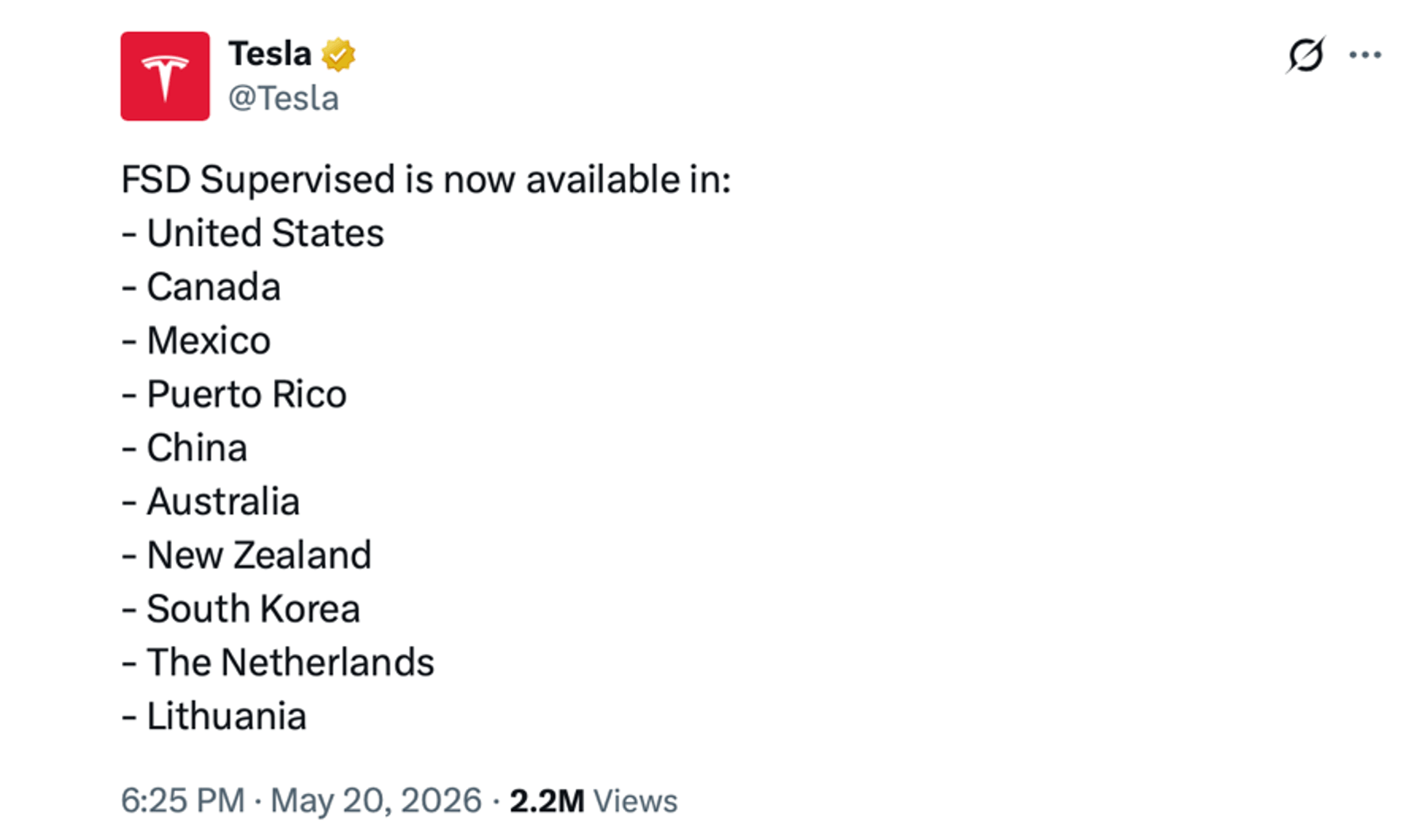
Even more impressive, Tesla is almost at 10.5 billion miles driven on full self-driving (FSD) mode. It will exceed 20 billion miles before the end of this year at the current rate.
Tesla already has the data to prove that FSD is 7X safer than human drivers, and before the end of this year, it will be able to document that it is at least 10X safer.

This is the killer application for the automotive industry. Autonomous driving. Not solid-state batteries.
Tesla will only make the jump when solid-state batteries have proven to have the longevity, safety, and economics of lithium-ion battery technology. Until then, we’ll just have to enjoy being safely driven wherever we need to go.
Buying SpaceX (SPCX) at IPO?
SpaceX could go public at a $2 trillion valuation with just around $16 billion in revenue last year… a hefty valuation on such little revenue.
Anyone who buys into the post-IPO hype will likely overpay – which could be a harsh lesson in the end. What does your founder have to say about that??
– Randall M.
Hi Randall,
Wonderful question. I’m glad you are thinking about the valuation. That makes me happy. Let’s tackle that first.
SpaceX’s S-1 filing just dropped yesterday, and we’re still working through it to gain a clear picture of valuation and future revenue forecasts for 2026, 2027, and beyond. So, I’m only going to use some relatively simple numbers as an exercise to ballpark valuation multiples.
I’ve long been predicting that SpaceX would go public at a $2 trillion valuation, and in just the last 48 hours, it appears that is exactly what will happen. We’ll be watching leading up to the June 12 IPO day, as that could change over the next couple of weeks, but as of today, $2 trillion is the number.
SpaceX’s 2025 revenue, according to the S-1, was $18.7 billion, almost all of which was from Starlink. That would put the enterprise value to 2025 sales above 100. To your point, that is a very “hefty” valuation.
I’m going to assume that 2026 revenues will come in around $40 billion, which would result in a forward EV/Sales of 50. Still hefty, but many would argue reasonable given the exponential growth potential that SpaceX, xAI, and potentially Cursor (assuming SpaceX does acquire Cursor) have in 2026 and beyond.
Perhaps surprisingly to most, SpaceX’s largest addressable market is now in AI after the acquisition of xAI.
Now that it has leased out its computational resources to Anthropic – and will eventually lease out to others – it is in the terrestrial web services business competing against Amazon Web Services and Google Cloud.
And once SpaceX begins manufacturing and deploying AI data center satellites into a sun-synchronous orbit, it will be the leader in orbital web services (OWS), providing inference at costs that no one in the industry will be able to beat.
SpaceX now has an addressable market worth more than $20 trillion. It is a near monopoly in launch services, and Musk and his teams are the best manufacturing company on Earth. And they have commissioned AI data centers at a speed and efficiency unmatched by any terrestrial web services company.
There are two things that I am sure of…
One is that there will be a lot of volatility in the share price of SpaceX (SPCX).
And two is that SpaceX will become worth tens of trillions of dollars and the most valuable company in history.
Now, as for the IPO, you’re right. With all the hype around the SpaceX IPO, this is the kind of stock that will price at a $2 trillion valuation but open at a $4 trillion valuation.
And to your point, I wouldn’t want to be buying in at a $4 trillion valuation right out of the gate.
With that said, SpaceX’s filing has indicated that it will make up to 30% of its IPO offering available to retail investors through the most common online brokers.
I can’t tell you how impressed I am that Musk and the SpaceX team have done this. Typically, for most IPOs, only 5% or, at best, 10% of IPO shares are made available to retail investors. So, 30% is unheard of.
So assuming that investors can get an allocation to the IPO shares, I believe that there is strong upside potential over the first few trading days, and certainly over the long-term. Buying in at the IPO price reduces downside risk materially.
Please note: this is not a buy or sell recommendation. I’m just trying to put the valuations and the IPO into context.
Ultimately, SpaceX and its IPO are like an investment in the future. One that is full of orbital AI data centers, a lunar outpost, the development of a colony on Mars, artificial superintelligence, and the ability to fly on a Starship in just 90 minutes from New York to Tokyo.
Will it happen overnight? No way. Will it happen?
Yes, I’d bet my life on it.
More stories like this
Read the latest insights from the world of high technology.
-
-

The AI Standards Body That Shouldn’t Exist
Imagine if a small number of elites – with tight coordination with the U.S. government – had a chokehold...
-

Blackstone Just Revealed the New AI Bottleneck
We have spent the last two years focused on the obvious AI constraints: semiconductors, high-bandwidth memory, networking equipment, and...