




Smarter AI Is Creating a Cybersecurity Boom
As companies give digital workers more responsibility, protecting their systems becomes part of the cost of putting AI to...



The date has been set… The day of SpaceX’s long-awaited IPO.
The date has been set…
June 12.
The day of SpaceX’s long-awaited IPO.
It will trade on Nasdaq under the appropriate symbol SPCX.
I had been predicting for some time that the IPO would happen on June 9, a day with a meaningful astronomical event – a conjunction when Venus and Jupiter come within 1.5 degrees of one another.
They are the two brightest planets in the night sky and look like stars to most.
It’s the kind of quirky and celestial symbolic gesture that Musk has become known for.
As it turns out, it’s the roadshow that will begin around the time of the conjunction, not the IPO itself.
The roadshow is where SpaceX executives will spend days meeting with investment banks and institutional investors to pitch their IPO, determine exactly how much they are going to raise and with whom, and at what price.
One thing is certain… There couldn’t be any more excitement about what’s coming. I haven’t seen anything like it.
And the success of the wildly popular AI semiconductor company Cerebras Systems’ (CBRS) IPO on May 14 has only heightened the anticipation for what will absolutely be the largest IPO in history, both in terms of amount raised and valuation at the time of the SPCX IPO.
SpaceX is not only going to the moon… It’s also going to Mars.
And the stars are aligned.
With all the excitement about SpaceX, it’s hard not to think about the implications.
Demand is already through the roof for the SpaceX IPO, with institutional investors clamoring for massive stakes in the company.
BlackRock alone is considering a $10 billion position in SpaceX, just a single company.
I believe that SpaceX will raise at least $100 billion, and it will have demand for even more.
It doesn’t need the money to maintain its business. It wants the money to accelerate it.
And that means that SpaceX will literally define both the pace of growth and the size of the space economy, creating exponential growth opportunities for companies that partner with SpaceX for launch services, as well as those that supply SpaceX with technology and materials.
A good portion of the funds raised will be used to accelerate the mass production of the Super Heavy launch vehicle and the Starship.
The SpaceX Gigabay manufacturing facility – which is under construction right now in Starbase, Texas –will be capable of manufacturing 1,000 Starships a year. It will be completed well before the end of this year.
SpaceX isn’t just working towards regular launches of Starships, though.
It is working towards multiple Starship launches every day.
At this scale, repeatability, and reusability, launch costs to low Earth orbit (LEO) will drop to just $100 a kilogram.
This is what makes the SpaceX million AI data center satellite constellation economically feasible, and for that matter, competing constellations from Google and others.
And yes, SpaceX is already in talks to provide launch services to Google for its competing AI data center satellites.
Musk and SpaceX are unique from that perspective.
Rather than taking a myopic view and trying to box out the competition or abuse its near-monopoly position in launch services, SpaceX does the opposite.
It provides access to launch services at fair and reasonable prices that are the lowest in the industry.
Musk believes that the most value comes not from abuse of power, but from expanding the size of the space economy as quickly as possible.
By democratizing access to space, it benefits not only SpaceX but the entire ecosystem, some of which it relies on for its own business.
And at just $100 a kilogram, even small, early-stage companies gain access to space, making their own businesses economically viable.
This has never been possible before.
A perfect example is Varda Space, a company that is only about six years old and has raised about $578 million to date.
Varda, for such an early-stage company, has already become the industry leader in space-based manufacturing.
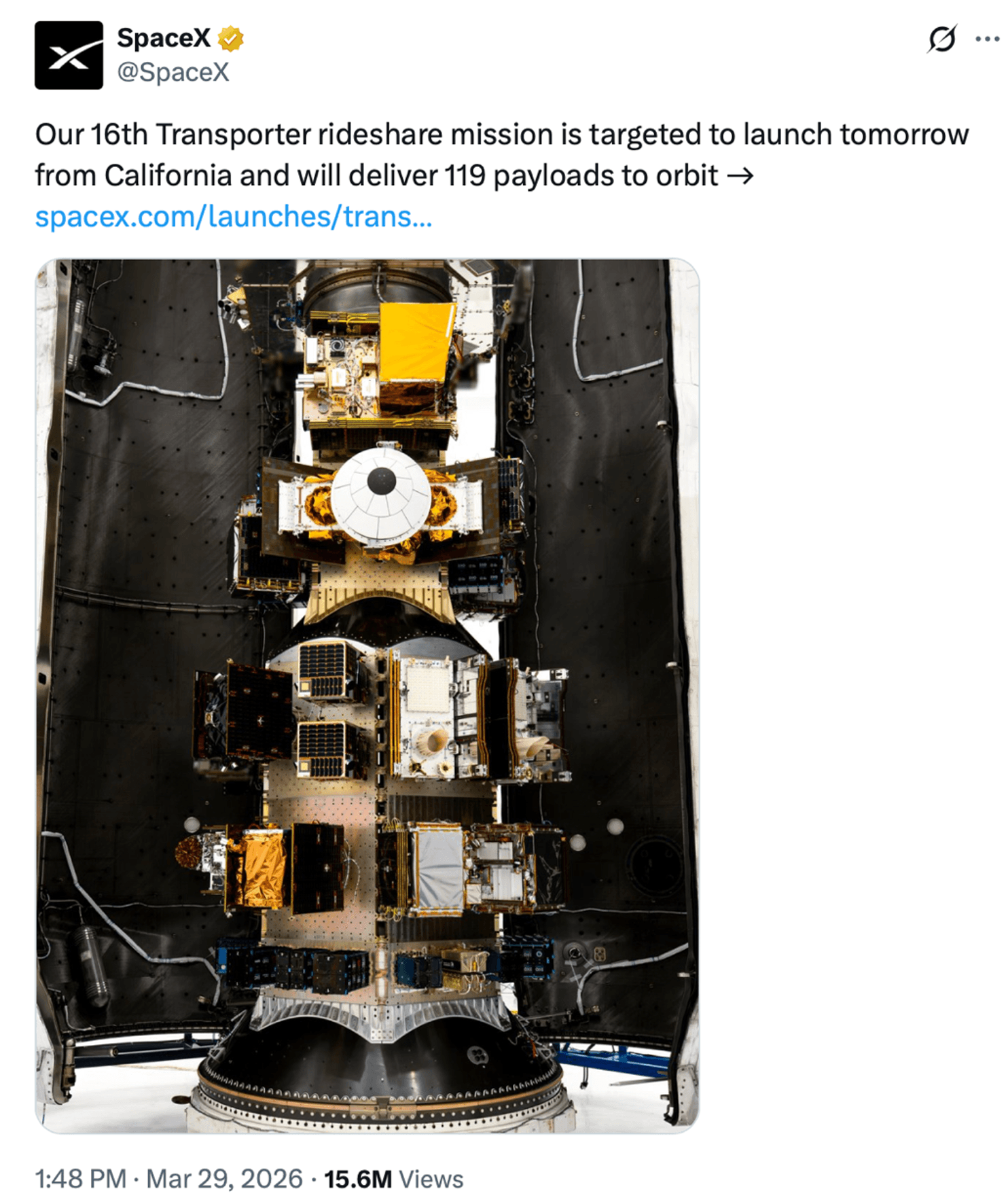
This March, it launched its sixth manufacturing spacecraft to orbit on a SpaceX rideshare mission.
Source: X @SpaceX
If we look closely at the image above, the white circular object is actually Varda’s W-6 spacecraft, which was successfully deployed in orbit on March 30th.
The company has been iterating quickly, launching regular missions, and gearing up for large-scale manufacturing in space.
It may seem counterintuitive to do so, but materials and compounds can be manufactured in microgravity with levels of purity and quality that are simply impossible on Earth due to the effects of gravity.
The initial target products for space manufacturing are pharmaceutical compounds, fiber optic cables, and semiconductor materials.
These are all very high-value, high-impact sectors that will see improved efficacy and quality as a result of space-based manufacturing.
Varda has already successfully demonstrated crystallizing an HIV drug in orbit and safely returning it to Earth.
That was just a proof of concept, and one that can be easily replicated at scale.
This success led to a first-of-its-kind deal between Varda Space and pharmaceutical company United Therapeutics (UTHR) to manufacture formulations for the treatment of rare pulmonary diseases.
The goal is to leverage the advantages of microgravity in space to enhance the quality of therapeutic compounds, improving their stability and bioavailability.
The initial targets will be focused on those therapies for life-threatening pulmonary diseases.
If it costs $5,000 or $10,000 per kilogram to get a pharmaceutical manufacturing spacecraft into orbit, none of this makes any sense, though.
But at $200 or $100 per kilogram, the economics justify the investment to build an entirely new industry, space-based manufacturing.
And it’s all possible because of SpaceX and its Starship.
Everyone in the aerospace industry knows this. My Bleeding Edge readers, of course, have known this for years.
And now, so do venture capital and private equity investors.
This is why they have been investing billions of dollars in advance in companies that benefit from this once-in-a-generation moment.
Varda Space raised $250 million this January and is now worth $1.6 billion and growing quickly.
This will become an industry-defining company and a representation of what is possible in this new space economy.
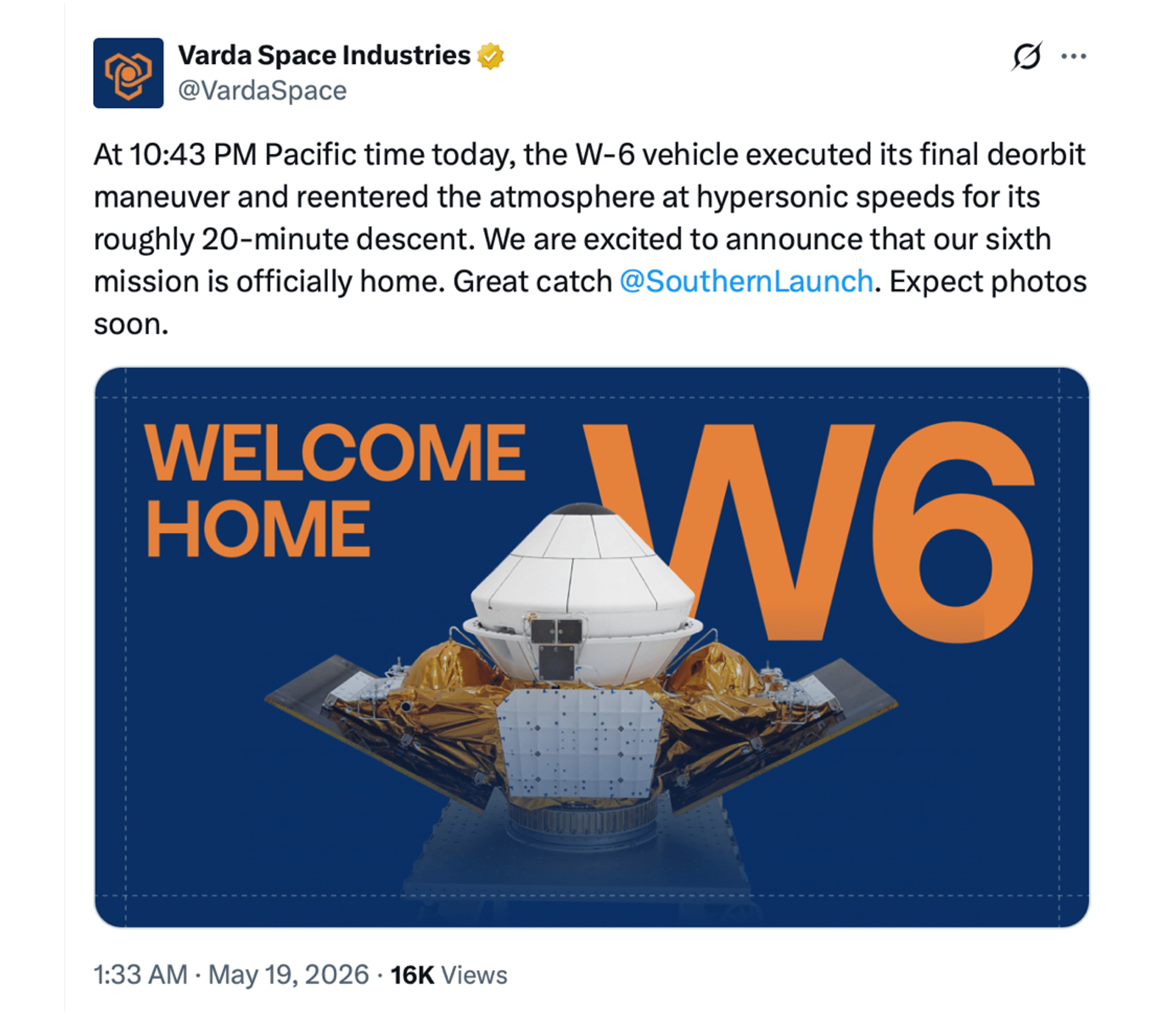
Fittingly, just hours ago, Varda’s W-6 spacecraft successfully returned to Earth after its months-long mission in orbit.
Source: X @VardaSpace
There’s so much more to come.
So much more to look forward to.
It’s time for liftoff…
Jeff
Add Brownstone Research as your preferred source on Google to see our latest stories in your feed.
 Add as a preferred source
Read the latest insights from the world of high technology.
As companies give digital workers more responsibility, protecting their systems becomes part of the cost of putting AI to...

The technology connecting the world's fastest computers may be one of AI's most underestimated opportunities…

What’s coming will look like what AI did to software companies – rapid disruption in a sector that investors...