




Beware of Biased Billionaires
Over the last week, we have discovered that this is a massive, well-coordinated psyop carried out by some powerful...



NVIDIA and AMD are the workhorses of training AI models. Without these two companies, the AI technological boom that we are experiencing wouldn’t exist. And that’s not changing any time soon.
“The workhorses of artificial intelligence…”
That’s how I often refer to graphics processing units (GPUs).
GPUs, originally designed for graphics processing, are a uniquely different semiconductor architecture compared to central processing units (CPUs).
CPUs are designed for sequential processing.
They are high-performance semiconductors capable of performing complex tasks in sequential order.
Most CPUs have few cores that are optimized to carry out their tasks quickly and in order.
GPUs, on the other hand, are designed for parallel processing.
Most GPUs have thousands of small cores capable of running smaller tasks in parallel – at the same time.
Understanding these simple architectural differences and the applications that would benefit from each kind of semiconductor is an important insight, as it’s had incredible investment implications.
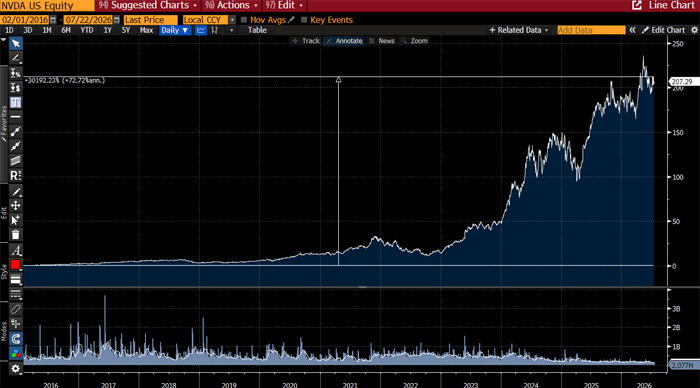
Back in early 2016, I predicted NVIDIA’s (NVDA) rise in the industry, and that it would become the workhorse for the wave of machine learning and artificial intelligence that I knew was coming.
NVIDIA is up about 30,000% since that time…
10-Year Chart of NVIDIA (NVDA)
I did the same with Advanced Micro Devices (AMD) a couple of years later, as its own GPU development began to catch up with NVIDIA in terms of performance, and it began making CPUs for servers that outperformed Intel’s (INTC) best CPUs.
AMD’s growth originally had two major tailwinds – grabbing increased market share of CPUs designed for AI servers and its position as another source of high-performance GPUs competing against NVIDIA.
Today, even though NVIDIA dominates, both companies are the workhorses of training AI models.
Without these two companies, the AI technological boom that we are experiencing wouldn’t exist.
And that’s not changing any time soon.
Google May Have Just Found a Way to Beat Nvidia at Its Own AI Game
– Inc.
Every month, for years, I continue to see analysts and the media types (financial or otherwise) proclaiming the collapse of NVIDIA because one major hyperscaler or another will be manufacturing their own AI semiconductors.
The latest example of this came earlier this week with the news that Google (GOOGL) is developing a brand-new AI semiconductor that is internally referred to as Frozen v2.
Not a very apropos name, if you ask me, for a cutting-edge semiconductor that’s supposed to deliver extraordinary performance and outwork even the best NVIDIA chips …
I have no idea what the name means, and it doesn’t matter.
What’s important is the purpose of the new design.
The team at Google is developing Frozen v2 in a way that is specifically designed for its Gemini frontier AI models to run more efficiently, in terms of both performance and cost.
In an ideal world, any company that has its own software models would design custom semiconductors to run those models. It’s the single best way to optimize performance of both the software and the semiconductors on a performance per unit of energy basis.
The problem is that it is both time-consuming and expensive to do so.
Which is why only large companies with a lot of capital and scale to their businesses have endeavored to do so.
Everyone else simply uses what’s available in the semiconductor market.
Many analysts and media are again suggesting that the release of Frozen v2 will come at the expense of NVIDIA.
They suggest, again, that this is the beginning of the end of NVIDIA, as all the big hyperscalers and frontier AI companies are “moving away” from the semiconductor giant.
They couldn’t be more wrong.
Let’s set aside that Frozen v2 – or whatever it will be called when it is put into production – won’t be available until 2028.
What’s important for us to understand is why Google has decided to design this Gemini-specific semiconductor.
As a reminder, Google already has its in-house designed tensor processing units (TPUs), which are manufactured by Taiwan Semiconductor Manufacturing (TSM).
Google’s first-generation of its TPU was manufactured by TSM back in 2015.
Since then, Google has been on its 8th and 9th versions of TPUs, which are being manufactured on TSM’s 2-nanometer process node. This is at the bleeding edge of semiconductor manufacturing technology right now.
Google’s TPUs are primarily used for running Google’s AI models, inference, and also for some AI model-training applications.
TPUs are used both in-house and also made available to third parties on Google Cloud.
So, after a decade of having TSM manufacture TPUs, has Google’s development of its own AI-specific semiconductors slowed down NVIDIA’s growth in any way?
The answer: No, not at all, not even by a single semiconductor.
NVIDIA, and AMD for that matter, have so much backlog for their products that they could be selling twice as many semiconductors each quarter as they are selling right now… if TSM could manufacture them. The reality is that TSM is maxxed out and trying to add capacity as quickly as it can.
NVIDIA and AMD’s growth bottleneck right now is TSM’s manufacturing capacity. That’s it.
Google’s own ability to manufacture more of its TPUs is also constrained by how much manufacturing capacity it can buy from TSM.
Google is in a pinch right now.
It doesn’t have anywhere near the leverage with TSM as NVIDIA, AMD, or Apple (AAPL), who have all been working with TSM for decades at extremely high volumes.
This is why semiconductor manufacturing capacity is arguably the most valuable asset on Earth right now.
This is precisely why Elon Musk has committed $119 billion to build out the Terafab, which will become the largest semiconductor manufacturing plant in history – to meet Tesla and SpaceXAI (SPCX) demand for advanced semiconductors.
Musk himself has said that TSM, Samsung, and to a much lesser extent, Intel combined only produce about 2% of the volume of advanced semiconductors that he believes he will need annually in the future.
That’s how large the gap is…
Google’s own Google Cloud business is doing extremely well, as is its AI business with its Gemini models.
Consider this:
The growth in utilization of its AI models is simply astonishing.
7X year over year?
3.2 quadrillion tokens processed in a month… and growing exponentially?
As a reminder, a token can represent a single word, or a part of a word, or punctuation.
An easy rule of thumb is that for every 1 million tokens, it represents about 750,000 words.
So that means 3.2 quadrillion tokens is about 2.4 quadrillion words processed in May.
The numbers are now so large they are hard to comprehend.
So, Google is in a pinch.
On one side, it is constrained in that it is limited in how many NVIDIA/AMD GPUs it can purchase and how many TPUs it can have TSM manufacture.
On the other side, it is witnessing exponential growth in its own computational demand, and the demand from its Google Cloud customers.
Talk about being stuck between a rock and a hard place.
This is what the catalyst is for developing Frozen v2.
The new Gemini-specific semiconductor embeds parts of Gemini’s AI architecture into the Frozen v2 semiconductor.
The result is a semiconductor that Google’s engineers believe will be able to process somewhere between 6-10 times more tokens per unit of power than Google’s current generation of TPUs.
That is a massive leap in performance by 2028 when the chip will be put into production.
It’s a development that has been born out of absolute necessity that will help relieve some of the constraints that Google is currently experiencing and will continue to experience even in 2028.
I like this example of Google’s Frozen v2 and its TPUs because it is representative of what is happening in the entire industry:
I could go on, but the key point is: None of these companies manufacture their own chips. And all of them work with TSM or Samsung Electronics to manufacture them.
Intel, if it can get its act together, may also enter the equation as a third manufacturing partner. This has yet to be seen.
And once again, has this widespread industry effort put a dent in NVIDIA or AMD’s GPU business?
Not even a smidge.
The reality is that this issue of in-house custom semiconductor development versus NVIDIA/AMD GPUs as the workhorses of AI isn’t an either/or issue – at all.
The entire industry is fanatically working to develop whatever solutions that they can to incrementally alleviate the inherent constraints caused by exponential growth in demand for computational resources.
AMD’s 2028 revenues will be about double its 2026 revenues.
NVIDIA’s 2029 fiscal year revenues (roughly its 2028 calendar year) will be at least 75% higher than its 2027 fiscal year (roughly its 2026 calendar year).
AND all of the companies that I named above will have millions of their own AI-specific semiconductor manufactured in the next few years.
AND it still won’t be enough to meet demand…
But it will be enough to develop artificial superintelligence (ASI) and transform the world as we know it.
Jeff
Add Brownstone Research as your preferred source on Google to see our latest stories in your feed.
 Add as a preferred source
Read the latest insights from the world of high technology.
Over the last week, we have discovered that this is a massive, well-coordinated psyop carried out by some powerful...

Last month I was excited to see an announcement made by a leading humanoid robotics firm, Figure AI, for...

When demand exceeds supply, something has to give…