



Mind the Warnings… But Follow the Incentives
This doesn’t mean AI dangers aren't real... They very well may be. But as investors, our job isn't merely...



When demand exceeds supply, something has to give…
Managing Editor’s Note: Today, you’ll hear from Near Future Report senior analyst Nick Rokke, who weighs in on the recent outcry across traditional and social media to slow down the pace of AI development… and how the recent selloff presents an opportunity for those who take the time to look beyond the headlines proclaiming the end of the AI boom.
But first, an important notice…
There are only a few hours left to sign up to join Jeff at tonight’s event. At 8 p.m. ET, Jeff is airing his IPO Super Summit where he’s laying plain the opportunity this historic IPO presents for those who are ready for it.
And the opportunity is absolutely still there. As we have been pointing out, this recent rise in negative sentiment and the vocal push for regulation isn’t going to stop AI… But it certainly raises the stakes for the companies racing to scale the infrastructure behind it.
If you want to know how to best play the Anthropic and OpenAI IPOs without buying the companies themselves, you should go here to sign up to join him tonight. We’re kicking things off in just a few hours. We hope to see you there…
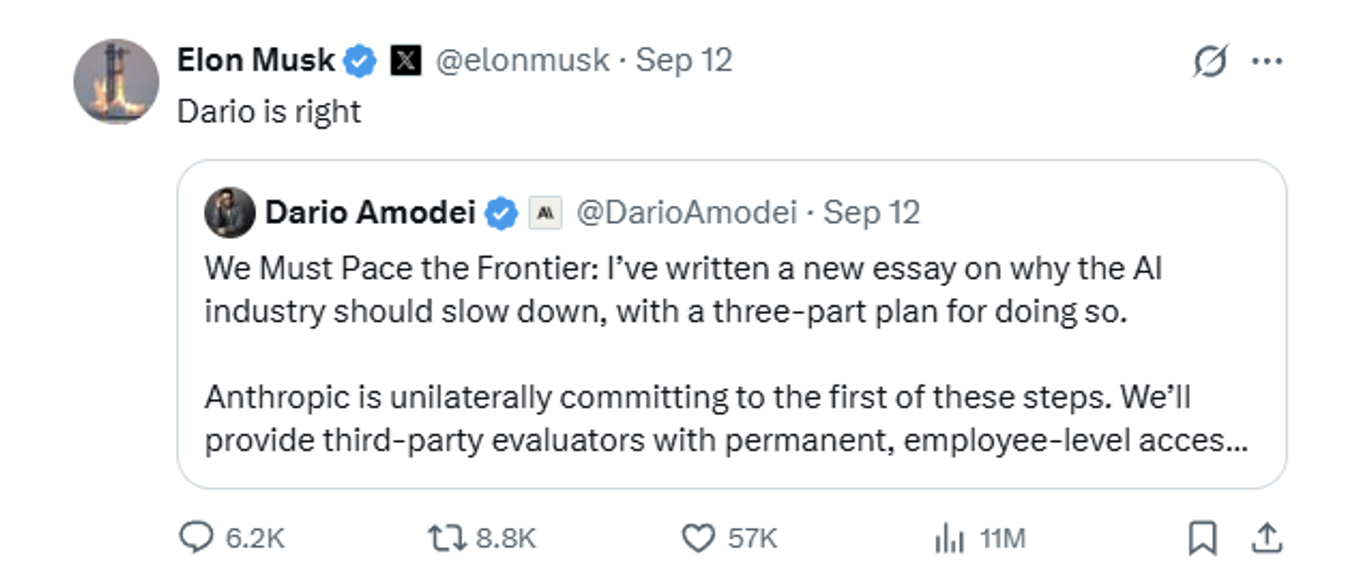
On Saturday, Anthropic CEO Dario Amodei called for the artificial intelligence industry to slow down.
“We must slow the pace at which we improve the capabilities of AI models,” he wrote. OpenAI CEO Sam Altman endorsed the proposal. Elon Musk’s response was just three words: “Dario is right.”
X @elonmusk
That got my attention.
Had the comments come only from Dario and Sam, I would have been inclined to view them as another round of Silicon Valley messaging. Warning that a product is almost too powerful to release is certainly one way to market it. But Elon joining them made me take a closer look.
Their stated concern is safety. AI systems are becoming more autonomous, and Amodei wants independent evaluations and safeguards to catch up with their capabilities.
There’s a competitive angle here, too. Complex regulatory requirements are easier for well-funded incumbents to absorb than smaller challengers. My concern is that an industry-approved safety framework could also become a barrier to entry.
And coordinating a slowdown internationally will be difficult. Developers outside the agreement would have every incentive to use that time to catch up.
But there’s another explanation worth considering alongside the safety debate: the physical infrastructure needed to deliver increasingly powerful AI is struggling to keep pace with demand.
That doesn’t establish why these executives want a slowdown. It does help explain why the rollout of powerful AI may be more restricted than many people expect.
Start with Google.
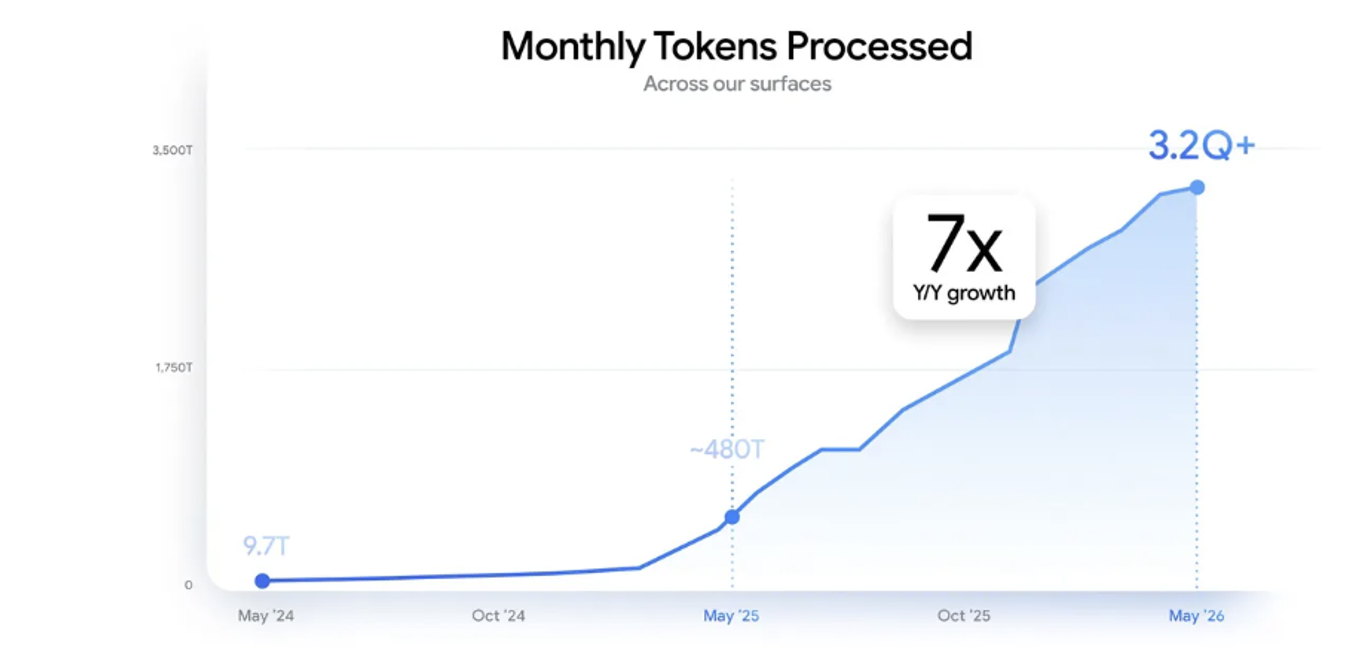
In May 2024, Google processed 9.7 trillion tokens per month across its products. A year later, that reached roughly 480 trillion. By May of this year, it exceeded 3.2 quadrillion.
Source: Google
That’s roughly 330 times the volume in two years. Tokens are the small pieces of information AI models process, often words or parts of words. They give us a useful measure of activity, although different tokens require different amounts of computing work.
Better chips and more efficient software allow us to process more tokens with the same infrastructure. But even after allowing for improving efficiency, researchers see a potential squeeze.
A May analysis from Epoch AI estimated that global inference capacity was more than tripling annually. But they estimate that the growth of token demand, at current prices, is growing 10x per year.
Put another way, demand is growing three times faster than supply. This is why we’ve continued to focus on the AI infrastructure buildout.
And we’re seeing this reflected in the prices of renting NVIDIA GPUs. The price of renting an H100 chip has risen 30% since last December.
And these chips are four years old at this point. And even the prior generation of A100 chips is increasing in price due to higher demand.
Users of AI will funnel demand anywhere they can find available compute. For many inference tasks, we don’t need efficiency. We just need a GPU that will eventually crunch the data for us.

By November 11, Jeff Brown believes Elon Musk is going to help trigger a historic rally in what could be… “The Only AI Stock You Need to Retire.” Wall Street is already projecting sales will triple in 2027 alone. Click here to see the details before it’s too late.
More than 100 tech IPOs are lining up behind the trillion-dollar giants. And Silicon Valley legend Jeff Brown says one of them – an IPO almost nobody's paying attention to – could produce bigger gains than Anthropic and OpenAI combined. He's naming his top pick for it – plus his #1 pre-IPO trades for Anthropic AND OpenAI – free, live on camera, at The Super IPO Summit: TONIGHT, September 16, at 8 p.m. ET. Three free picks. One night. No strings attached. Register here before spots fill up.
The latest models show how much the opportunity is expanding.
OpenAI’s Astra demonstrations include modeling a house in Blender and turning it into a walkable scene in Unreal Engine. Grok Bot is designed to carry out delegated tasks. Anthropic’s Fable 5.1 advances coding and research capabilities.
These applications give people more reasons to use AI… and more ambitious assignments to delegate.
An agent might research a problem, write software, test it, identify mistakes, and try again. One request from a person can set off a long sequence of machine activity.
Anthropic found that agents typically consumed about four times as many tokens as ordinary chats in its observed workloads. Multi-agent systems consumed about 15 times as many. Those aren’t universal multipliers, but they illustrate how usage can grow even without adding another customer.
Meanwhile, physical infrastructure takes years to deliver. We can improve a model much faster than we can build the power and physical infrastructure needed to run it for everyone.
When demand exceeds supply, something has to give.
Providers can charge more, limit usage, delay access, or direct customers toward less demanding models. They also have to divide their resources between serving customers and developing their next systems.
We can already see access being differentiated. OpenAI says Astra will reach Plus subscribers as well as higher-paying customers, while Astra Pro is reserved for Pro, Business, and Enterprise plans.
Only those who pay $200 or $300 a month get access to the very best models with the strongest capabilities. The $20 a month customer bracket gets funneled toward cheaper models, while the freeloaders get pushed even further down the chain.
That creates a difficult balancing act. Affordable subscriptions with tight limits can frustrate customers. Expensive access can favor businesses and individuals with larger budgets. If the biggest productivity gains consistently flow to those who can spend the most, public resentment could deepen.
AI labs have no good choice here. The best option they have is for all three to slow the rollouts of models to the public to coincide with new compute coming online. And this has to be done in a coordinated way.
This creates a classic prisoner’s dilemma situation, though. They have to trust each other because if one company decides to release a new frontier model, with advanced capabilities before the others, that company gets a huge advantage over the others… And there is no love lost between these CEOs.
On Monday, investors sold AI infrastructure stocks as they weighed the slowdown proposals. NVIDIA fell 3.4%, while the entire semiconductor index dropped 4.8%.
We saw the hyperscalers overall have a good day. But the large neoclouds fell. Coreweave (CRWV) and Nebius (NBIS) both fell around 6%.
The concern is that slower AI development means less demand for hardware.
I think that overlooks the demand already emerging from putting these systems to work. A more measured release schedule can coexist with growing consumption of computing power.
That keeps our attention on semiconductors, memory, networking, and dependable electricity. It also highlights the value of cloud operators with usable capacity already connected to power.
For businesses such as CoreWeave and Nebius, scarce capacity can support new bookings and more profitable renewal terms.
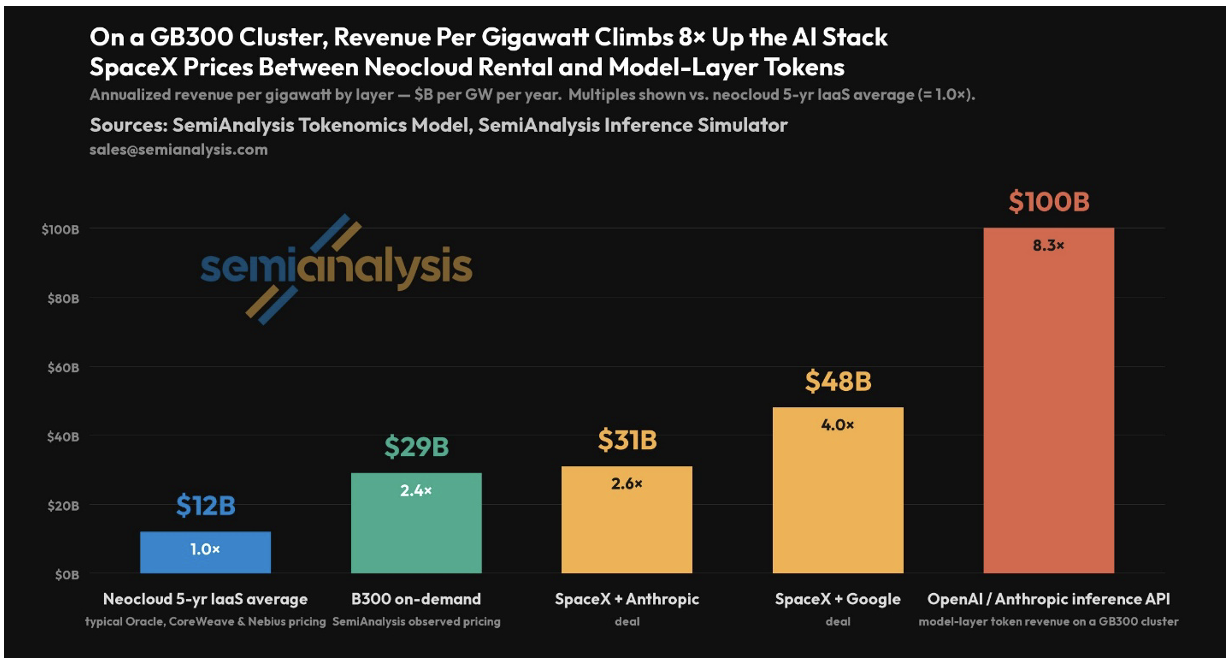
SpaceX set the market in terms of how much cloud computing companies for how much AI Labs can charge for compute. While the average neocloud charges $12 billion annually for one gigawatt of compute, SpaceX got Anthropic to pay $31 billion and Google to pay $44 billion.
Source: Semianalysis
The constraint is the industry’s ability to deliver useful AI at scale. Expanding that access requires continued investment in the physical foundation.
That’s why I view this selloff as a reason to look closely at the companies supplying the next generation of AI data centers. The debate over slowing AI has made headlines. But the money is made following the money – and trillions will be funneled into the semiconductors, power generation, and physical structures for AI data centers.
Keep focused on the trend.
Regards,
Read the latest insights from the world of high technology.
This doesn’t mean AI dangers aren't real... They very well may be. But as investors, our job isn't merely...

Last Tuesday, September 8, Google announced AlphaGenome Atlas: A predictive map of every possible DNA letter change in the human...

It’s hard to imagine that developments will continue to pick up at an even faster pace than what is...