







Figure 03 Ready for Mass Production
According to Figure AI, “The future of home help is here.”
The world just took a major step forward – towards the proliferation of general-purpose, intelligent humanoid robots in consumers’ homes.
Last week was yet another incredible week in the world of high tech. And one of the biggest events was an update from a company we know well in The Bleeding Edge – Figure AI.
The AI/robotics innovator signaled a strong pivot in messaging…
The announcement of Figure 03 came with the tagline, “The future of home help is here.”
This is notable, as Figure had previously been emphasizing more industrial applications, primarily with its pilot deployment of Figure 02 in the BMW manufacturing plant in Spartanburg, South Carolina.
So something has shifted…
Built for the Home
In contrast to 02, Figure 03 has been designed with a soft, white, fabric exterior, with a less mechanical look, softer hands with tactile sensors to improve fine motor skills, and wireless charging through Figure 03’s feet (i.e., no need for the consumer to plug in for recharging).
Figure 03 – Designed for the Home | Source: Figure AI
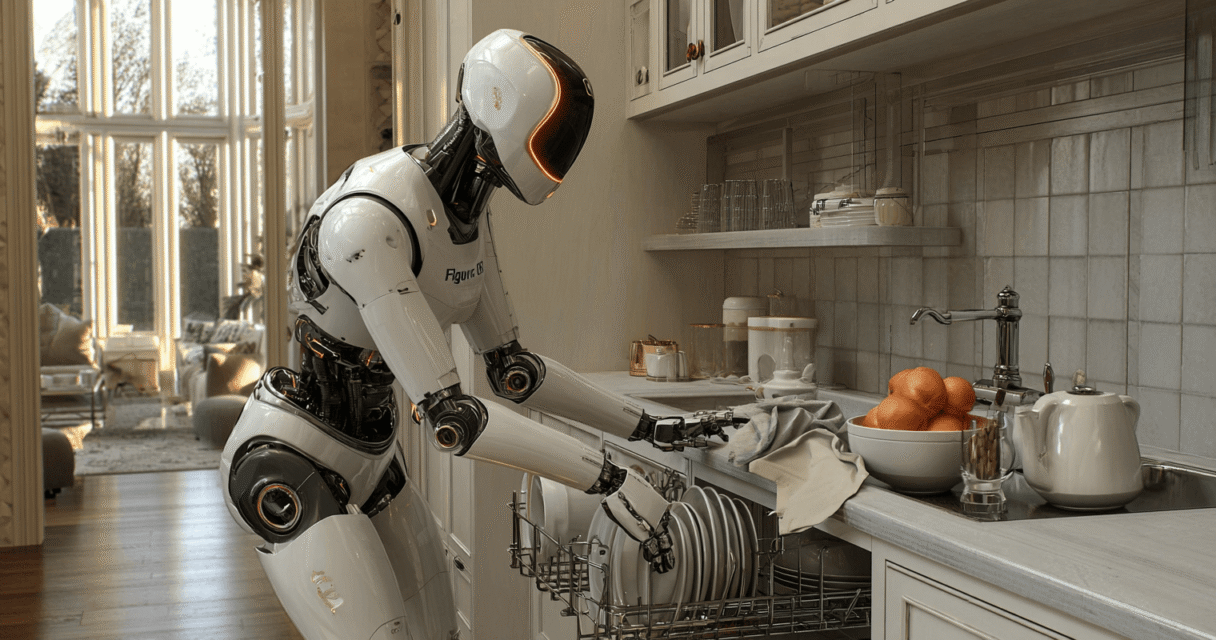
Figure did a nice job bringing to life the kinds of tasks that Figure 03 is being trained to perform in the real world.
It has clearly become more dexterous, with an improved capability to manipulate a wide range of typical objects that we’d find in any home. And the tasks that it is now capable of doing are the same tasks that most of us do for ourselves daily.
Figure 03 Taking Care of the Dishes | Source: Figure AI
This is a major development for Figure’s humanoid robots.
What happened?
Upload and Go
A major part of the upgrade took place in Figure 03’s “brain,” what Figure AI calls Helix, its vision-language-action AI model.
These developments are closely tied to a major announcement that Figure made last month, Project Go-Big. Part of that announcement was a partnership with Brookfield, which owns more than 100,000 residential units worldwide.
The purpose is simple… to accelerate the collection of videos of humans performing daily tasks. This newfound data, the video content, is needed for training Figure 03’s brain – Helix.
Data and video available on the internet have limitations. Figure recognized that it needed to scale up the data collection specific to its design goals to accelerate the training of Helix. What’s very interesting about this focus is that it signals a shift towards vision-based learning.
This is a validation of Tesla’s approach for not only its self-driving software, but also its approach to training Optimus. While it was largely unpopular in the past, Musk has long maintained that vision-based systems are the only path forward to achieving general-purpose intelligent robots. It doesn’t matter whether that robot is a car, a truck, or a humanoid robot.
Now, Figure has been able to demonstrate zero-shot, human-video-to-robot learning. Put simply, Figure can feed Helix training videos on human tasks, and then Figure 03 can perform those tasks successfully.
This is powerful. And it reminds me of The Matrix. Preloaded training data on just about any skill you can think of was simply uploaded to the human brain in the movie. It’s an apt analog for what Figure is doing with Figure 03’s Helix right now. Only it’s not fiction, and Figure 03 can operate in the real world. It’s not confined to a matrix.

I’m Going to Learn Jujitsu | Source: The Matrix
Aside from the improvements in Figure 03’s brain, Figure has implemented some hardware improvements, as well.
Figure’s Big Hardware Upgrades
Figure has significantly upgraded its camera architecture to deliver twice the frame rate as the previous model, one-quarter the latency, and a 60% wider field-of-view per camera. As Helix is now a visual-centric AI model, this makes perfect sense. High-resolution, high-frame-rate video results in improved performance.
Even more interesting is that Figure installed a camera in the palm of Figure 03’s hands with a wider field of view. This enables Figure 03 to “see” objects in spaces that might be difficult to view with Figure 03’s cameras in its head. A simple example might be reaching around the corner of an object or trying to grab something inside a small drawer.
And in order to improve fine motor skills, Figure developed its own tactile sensor in-house, as well as developing softer fingertips to better manipulate a wide range of objects. This latest technology can detect a force of just 3 grams of pressure, the equivalent of the force of a paper clip resting on your fingertip.
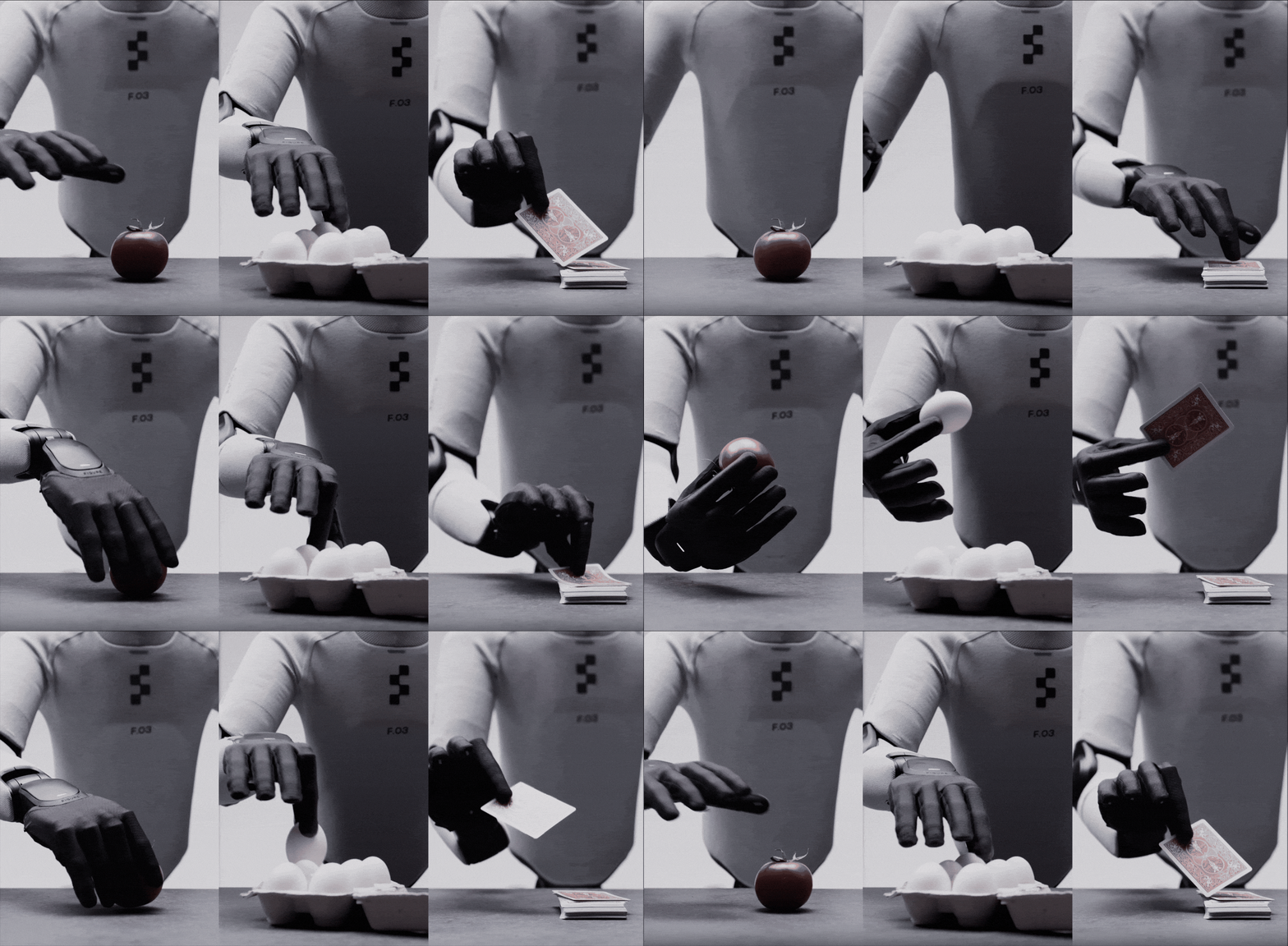
Figure 03’s Sensitive Touch | Source: Figure AI
Figure 03 is designed to be a general-purpose household robot. We can speak with it and give household commands and instructions on what we need done, just like we would with a housekeeper. It has a real-time natural language model enabling natural conversations.
And for those who are fashion-conscious, Figure 03’s clothing is not only washable, its clothing can also be changed and is customizable. As silly as it seems, is it that hard to imagine customized designer outfits for your Figure 03 robot?
Signal to Go-To-Market
Let’s face it, in the first few years of consumer adoption, this kind of product will be a must-have status symbol, just like the iPhones were in the years that followed the first iPhone release back in 2007.
Figure 03 is fully autonomous and capable of working around the clock. When it gets low on energy, it simply returns to its stand to rest and charge up, using a wireless inductive charging technology.
But the largest signal that Figure has given – to indicate that it is preparing to go to market with Figure 03 – is the simplification of its hardware design, and its move to die-casting, injection molding, and stamping to enable lower cost, mass production.
Figure’s BotQ in-house manufacturing facilities are gearing up to produce 12,000 Figure 03s a year as early as next year, and a stated target of manufacturing 100,000 Figure 03 humanoid robots over the next four years.
This is happening now. And it’s all enabled by advanced semiconductors, high bandwidth memory, novel actuator designs, neural networks, and vision-based robotic systems. Intelligent, general-purpose humanoid robots will be one of the biggest trends in 2026.
And aside from home and distribution center applications, don’t be surprised if you see one of these making a delivery to your door in the near future…
Knock, knock.
Jeff

Home Delivery | Source: Figure AI
Continue following Brownstone Research
Add Brownstone Research as your preferred source on Google to see our latest stories in your feed.
 Add as a preferred source
More stories like this
Read the latest insights from the world of high technology.
-
-

Anduril’s Arsenal
This is a landmark deal and the most significant initiative in shipbuilding and defense technology since World War II.
-

Google’s Nuclear Deal Reveals the Scale of AI’s Power Problem
Google’s recent agreement reveals the scale of the AI power shortage and why supplying power is such an important...