


The Maximum Truth-Seeking AI – A Magnitude Smarter
Grok 4.2 has evolved into something so much bigger than what was originally planned…


It’s our first Bleeding Edge AMA edition of 2026…

Happy New Year to all of you, my subscribers, and my team as well.
I hope that 2026 brings everyone happiness, health, and a passion to embrace what’s going to happen in 2026. It’s going to be an incredible year. And if you’re reading this now, I know you’re already up to speed about what’s coming.
Seneca said:
“Luck is when preparation meets opportunity.”
My job is to do my best to make sure my subscribers are prepared for what’s coming. I’ll make sure you’re ready, and whether or not you act on that information or not is entirely up to you.
I know how busy the holidays can be, so if you haven’t done so already, I definitely recommend reading my year-end review published on December 31, 2025, and my predictions issue published yesterday on January 1. There’s no better way to get ready for 2026 than to see and understand exactly what’s coming. This will give us a framework for the year to come.
Best wishes to all in 2026. We have so much to look forward to,
Jeff
Jeff, I’ve greatly enjoyed your updates since my brother turned me onto them. I’ve put them to use in our new investment portfolio (though later than I would have liked). I enjoy being on the cutting edge of technology news and seeing the various predictions pan out over time.
One that I’ve been wondering about, though, concerns Tesla. There was a big build-up to its launch in Austin, but since then, I’ve heard crickets on that score, and over the past month, I’ve only seen news about Waymo and… some other one.
What’s the latest on the Tesla EV rollout?
Thanks.
– Clint H.
Hi Clint,
Happy New Year.
And no need to worry, it’s not too late to benefit from what’s happening right now in the markets and with technological advances. If you haven’t done so already, please read my predictions issue published on January 1, and that should give you a good feeling for what’s coming in the next few years.
As for Tesla, one of the things that makes the company so unique, and hated by journalists and publishers, is that it rarely advertises anywhere. This is true of all of Musk’s companies.
I subscribed to Automotive News, the most influential trade publication in the U.S. for the automotive industry, for years. And I was always astonished how they could write articles about the EV industry, with no mention at all of Tesla.
The reason was that Tesla didn’t buy advertising. These industry publications have a huge bias towards providing coverage for companies that pay for advertising and downplay those that don’t.
Automotive News is a bit better now about covering Tesla. So many complained because they wanted updates on such an influential company in the industry, but it is still not objective and complete.
But the lack of positive and accurate coverage on Musk’s companies isn’t a reflection of what is actually going on.
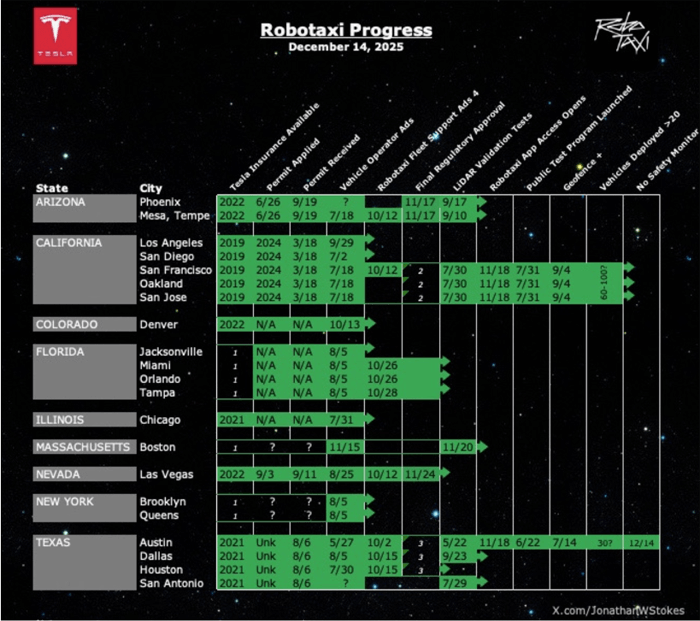
Source: Jonathan Stokes
December was a big month for the Robotaxi rollout in Austin. On December 14, Tesla removed the safety driver from the Robotaxi. And it began testing the new golden Cybercab, which has no steering wheel, gas pedal, or brake pedal.
Tesla is now demonstrating Level 5 autonomy with Robotaxi, Cybercab, as well as any Tesla that is using FSD version 14.2.2. My Tesla drives me and parks itself wherever I go. I’ve taken trips for a couple of hours and not had to do a thing. I can even speak with Grok, which is now integrated with the navigation system and FSD, and make trip changes along the way in real time.
As per my predictions issue, this year tens of millions of people in the U.S. will see the various kinds of Teslas driving around without anyone behind the wheel.
It’s real, the tech is there already, all that’s left is to expand and deploy city by city, which each requires state-level regulatory approvals.
I’d like to encourage you to find a way to experience this for yourself. Perhaps take a ride with a friend who has one or rent one for a day. I promise that you’ll be amazed.
Enjoy the ride…
Thank you, Jeff Brown, for your daily insightful updates on any and all subject matters.
I wish you would revisit employment opportunities in the next 5 years, and which subject matter our children should take to prepare them for future employment.
Also, please address the gap between the ”haves and have-nots.”
My outlook toward the next 5-10 years is looking bleak. Will AI provide a way to live peacefully among ourselves?
Praying for a positive outcome.
– Jeff I.
Hi Jeff,
Thanks for writing in with this. We recently explored the impact of artificial intelligence – and particularly artificial general intelligence – on the labor force with The Coming Labor Crisis of AGI.
In case you missed that issue, I do a pretty substantial dive into the future of work once artificial general intelligence is achieved and adopted across industries.
I said that, essentially, work in the AGI era will fall into one of two camps – economically essential bottleneck work and non-essential accessory work…
Examples given for bottleneck work include: feeding and sheltering people, producing energy, maintaining the productive infrastructure of the economy, advancing science, decision-making, logistics and delivery, maintaining national security, and enforcing the law to maintain order and stability.
The key point is that an economy cannot continue to grow without these bottleneck tasks being performed.
[…]
Examples of accessory work include: work associated with arts and crafts, performing for others (i.e., entertainment), literature, hospitality, fine dining, design, customer support, work related to religious and civic organizations, etc.
Conceptually, the idea is that AGI will be used to automate as much of the bottleneck work as possible. After all, it is a bottleneck. So, anywhere technology can be used to remove a bottleneck, a higher level of economic growth is achievable, assuming the continued increase in computational resources.
The research assumes that all bottleneck work will be automated with AGI. And, where necessary, it will be augmented with intelligent robots capable of interacting with the real world.
[…]
Much of the accessory work, however, will likely be relegated to humans for two primary reasons:
- To save on computational resources. In other words, the value of the computational resources will be higher than the value of the accessory work being performed, so the work is left to humans.
- Accessory work will be delegated to humans to provide purpose to the labor force. It will provide stability and continuity during this transition to the widespread availability of AGI and computational resources to power it.
Yes, the nature of work will change. In fact, we’re already seeing the seeds of disruption begin to take root. That disruption will only grow once we achieve AGI… and I believe we’re just months away now.
When it comes to accessory work, only the exceptionally skilled will see significant wage growth. Everyone else will see stagnation.
The lion’s share of wage growth and professional mobility will reach workers in industries that utilize AI to further accelerate technological progress – so think STEM (Science, Technology, Engineering, and Mathematics) jobs, for the most part.
I would suggest those are all worthwhile pursuits for young people wondering what general fields to pursue. Of course, there are many potential paths under the umbrella of STEM.
I’ve suggested directions to take for those interested in working in the crypto industry… or who want to work in robotics – technicians, engineers, etc. – and with other forms of manifested AI… Computer science will still be essential.
And there are incredible job opportunities now in the trades. Plumbers, electricians, construction workers, welders, etc., are in very high demand. Liberal arts majors from “great” schools are having conniption fits right now because those who work in the trades are making more money than they are. They just can’t understand that the economic value of what trade workers can provide is higher than what they are capable of doing.
This opportunity isn’t going away anytime soon. And it’s now just the AI data center infrastructure buildout. A multitrillion-dollar trend is underway to re-industrialize the U.S. economy, creating jobs and building a resilient supply chain. Jobs are everywhere, and as long as workers are willing to adapt, learn new skills, and potentially move to where the work is, you’ll be fine.
And with the accelerated economic growth that I’m predicting for the next several years, a rapidly expanding GDP means opportunity for anyone willing enough to take action.
I think it’s important to remember that, like any technology, AI is a tool. It’s designed to augment human performance, not eliminate it entirely.
The companies and individuals that move to embrace AI in their work will improve their positions, be more productive, and be less likely to be impacted by the oncoming disruption.
My team and I use AI daily to support our work and research. Though, importantly, we take care to check where any AI-generated information comes from. So many popular models have been comprehensively trained on information picked up online, leaving them exposed to biased and untrustworthy internet sources.
Yes, the landscape of work is changing, and we’ll see some roles restructured to go wholly to AI, but we should remember that AGI will also result in a significant productivity boost. Increased productivity means increased economic growth… and beyond that, AGI will set the world on track for an age of extraordinary technological progress.
Those who adapt and adopt will grow… those who fail or refuse to do so will fall behind. This is the nature of transformative technology.
And beyond that, we’ll also see incredible investment opportunities for those willing and able to position themselves to take part in this explosive growth.
And we’ll be here every step of the way.
Customer wants to know: What was the perspective of Jeff Brown regarding [an Exponential Tech Investor] recommendation… Why was it only recommended to sell half of the gain?
– David K.
Hi David,
Good question!
First and foremost, our goal is to build model portfolios of fantastic growth companies with incredible potential. And when we make recommendations, they are always made as general guidance (not individual investment advice). It is up to each individual to decide what they want to do with their portfolio at the end of the day. My goal is to provide my subscribers with the knowledge to make their own assessment about each model portfolio position.
As for the strategy to sell half of the position, it guarantees our initial investment is covered in higher-risk investing environments while still giving us room to benefit from exponential future growth.
It’s simply a strategy we like to employ – especially with more aggressive portfolios and holdings that are sensitive to volatility – where we’ll sell half a position once it has doubled to recoup the investment. Then we keep the second half invested, “playing with house money,” so to speak.
It’s also just good risk management. We sell half when we still believe a company has room to run, but perhaps its valuation is high… there’s a change in management… market sentiment is shifting… or any number of things that could – but not necessarily will – impact a position.
By strategically selling half our position when we’re up more than 100%, we can guarantee that, at a minimum, we’ve covered our investment. Then we can let the position run for as long as the trend continues and make an official exit down the line at the opportune moment.
Generally speaking, folks are also less prone to impulsive decisions with their investments when you take the prospect of a loss off the table entirely.
It’s not a hard rule for every position, though. For example, if one of our positions has gone up 200%, but it is still reasonably valued or even undervalued, we most likely wouldn’t recommend selling half. We might even recommend buying more.
We’re checking our model portfolio positions daily, always watching for the best moment to lock in a profit or to recommend buying more. So when it’s time to officially exit, you’ll hear it here first.
Jeff

Read the latest insights from the world of high technology.
Grok 4.2 has evolved into something so much bigger than what was originally planned…

The skeptics and “experts” who said this wasn’t possible will be handed their shorts again.

Pandora’s box has been opened in the last 24 hours, and there is no way to put a lid...
Thanks for signing up for The Bleeding Edge — we’re glad you’re here!
Want updates sent straight to your phone too? Sign up for SMS alerts to get the latest delivered via text.
Brownstone Research: By submitting your phone number, you agree to our SMS Terms & Conditions, Terms of Use, & Privacy Policy, and give express written consent to receive marketing text messages from BSR. Messages are recurring & frequency may vary. Reply STOP to 94703 to opt out. Reply HELP to 94703 for info. Consent is not a condition of purchase. Message and data rates may apply. For additional information, you may contact Customer Service at 888-512-0726 or smssupport@brownstoneresearch.com.