


An Exciting Moment for the Nuclear Fusion Industry
While I maintain that the “AI Fear Trade” is largely overblown, that doesn’t mean there won’t be market shocks...


It looks like OpenAI has reached its “last resort.”
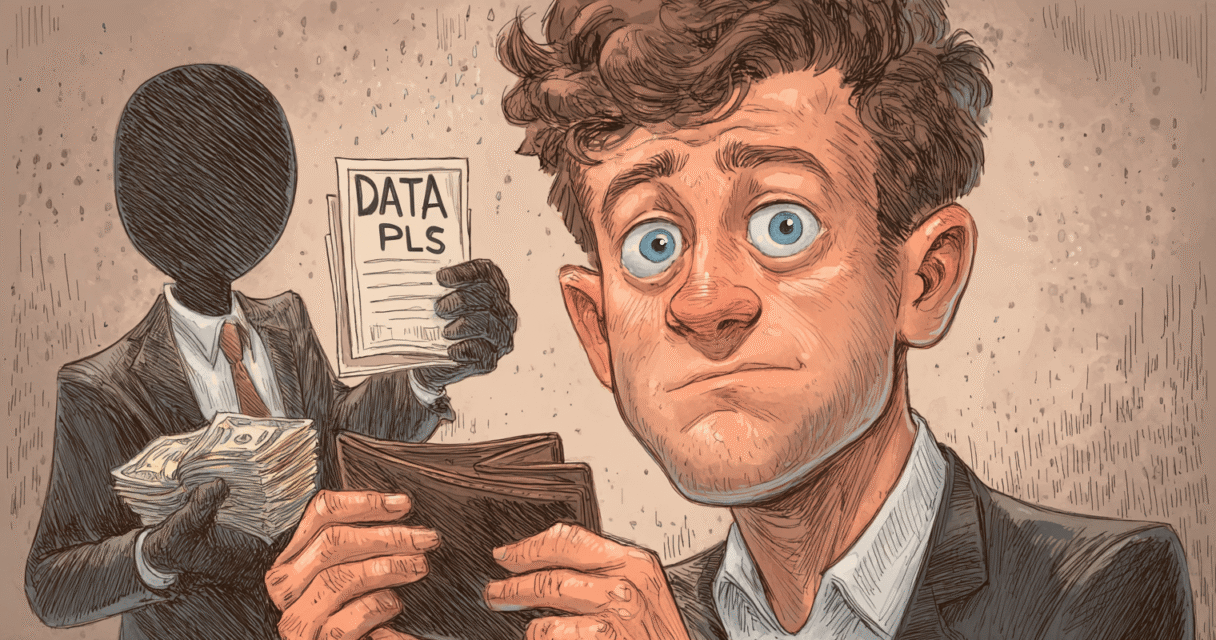
Sitting high on his perch at a fireside chat at Harvard University, OpenAI CEO Sam Altman was clear in his position.
He said that he “hates advertising.”
He referred to it as a “last resort,” turning his nose up at companies like Meta and Google, which built their multitrillion-dollar empires on advertising.
It was an ironic display of virtue signaling…
Especially when considering that Altman once took such a principled stance on OpenAI remaining a non-profit company.
He discarded that quickly, and OpenAI turned into an all-about-profit-company-at-all-costs business model – a decision for which he’s now being sued, by none other than the richest person in the world, Elon Musk, who was co-founder of OpenAI.
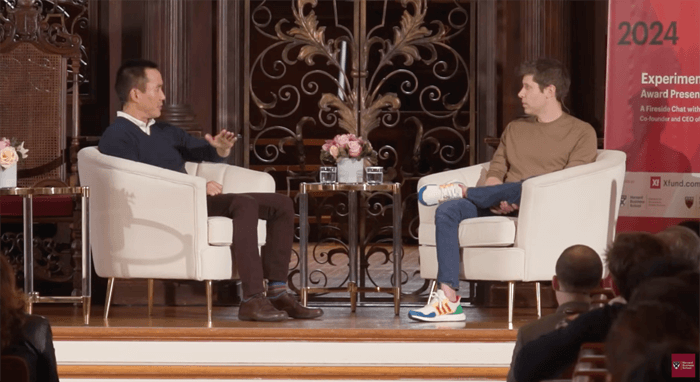
Altman’s Fireside Chat October 2024 | Source: Harvard Business School
But Altman’s anti-advertising stance posed one major problem that OpenAI continues to struggle with…
Given OpenAI’s egregious penchant for spending, profit has been impossible to come by.
Altman and his executive team have committed to spending $1.4 trillion on AI infrastructure buildouts… and it only has a small fraction of that money in hand.
Compounding that problem, the company is burning through about $17 billion a year, just to keep the business running.
Without any clear path to generating free cash flow – and only its $1.4 trillion of commitments in tow – the funding gap is too large to bridge.
And investors are getting skittish.
This is the impetus for an OpenAI IPO later this year.
The company will be able to raise tens of billions of dollars, and just as important, provide liquidity for all those skittish investors.
This matter is deeply concerning to me… as OpenAI will likely conduct its public offering at an absurd valuation, providing extremely profitable liquidity to venture capital and private equity investors at the expense of retail investors, only to see the stock collapse after the IPO.
The details of the IPO are not available yet, but I’ll be watching for this closely.
But the pressure from investors isn’t just about liquidity and an IPO.
They want OpenAI to start making money to reduce the risk of their investment and also help the company look more attractive at the IPO.
So much for hating advertising.
It looks like OpenAI has reached its “last resort.”
This month, OpenAI announced its plans for advertising on its ChatGPT large language model (LLM), which took the world by storm starting in November 2022.
Any users in the U.S. who use the free version of ChatGPT will start to see advertisements, adopting the same model as Google, Meta, and others.
How disappointing. How predictable.
OpenAI is making efforts to position itself in some kind of magnanimous way, to “make powerful AI accessible to everyone,” through its free product and low-cost subscription tier.
It’s referring to ChatGPT Go, which was launched in 171 countries last year, costs $8 a month, and those subscribers will also be pounded with ads, as well.
I don’t like [ads] in general, and I think that ads plus AI is uniquely unsettling to me. When I think of GPT writing me a response, if I had to go figure out exactly how much was who paying here to figure out what I’m being shown, I don’t think I would like that. And as things go on, I think I would like that even less.
– Sam Altman
It reminds me of the tech saying, if the product or service is free (or cheap) to use, that means you are the product.
For the moment, it appears that OpenAI Plus, Pro, Business, and Enterprise customers will remain ad-free. We’ll see how long that lasts.
I remember when the Wall Street Journal migrated to a very expensive annual fee to access its website.
At the time, the advertising model wasn’t working, so the company switched to subscriptions.
The idea was no more advertising, just great content.
What we got was paying hundreds of dollars a year, just to get served even more advertising and lower-quality content.
So many companies have gone down that same route.
Is OpenAI different?
Will they do it the right way?
Will they not sell out?
Here’s how OpenAI is positioning its advertising efforts:
Do you believe Sam Altman and OpenAI?
Do you believe this sworn former-non-profit-turned-for-profit, that it will prioritize acting in our best interests, not the company’s, cross their hearts and hope to die?
I’ll leave that for you to answer for yourself.
But I will say, we learned from real-world experience that Meta, Google, Microsoft, OpenAI, Twitter, Anthropic, and others were actively working with the White House during the pandemic.
This is now not disputed.
The goal was to manipulate the information we were receiving, feeding us lies, and censoring/banning scientists, researchers, and many credible resources that didn’t fit the desired narrative.
Fool me once, shame on you; fool me twice, shame on me.
In the coming weeks, users will start to see the implementation of ads in ChatGPT… in the way shown below…
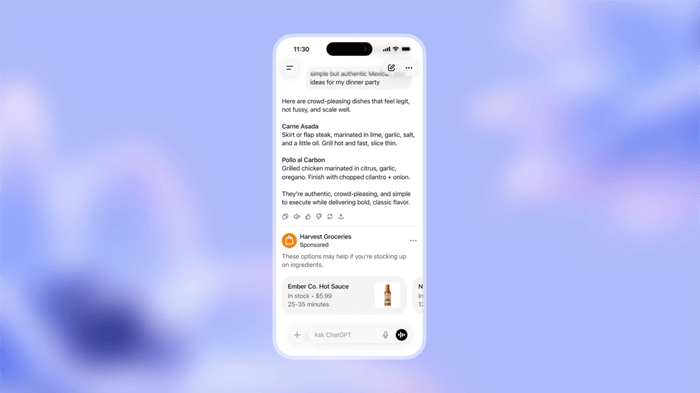
Source: OpenAI
In the example above, the user is asking about ideas for a dinner party.
ChatGPT serves up some food ideas, and then the ad served is for groceries consistent with the dishes recommended.
Just like Google’s search, ads are designed to be contextually relevant to a search query.
Interested in Santa Fe, New Mexico?
Here are some suggestions about where you might stay…
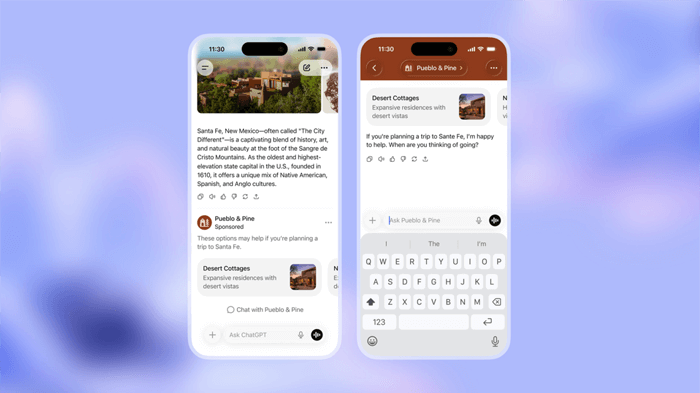
Source: OpenAI
OpenAI is in a tight spot right now.
The reality is that its operational expenditures are out of control.
Its financial commitments are so large, they seem impossible to meet.
Its investors are nervous, and about 90% of its users aren’t paying anything to use its service.
“Mining” its users’ data for the purpose of advertising was inevitable for OpenAI.
And it’s not just ads, OpenAI is also requiring that merchants pay OpenAI a 4% fee on sales made through ChatGPT’s checkout feature.
It is important to note: This 4% is on top of the typical fees that Shopify charges for payment processing. (Note: Last September, OpenAI and Shopify teamed up on an Agentic Commerce Protocol enabling Instant Checkout through ChatGPT.)
This is designed to make ChatGPT’s agentic AI technology appear to be free…
But in reality, be expensive to the consumer (by way of being expensive for the merchant), who will have to bear the fees.
It is also an indication of OpenAI trying to insert itself as a middleman, adding a lot of friction into the transaction just for matchmaking – connecting the buyer and the seller.
It’s too high a rate for such a simple service, but it shows how greedy, or desperate, OpenAI has become.
Agentic AI and generative AI business models haven’t solidified yet.
But these heavy-handed approaches are not for the benefit of humanity – to quote OpenAI’s (the non-profit’s) original 2015 mission.
The cost of compute continues to fall exponentially, which means the cost of delivering these kinds of services is falling, as well.
A small monthly fee while maintaining privacy for users is a far better approach, which will ensure healthy margins for the service provider and provide a valuable service for both the consumer and merchant alike.
But just because that’s the better approach doesn’t mean that’s what will happen.
Get ready to be monetized by OpenAI.
Jeff

Read the latest insights from the world of high technology.
While I maintain that the “AI Fear Trade” is largely overblown, that doesn’t mean there won’t be market shocks...

The more transactions that take place over Meta’s networks, the more money it makes. So why limit that to...

Cortical Labs has been developing a biological computing system based on human brain cells…
Thanks for signing up for The Bleeding Edge — we’re glad you’re here!
Want updates sent straight to your phone too? Sign up for SMS alerts to get the latest delivered via text.
Brownstone Research: By submitting your phone number, you agree to our SMS Terms & Conditions, Terms of Use, & Privacy Policy, and give express written consent to receive marketing text messages from BSR. Messages are recurring & frequency may vary. Reply STOP to 94703 to opt out. Reply HELP to 94703 for info. Consent is not a condition of purchase. Message and data rates may apply. For additional information, you may contact Customer Service at 888-512-0726 or smssupport@brownstoneresearch.com.