


The Burgeoning Space Economy
The Artemis II team has now traveled farther from Earth than any humans in history…


It’s nearly impossible for Wall Street to assess the degree to which AI, more specifically agentic AI, will have on software companies.

On Thursday afternoon, June 17, 2010, a group of investors received an email about an early-stage company raising capital.
There wasn’t much to go on.
The email simply read:
UberCab is “everyone’s private driver. We’re solving the taxi scarcity problem with on-demand private cars via iPhone and SMS.”
After 2 weeks in the app store, their alpha set of 10 drivers is doing 10+ rides on weekend evenings in SF.
That was it.
The smartphone application had only been in the app store for 2 weeks after all.
And there were only 10 drivers providing rides using the platform.
Out of all the investors that received that e-mail, only five of them invested in the seed round. Just five.
And for those who chose not to, they missed out on mind-boggling wealth.
It has become a decision that they’ll regret for the rest of their lives.
The company, of course, was Uber.
It’s not the Uber we know and use today, though.
Back then, it was just an idea – an experiment designed to figure out if an entire industry could be disrupted through the use of technology.
It was a chance to empower a product or service capable of doing something faster, better, and cheaper than anything else that was available at that time.
After all, it was just a few years after Apple released its very first iPhone in 2007, which singlehandedly transformed the mobile phone market.
Apple alone was responsible for the downfall of Nokia, Ericsson, and Motorola’s mobile phone business, as well as Blackberry in its entirety.
Uber’s impact was equally severe on the taxi industry.
By installing a simple-to-use smartphone application, consumers could enter their precise location for pickup and their desired location, all with the tap of a button.
This would then summon their ride and have a driver chauffeur them with virtually no friction at all. Magic.
No need to speak to anyone. Just press a button. There’s an app for that.
Source: New York Times
As we now know, consumers greatly preferred Uber or Lyft rides over yellow taxis.
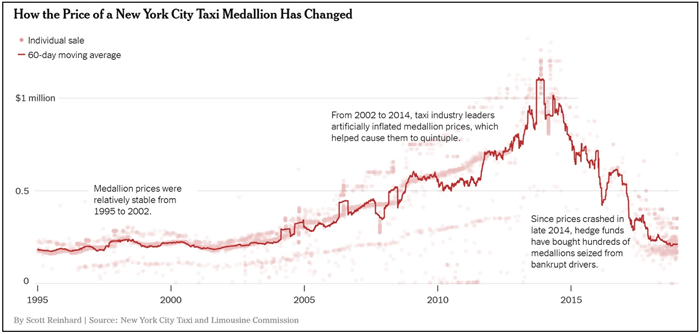
And the easiest way to visualize that is to look at the chart above, which shows the price of a New York City taxi medallion, which is required for a taxi driver to drive a yellow cab.
The price of a medallion peaked above $1 million in 2014, and then it collapsed to as low as $60,000 by 2021, and it is sitting around $90,000 last year.
In hindsight, it’s obvious.
Investing in a taxi medallion after Uber launched its service would have been a horrible idea.
Most didn’t see the disruptive impact of the use of software applications on industry.
But many did.
Perhaps the most classic example is venture capitalist Marc Andreessen, who famously wrote in 2011, “Software is eating the world.”
Fifteen years later, that has certainly proven to be true.
Uber (UBER) is now worth $153 billion, generating more than $10 billion in free cash flow this year and still growing revenue at a double-digit clip every year.
And the next disruption – the largest disruption the world has ever seen – has already begun to turn industries and companies on their heads.
Andreessen and his venture capital firm, a16z, are now saying, “AI will eat application software,” which is a topic that we explored in Tuesday’s Bleeding Edge, about the SaaSpocalypse.
It’s nearly impossible for Wall Street to assess the degree to which AI, more specifically agentic AI, will have on software companies.
So nearly impossible that the simple answer has been to sell off their shares at incredibly cheap valuations. Panic button pressed.
The thinking is that without an accurate assessment of the impact, it’s just better to step aside. And things are moving too fast.
As a result, the companies that make the hardware to enable artificial intelligence are the ones that continue to get all this attention. These are the companies that institutional capital can’t get enough of. Software can’t eat hardware…it needs it to survive.
I first started positioning my subscribers for this trend in artificial intelligence back in early 2016, when I pounded the table recommending NVIDIA.
And my model portfolios continued to increase the concentration over the years to more and more hardware, electrical components, energy production, semiconductors, and data center infrastructure.
Institutional capital finally understands the true value of manufacturing hardware, without which, the software – artificial intelligence – would not be possible.
Travis Kalanick, the founder of Uber, was pushed out of the company he founded in 2017.
The catalyst for the change centered around internal problems at Uber, which resulted in a large investigation of the company.
But the company, while growing like wildfire and incredibly successful, was burning through cash.
In 2016, Uber had a negative $4.5 billion in free cash flow, and in 2017, it was negative $2.2 billion.
Kalanick had been expanding as quickly as possible, as well as spreading the company thin with large expansions into food delivery services, delivery robots, and investing massive sums in developing autonomous driving technology.
So what was it? A software company? A ride-hailing company? A robotics company? An autonomous driving company? A food delivery company?
We can imagine the kinds of discussions that were being had at the board level, and with Uber’s venture capital and private equity investors at the time. “Focus, Kalanick! These objectives are outside Uber’s core business! You’re going to bankrupt the company on these speculative bets!”…
In the end, the board removed Kalanick and inserted Khosrowshahi as CEO, who systematically exited most of Uber’s pursuits, other than ride hailing (which it calls “mobility”) and “delivery” (which is its Uber Eats service).
Kalanick, in his second act, acquired Cloud Kitchens in 2018, which built “ghost kitchens” to make food for companies that serve the food delivery services.
That was just a stepping stone, though…
Last month, Kalanick launched his latest venture, Atoms.
Atoms is essentially an intelligent hardware company.
Its mission is:
Physical autonomation to transform industry and move the world.
This is a symbolic shift for the founder of Uber, who once used software to eat the world.
Now, he plans to use intelligent hardware to transform industry and move the world.
As investors, we should interpret that clearly as, “use intelligent hardware to disrupt industry and eat the incumbent competition’s lunch.”
Source: Atoms
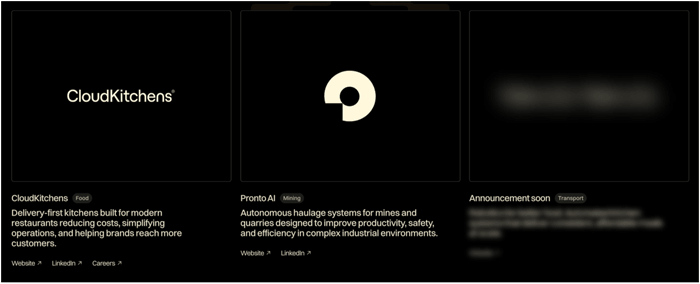
Kalanick rolled his CloudKitchens business into Atoms, which incorporates robotics for food production.
He also added Pronto AI, which uses robotics in the mining industry.
And as shown above, there will be an “Announcement soon” related to “Transport,” that is believed to be some form of autonomous driving technology…
There are rumors that Uber may very well back an Atoms acquisition of an autonomous driving technology. This is not a stretch at all to believe, considering Uber has invested in just about every possible partner in the autonomous driving and electric vehicle space:
A deal with just about everyone other than Tesla, of course.
Some have suggested that Uber’s CEO sees Tesla as a threat with its Robotaxi service, while others believe Uber should cut a deal with Tesla.
They’re missing the point. Musk is the danger. His business strategy is always to radically change the cost structure of delivering a product or service to greatly expand access to that service. Partnering with Uber would only increase prices by 30% by adding the middleman. For Musk, that defeats the point.
Kalanick wants to do the same by focusing Atoms on industrial applications. Pure disruption.
Kalanick was also clear that the goal was not to enter the field of intelligent humanoid robots. That’s a smart move, given the well-established players in that sector, which has already proven to be rife with intense competition right now. He recognizes there is no point trying to tilt against Musk. Lower-hanging fruit is everywhere.
Intelligent robotics, of all shapes and sizes, is one of the greatest investment themes of all time.
And it’s one that will define the next decade and transform our lives.
In this world we find ourselves in right now, it is more important than ever to understand the companies that are being disrupted, just as much as it is to understand those that will become the next NVIDIAs, AMDs, Teslas, or SpaceX.
We may know companies that are fantastic businesses, and we may even love their products and/or services…
But that doesn’t mean they are immune to disruption.
Disruption sneaks up fast. It’s a blunt force object. It hits hard. It is unforgiving.
And the mark it leaves is permanent.
Jeff
P.S. Hi, Jeff’s managing editor here…
As Jeff laid out in today’s daily, AI disruption is really just getting started… and really, even some of our favorite companies aren’t immune.
You could sit back when AI disruption strikes… or you could use the volatility that disruption kicks up to your advantage.
Jeff has a strategy for snapping up quick profits on fast falls in any market. He held a briefing just yesterday afternoon getting into all the details.
You can still catch the replay right here for a little while longer, if you’re interested.

Read the latest insights from the world of high technology.
The Artemis II team has now traveled farther from Earth than any humans in history…

Here at Brownstone, we know how invaluable a strategy that lets us leverage momentum anywhere disruption strikes can be...

Those who played the game paid Niantic to work for them. And none of them were told that Niantic...
Thanks for signing up for The Bleeding Edge — we’re glad you’re here!
Want updates sent straight to your phone too? Sign up for SMS alerts to get the latest delivered via text.
Brownstone Research: By submitting your phone number, you agree to our SMS Terms & Conditions, Terms of Use, & Privacy Policy, and give express written consent to receive marketing text messages from BSR. Messages are recurring & frequency may vary. Reply STOP to 94703 to opt out. Reply HELP to 94703 for info. Consent is not a condition of purchase. Message and data rates may apply. For additional information, you may contact Customer Service at 888-512-0726 or smssupport@brownstoneresearch.com.