


The Maximum Truth-Seeking AI – A Magnitude Smarter
Grok 4.2 has evolved into something so much bigger than what was originally planned…


We’re in for one incredible ride in 2026.

The Solow Paradox was named in 1987.
It describes a techno-economic perplexity that is best summed up by a quote from economist Richard Solow, for whom the paradox was named:
“You can see the computer age everywhere but in the productivity statistics.”
1987 marked my first year at Purdue University, where I studied aeronautical and astronautical engineering.
In hindsight, it was a painful time to be a student, yet I immensely enjoyed those years of learning.
We were still programming in Fortran and Pascal.
I even remember the Purdue computer lab, which still had an old mainframe that required programming cards to be fed to it.
It was very difficult to get run time on the mainframe as well, as it was usually being utilized by graduate student projects.
Single problems in aerodynamics or orbital mechanics could take 20 pages of calculations performed by hand, and we’d have to iterate to get a simple hand-drawn chart with a few data points.
It was painful and tedious.
And desktop computers with a math coprocessor ran $4,000–5,000, putting them way out of reach for most consumers.
The costs per unit of compute for consumers, businesses, and governments were prohibitive.
And it goes without saying that there was a lot of friction in using these devices.
Things didn’t integrate well, user interfaces were complex, bugs were everywhere, hardware was unreliable, and connecting with other devices was often a nightmare.
Costs were high, friction was high, and initially there were little to no productivity increases.
This was the point that Solow was making.
But the productivity boost was coming… it just took time.
In 2017, Erik Brynjolfsson, Daniel Rock, and Chad Syverson published a paper at the National Bureau of Economic Research.
It was titled Artificial Intelligence and the Modern Productivity Paradox: A Clash of Expectations and Statistics.
We can think of it as a modern version of the Solow Paradox – an AI-driven modern productivity paradox.
Their point was simple to understand…
There are lags in productivity during times of technological transitions.
It takes time and money to implement new technologies, so the productivity gains are not immediate.
Workers need to be trained on how to use the technology…
Compute infrastructure needs to be built…
Organizations need to change to adapt to the new technological realities…
And the integration of the technology has to be implemented across an organization.
That means that there is a lot of initial friction in the adoption and implementation of new technologies.
Brynjolfsson et. al. described a J-curve, whereby initial productivity can be flat, or even dip, before an inevitable acceleration.
In 2017, it was still very early days for artificial intelligence. And not surprisingly, what their paper described is exactly what we’ve seen from 2018 through 2023.
And in 2024 and 2025, we witnessed periods of investment in infrastructure with massive capital requirements, along with training, implementation, integration, and a whole lot of experimentation.
This is the period where productivity may have appeared to be flat – the beginning of the J-curve.
This is the backdrop for 2026, as we look ahead into a year that we’re never going to forget.
We will look back at 2026 as a pivotal year in history – the year of artificial general intelligence (AGI).
It’s the year when everything changes.
And I do mean everything.
I’ve been an active investor since I was 16 years old, and a technologist since before that. I have never been more excited about the year ahead than I am right now. It’s not even close.
Disruption and opportunity will be everywhere.
And for those who stay ahead of the curve, the investment potential is extraordinary.
Some of the predictions I make will seem impossible to many. That’s natural. The human brain is programmed to think linearly – not exponentially.
But this year isn’t a year to rely on old muscle memory.
It’s a year that will require us to have an open perspective, a flexible mindset, and be prepared to take action.
To that end, let’s get to my 2026 predictions.
The implications of this are fairly obvious.
There will be economic opportunities everywhere for those willing to pursue them. Economic growth like this will benefit the entire country.
And the U.S. economy will materially outpace any economic growth in other developed markets. It won’t even be close.
The U.S. economy and its stock markets will lead far ahead of anywhere else for three key reasons:
These converging factors will lead to an economic boom larger than anything any of us has seen in our lifetimes, which will extend out for the next several years.
My sincere advice: Let’s make the most of it and enjoy the ride.
This is extremely contrarian.
Most experts are forecasting flat interest rates for the year, or just 25-50 basis points in cuts.
Their argument is simple. They believe that the Fed can’t afford to lower rates much more, or else inflation will come back due to strength in the U.S. economy being driven by the current economic and regulatory policies.
But that perspective is wrong.
And it misses the points that I made about productivity earlier.
There is one thing that can offset the inflationary impacts of lowering interest rates in a strong economy: above-average productivity growth.
And that’s exactly what we’ll see in 2026.
In 2026, the J-curve begins its upward bend. Material increases in productivity allow products and services to be produced and delivered more efficiently.
This shifts the supply curve to the right.
It enables an economy to grow faster even though prices are flat or declining.
AI and automation technology will drive this.
Unit labor costs will decline, which will offset any inflationary pressures.
There will be enough slack in the labor market due to job displacement that wage growth won’t rise much.
In short, growth will appear to decouple from inflation.
The Fed will still act independently, but President Trump will obviously appoint a Fed Chair who understands and agrees with my forecast on tech-enabled productivity growth and the ability to lower interest rates.
Artificial intelligence, automation, and the re-industrialization of the U.S. economy will be the catalysts for this productivity growth.
President Trump knows that interest rates need to come down for three primary reasons:
The reality is that we are going to see a large impact on the U.S. workforce in 2026 due to the adoption of AI.
This will result in a rise in unemployment.
Ironically, it won’t be because there aren’t jobs available. It will be because of either a skills mismatch or job opportunities being in locations where the labor is not.
Higher unemployment will provide cover for lowering interest rates.
And as I mentioned above, lower interest rates will enable people to sell their homes and buy a new one closer to where the jobs are.
Some will certainly choose not to adapt or to move to where the work is. They will be the most impacted.
But for those willing to move, the quality of life and earnings potential will increase.
Lower interest rates will pull at least $1 trillion off the sidelines and put that capital to work in investments and IPOs.
Hundreds of high-quality tech and biotech companies have been private for years and are ready to access the public markets.
Lower interest rates, combined with a strong economic environment, result in great market conditions for IPOs.
This is an environment where private companies can expect to receive higher valuations for their public offerings.
This allows them to raise the capital they need for future growth, while giving up the least amount of equity in doing so (i.e., less dilution for shareholders).
Even more bullish for IPO’s in 2026 is the potential for big names like OpenAI, SpaceX, and Stripe, which all may go public.
Nothing would get the retail markets more excited than names like these. Like rocket fuel for the IPOs…
And after four underwhelming years in the IPO markets, institutional capital is geared up for a big year, as well.
2026 through 2028 will be fantastic years for IPOs and liquidity in the financial markets.
With that as the economic and market backdrop for 2026, we’ll now have a look at sector-specific predictions for the upcoming year.
2025 was the year of agentic AI, as we explored in my end-of-year review yesterday.
2026 will be the year of AGI…
Oddly, most of the industry and the media continue to pretend that xAI doesn’t exist.
Many companies make their benchmark comparisons against Google, OpenAI, Anthropic, and others, while leaving out xAI.
Obviously, doing so won’t make xAI go away.
The industry is in awe and/or trepidation of how much xAI has been able to achieve in such a short period of time.
Its ability to spin up physical data center infrastructure is unparalleled in the industry. And its technological approach to solving for AGI has put xAI on the fastest path to AGI.
Many will still say that xAI hasn’t achieved AGI, despite the reality of what it will have developed this year.
These “experts” will be the ones who consistently predicted that AGI wouldn’t come for many years, as well as the naysayers and decels that we’ve talked about in The Bleeding Edge.
It won’t matter what they spew. They’ll just be talking their own book.
As a result of the breakthroughs in AI in 2026, there are a couple of major implications…
A simple example of Prediction 9 would be to have a conversation with your personalized agent about your upcoming week.
You discuss your meal plans for the days that you’ll be home and the restaurants that you want to eat at. You’ll tell it what appointments and reservations you need scheduled, and that you need a gift sent to a friend and flowers sent to another.
With direction, your agent will take care of it all, including recipes for the week, ordering the food, scheduling delivery at home according to your schedule, and transacting autonomously without the need for prompting.
This year will be the year when the consumer market will truly feel the impacts of autonomous technology.
For those who have a Tesla with full self-driving (FSD), you’ll already know what this means.
Or for those that live in one of the few cities where Waymo’s autonomous ride service or Tesla’s Robotaxi service is operating, this future will already be real.
2026 is the year when the majority of the population wakes up to this transformational technology.
We will literally see and feel millions of “ah-ha” moments as the lights come on all around the country.
We ended 2025 with Tesla having exceeded 7 billion miles driven autonomously using its FSD AI software.
This compares to Waymo’s paltry, but still impressive, 127 million autonomously driven miles.

Source: Tesla
Tesla has already proven that its technology is seven times safer than the average human at driving.
And for anyone who has experienced Tesla’s FSD version 14.2.2, you’ll understand why.
I have to humbly acknowledge that it is far better, more attentive, and skilled than I am as a driver, or anyone else, for that matter.
2026 is going to be the year for autonomy:
This means that tens of millions of Americans will see Robotaxis, Teslas, and Cybercabs driving around on the streets with no one behind the wheel in 2026. Major population centers will see this first, as this will be Tesla’s target for Robotaxis and Cybercabs.
The other way we’ll feel the presence of autonomous technology will be through the employment of humanoid robots.
2025 saw early deployments of humanoid robots in factory settings like Figure AI’s 02 at BMW, or Tesla’s Optimus at its own factories.
Tesla will absorb most of its production for work in its offices and factories, while Figure AI will look to sell into both the industrial and consumer markets.
Apptronik will initially focus on enterprise applications, and 1X Technologies will target the home market with NEO.
Intelligent, general-purpose humanoid robots will become part of everyday life. In 2026, they’ll be most visible in logistics and factory settings, as well as early adoption in consumers’ homes with Figure 03 and NEO.
Imagine, just imagine, what this level of autonomous technology would do for manufacturing costs… and therefore scalability.
The implication is that the cost of manufacturing in a developed market is just as competitive as anywhere else.
The nominal cost of manufacturing becomes a product of the cost of raw materials and the cost of electricity in any given market.
Countries with a low cost of energy will have a competitive advantage, which is precisely why energy policy is so critically important.
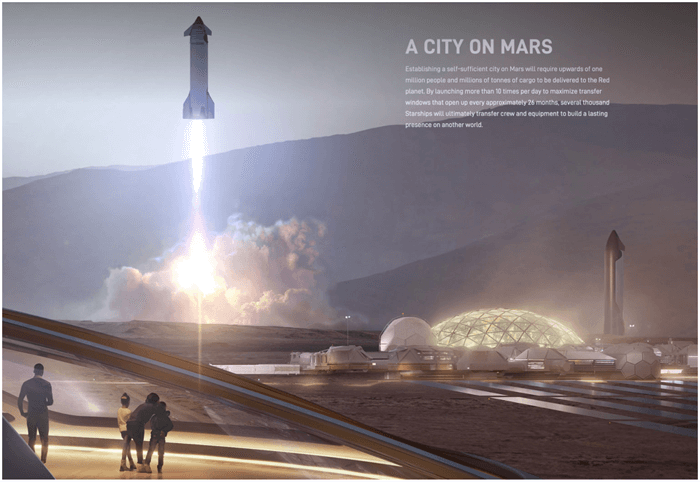
2026 will be the year of the Starship, plain and simple.
Elon Musk and his team at SpaceX worked diligently towards building a highly resilient third generation of Starship, which will see its first launch in the first quarter of this year.
SpaceX will commercialize Starship, resulting in launch costs to low Earth orbit (LEO) to plummet on a per-kilogram basis to levels in the hundreds of dollars by the end of the year.
And it’s so much more exciting than just the commercial aspects:
The accomplishments of a single company will ignite the passions of the next generation of explorers, builders, and engineers, as well as enable a vibrant private space economy.
Source: SpaceX
The improvements made at the policy level under the leadership of Robert F. Kennedy Jr., specifically those centered around evidence-based medicine – and accelerating FDA approvals for safe and efficacious drugs and therapies – will begin to reap major rewards in 2026.
In October 2025, the biotech index XBI broke out of the bear market trading range it’s been trapped in since the collapse in 2022 – and did so with vigor.
It is a tangible and symbolic signal that the biotech winter is definitively over.
The AI-enabled breakthroughs in biotech and life sciences that I’ve been writing about for the last four years are already having a profound impact on the drug discovery and development process.
While it required a lot of patience, we’ve finally entered the beginning of biotech’s golden age, where the costs of discovering, developing, and taking drugs and therapies through clinical trials drop dramatically, and the timelines shorten by years.
Institutional capital now understands this, and with the tailwinds of lower interest rates, the potential investment returns from early-stage biotech investments are too compelling to ignore.
Capital will flood back into early-stage biotech companies with compelling technology and pipelines in 2026, creating a vibrant and liquid market where companies begin to trade at the kinds of valuations that were common in 2020 and 2021.
The latest developments in biotech and life sciences have made me so bullish on the sector that the timing is right for me to relaunch biotech investment research this year.
It has been a frustrating wait, but it was important for me to see the clear signals and economic conditions that will ensure the next biotech bull market before launching my research service.
Finally, the wait is over.
This will be one of my biggest initiatives of 2026.
If I can make one simple, critical point, it’s that the AI infrastructure boom is nowhere near being over.
We are not in a bubble.
The infrastructure buildouts to support AI, AGI, and ultimately ASI will continue.
Another major trend will be in what I refer to as task-specific computing.
What has happened during the last few years is what I think of as brute force computing.
Companies and countries have been throwing massive clusters of GPUs at training and running AI models and applications, aiming to get things done as quickly as possible.
The emphasis hasn’t been on cost as much as it has been on speed at any cost.
The race to AGI is as torrid and frantic as the Manhattan Project was to develop nuclear technology. Whatever it takes.
2026 will bring a lot more sophistication to data center design and computational platforms.
AI workflows will consider which kinds of computational platforms should be used for which tasks. Specific computational platforms are better suited to specific tasks.
Rather than only GPUs, we’ll see AI workflows parsed into GPU workloads, AI-specific semiconductors like Groq or Cerebras for inference workloads, TPUs for inference, quantum computers for extremely complex tasks, and even thermodynamic computing for certain problems.
2026 will also be the year when orbital data centers will become real, rather than symbolic prototypes.
Sun synchronous orbits can take advantage of the limitless free energy provided by the sun and the cooling provided by space.
It won’t be a replacement for what’s happening on Earth, but more of an addition to what’s happening on Earth.
The industry will look for energy wherever it can find it, whether it be natural gas using turbines, from the grid, from new nuclear power plants, or in orbit from the sun.
The most likely candidates for early orbital deployments in 2026 are Google (GOOGL) through its Project Suncatcher, Starcloud (private), and Relativity Space (private – now led by Eric Schmidt).
2025 was a radically transformational year for the digital assets industry.
It went from an industry on the precipice of collapse due to an antagonistic regulatory environment in 2024 to one that has been completely reinvigorated and empowered through regulations in 2025.
The GENIUS Act for stablecoins was passed in July with remarkable speed, laying the foundation for the market structure bill known as the CLARITY Act, which will be passed in 2026.
The GENIUS Act – combined with the CLARITY Act – will open the doors for financial services with clear rules and guidelines for transacting in digital assets.
Stablecoins are the gateway to other digital assets. They also provide instant settlement, and cross-border transactions can be made for a fraction of the cost compared to using traditional payment rails like those provided by SWIFT.
Blockchain technology removes friction, reduces costs, provides for instant (or near instant) settlement, and provides an immutable ledger of every transaction.
And with the regulatory support out of Washington D.C., the world’s largest economy and financial services industry will be free to lean into digital assets in 2026.
The single largest pain point in the U.S. market related to economic growth is energy production.
Countries that have abundant, cheap energy are wealthy… and those that don’t are not.
And the biggest chokepoint to achieving AGI – and ASI for that matter – is energy production.
Naysayers are proclaiming that the AI bubble will end because the U.S. will run out of energy.
That’s nonsense.
Nuclear energy – via both fission and fusion – is the long-term answer to energy production for AI, as well as the sun in orbit.
In the meantime, natural gas production will increase to bridge the gap, and in some cases, even coal will be utilized for a short period of time.
Holtec International will also restart the Palisades nuclear power plant in Michigan next year. Three Mile Island will restart in 2027 with an agreement already in place with Microsoft.
And the Duane Arnold energy plant in Iowa will likely start around the end of 2028 to help meet the voracious energy needs.
2026 will be a pivotal year for nuclear energy as the next generation of nuclear – small modular reactors (SMRs) and fusion – comes out of the laboratory and into reality.
It’s the beginning of what will become a decentralized network of clean, emission-free, cheap, abundant energy capable of driving extraordinary economic growth.
Next year will be one that none of us will forget.
We’ve just arrived at the steep part of the exponential growth curve in artificial intelligence, and very soon, economic growth.
There is the potential to see double-digit economic growth within 24 months, given the current environment and technological breakthroughs.
This is not a year to miss.
Great investment opportunities will be abundant for those knowledgeable about these trends… and bold enough to act.
What’s about to happen in the next three years will not only create opportunities for generational wealth but also for a vastly improved quality of life.
What’s coming will shock our senses. For many, radical change will happen so fast, it will be jarring. For those of us here together at The Bleeding Edge, it will be exhilarating. After all, we already know what’s coming.
We’re in for one incredible ride in 2026.
I want to wish all of you the very best in the New Year, and most importantly, good health and happiness.
We have so much to look forward to,

Read the latest insights from the world of high technology.
Grok 4.2 has evolved into something so much bigger than what was originally planned…

The skeptics and “experts” who said this wasn’t possible will be handed their shorts again.
Pandora’s box has been opened in the last 24 hours, and there is no way to put a lid...
Thanks for signing up for The Bleeding Edge — we’re glad you’re here!
Want updates sent straight to your phone too? Sign up for SMS alerts to get the latest delivered via text.
Brownstone Research: By submitting your phone number, you agree to our SMS Terms & Conditions, Terms of Use, & Privacy Policy, and give express written consent to receive marketing text messages from BSR. Messages are recurring & frequency may vary. Reply STOP to 94703 to opt out. Reply HELP to 94703 for info. Consent is not a condition of purchase. Message and data rates may apply. For additional information, you may contact Customer Service at 888-512-0726 or smssupport@brownstoneresearch.com.