

An Exciting Moment for the Nuclear Fusion Industry
While I maintain that the “AI Fear Trade” is largely overblown, that doesn’t mean there won’t be market shocks...


The most obvious clean energy solution has been in front of us for years.

November 2023 was the bottom for the nuclear power industry.
It was also the peak for anti-nuclear power rhetoric.
That month, Portland, Oregon-based NuScale Power (SMR) announced it was shutting down its efforts to build the first of six small modular reactors – SMRs – out West, as part of its Carbon-Free Power Project.
The Carbon-Free Power Project was an ambitious collaboration between NuScale and the Utah Associated Municipal Power Systems – designed to provide clean, carbon emissions-free electricity to seven Western states in the U.S.
It all appeared to be going extremely well.
More than two dozen utilities had already signed up to buy electricity from the project…
And then it all just fell apart.
NuScale’s original forecast of a $5.3 billion price tag had increased to $9.3 billion.
That was due to onerous nuclear regulations and red tape, rising interest rates, and inflation – all factors that were entirely caused by U.S. government policy at the time.
“They” said they wanted carbon-free clean energy, but the actual policies were not pro-nuclear.
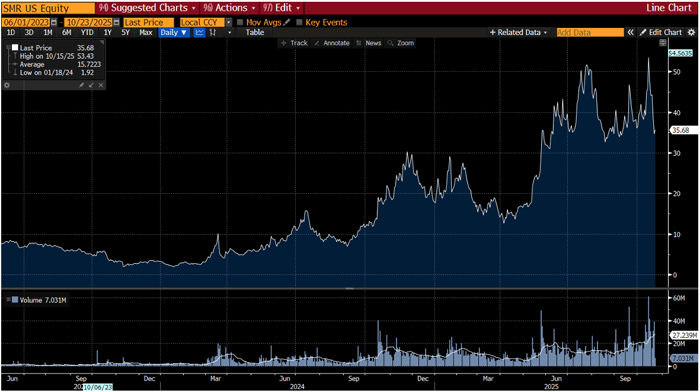
The cancellation of this Carbon-Free Power Project marked the all-time low in NuScale’s stock price.
NuScale (SMR) Stock Chart Since June 2023
It was depressing.
The most obvious clean energy solution has been in front of us for years. Pioneering new companies have been developing the fourth generation of nuclear power, far safer and cleaner than anything used in production today… and yet the government wasn’t interested.
Then, 2024 breathed new life into nuclear energy with the beginning of the explosion in new data center construction to support the AI infrastructure buildout.
And still there was no government support. It was institutional capital that realized nuclear energy was the only long-term answer to supporting the AI infrastructure buildout.
Here’s what I wrote back in June 2024…
And that’s the rub. That’s what almost no one is talking about.
China has a path towards overtaking the U.S. in clean energy production. But more importantly, building the power plants to fuel the development of artificial general intelligence (AGI) and, ultimately, artificial superintelligence (ASI).
The adversary has a stated national plan – that it launched last decade – to become the world’s AI superpower by 2030… That’s just six years away!
And it’s backed by incredible government support. Some $6 billion is being pumped into universities by China’s Ministry of Education to support 400 major new degree programs focused on AI and robotics. Is the U.S. doing that? How about the U.K.?
Again, this has been underway for years. China’s education system has been pumping out AI graduates for years to quickly increase its related workforce… all the while feeding mindless and manipulating content to the Western world using TikTok as a medium for distribution.
Think this is a joke? Think again. This is systemic, centralized planning with one simple goal in mind…
Beat the West in artificial intelligence. At all costs.
And China is providing the industry with the energy and money it needs to get there.
Which is why the U.S. government has just woken up.
It wasn’t until 2025 that the tide shifted completely to a pro-nuclear energy stance with the full support of the White House, the U.S. Department of Defense, and the U.S. Department of Energy.
The inflection point came in May 2025 when President Trump signed Executive Order #14299, “Deploying Advanced Nuclear Reactor Technologies for National Security.”
That’s all it took – a clear, unequivocal pro-nuclear policy stance.
Everything has changed since then.
The directive was clear:
Timed in support of the President’s planned executive order, the Department of Defense (DOD) announced in April a list of eight approved companies selected as candidates to produce nuclear microreactors to support Department of Defense installations in the U.S. and abroad.
It is a unique public/private partnership whereby the DOD, now known as the Department of War, will select technology companies to build and operate microreactors designed to make the U.S. military more resilient… and not at the mercy of utilities or the logistical problems of getting fuel to remote locations.
These microreactors tend to generate 3–5 megawatts (MW) and up to 20 MW of power, enough to support a small town.
This emerging technology is game-changing for remote locations where large amounts of energy are needed to support operations.
The eight companies that were selected are:
As part of this DOD program, BWX Technologies (BWXT) began the construction of a 1.5 MW prototype SMR in Lynchburg, Virginia, this July.
This technology is designed to be a mobile microreactor, something small enough to fit in a shipping container or on a cargo plane.
The plan is on schedule to have this microreactor shipped to the Idaho National Laboratory’s federal lands and begin producing electricity no later than 2028.
Below is a bird’s-eye view of the site being prepared for the arrival of the BWXT microreactor.
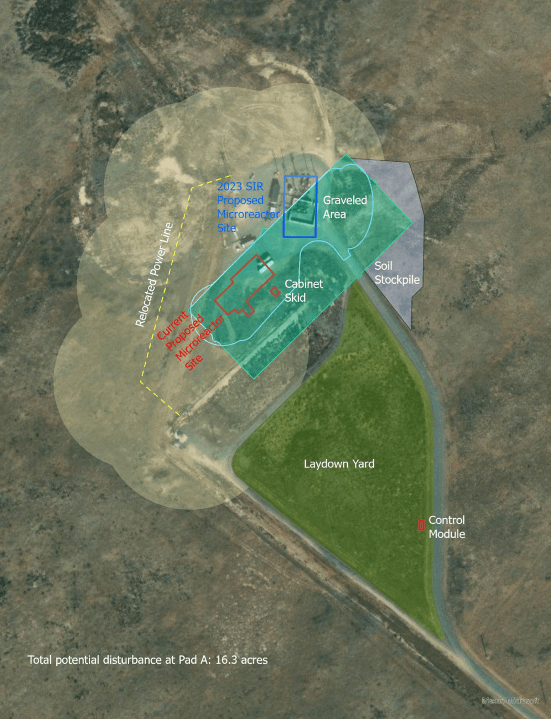
INL Site of BWXT’s Mobile Microreactor | Source: Department of War
But this is just one project…
Just this month, fulfilling the directive given from the executive order, the U.S. Army announced the Janus Program, which has an objective to supply Army bases with these mobile microreactors by 2028.
They will ensure that weapons are powered and military operations have the electricity needed to do their work – free from bad weather, cyberattacks, or a failure from a public power utility.
The speed with which these projects are moving is just incredible.
We’re within 36 months of several new microreactor designs coming online and producing electricity.
And we will absolutely see at least two or three SMR prototypes demonstrating critical mass – the point at which a self-sustaining nuclear reaction can take place – by summer next year.
Oklo and Valar Atomics have already broken ground in Idaho on their prototype reactors.
Moments like this are magical. They are a catalyst for previously pent-up and soon-to-be hyper-accelerated technological development.
The pro-nuclear policy stance, coupled with the clear national security directive for microreactors to support the U.S. military operations, and the nearly limitless energy demand coming from the AI infrastructure buildout, has given institutional capital the confidence to invest heavily in the next generation of nuclear energy companies.
Any great ideas, great projects, and great companies are getting the funding they need to build.
And when the private sector needs (AI infrastructure requirements) intersect with the government needs (microreactors to support the U.S. military), we have the makings for a complete transformation of a sector.
In this case, it’s carbon-free, next-generation energy production.
It’s a green light to innovate and iterate quickly and bring new energy production online in just two or three years, compared to a decade-plus, which used to be the norm.
What’s happening right now is like a Silicon Valley birthing for energy production, which will bring about positive, radical change to an industry that has struggled for decades to get anything done.
Jeff

Read the latest insights from the world of high technology.
While I maintain that the “AI Fear Trade” is largely overblown, that doesn’t mean there won’t be market shocks...

The more transactions that take place over Meta’s networks, the more money it makes. So why limit that to...

Cortical Labs has been developing a biological computing system based on human brain cells…
Thanks for signing up for The Bleeding Edge — we’re glad you’re here!
Want updates sent straight to your phone too? Sign up for SMS alerts to get the latest delivered via text.
Brownstone Research: By submitting your phone number, you agree to our SMS Terms & Conditions, Terms of Use, & Privacy Policy, and give express written consent to receive marketing text messages from BSR. Messages are recurring & frequency may vary. Reply STOP to 94703 to opt out. Reply HELP to 94703 for info. Consent is not a condition of purchase. Message and data rates may apply. For additional information, you may contact Customer Service at 888-512-0726 or smssupport@brownstoneresearch.com.