
An Exciting Moment for the Nuclear Fusion Industry
While I maintain that the “AI Fear Trade” is largely overblown, that doesn’t mean there won’t be market shocks...


When Elon Musk stated he wanted to build his own semiconductor manufacturing plant, many assumed he was just bluffing…
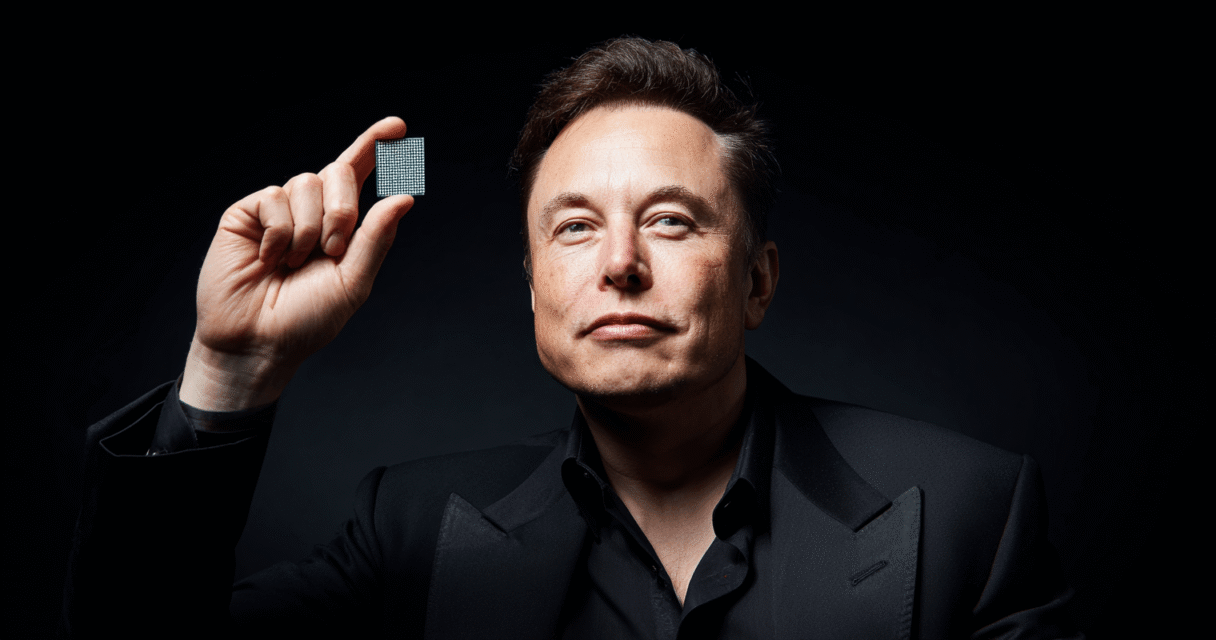
Many thought that Musk’s off-the-hand comments that he wanted to build his own semiconductor manufacturing plant, or “fab”, were pure nonsense.
After all, that’s not how the industry works.
Semiconductor companies that have their own in-house manufacturing make semiconductors – like Intel (INTC), ON Semiconductor (ON), Micron Technology (MU), ST Microelectronics (STM), Infineon (IFNNY), and NXP Semiconductors (NXPI) – are all good examples.
Admittedly, however, not 100% of their chips are made in-house.
Some of their production is outsourced to contract manufacturers like Taiwan Semiconductor Manufacturing (TSM), Samsung Electronics (SSNHZ), GlobalFoundries (GFS), United Microelectronics (UMC), and SMIC.
TSM absolutely dominates the most advanced semiconductor manufacturing process nodes, which arguably make it the single most important company in the world. If China were to take over Taiwan and restrict TSM’s output, it would feel like the world’s electronics manufacturing industry came to a halt.
Apple (APPL), Microsoft (MSFT), Meta (META), Amazon (AMZN), NVIDIA (NVDA), Advanced Microdevices (AMD), Qualcomm (QCOM), Tesla (TSLA), and nearly every fabless semiconductor company that needs advanced semiconductor relies on TSM for production.
And that’s the problem.
TSM controls production for the most important technology companies in the world.
Everyone is on allocation.
And companies like NVIDIA and AMD – which have had multi-decade relationships with TSM – have material competitive advantages, ensuring production capacity compared to other companies.
This has long been Musk’s frustration in dealing with TSM.
Not only is his desired production of semiconductors throttled, but he has almost no leverage to negotiate better pricing.
This was the catalyst for Musk signing a $16.5 billion deal last year with Samsung Electronics to manufacture semiconductors for AI applications at Tesla, specifically for AI data centers, robotics, and autonomous driving applications.
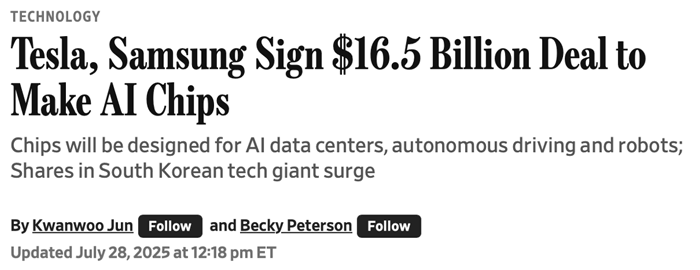
Source: Wall Street Journal
The clever take on Musk’s ruminations about building his own semiconductor fab was that he was just suggesting that in an effort to negotiate better pricing from TSM. I’m actually sure that was true.
But the best business “threats” used in negotiations are ones that are real.
It is so rare for a company to switch away from TSM. It is a painful process and one not without risk.
TSM is unmatched in its manufacturing capacity and quality, and no other semiconductor manufacturer works at the bleeding edge like TSM.
And yet, Musk wasn’t bluffing.
He made the move to Samsung Electronics despite the risks.
Tesla is having its AI5 chip – and eventually its AI6 chip – manufactured by Samsung Electronics. These chips power Tesla’s autonomous driving computer, Optimus robots, and Tesla’s AI data centers.
But it hasn’t been without problems.
And I’m sure TSM told him that they would struggle at Samsung.
Samsung has still been unable to get Tesla’s AI5 chip to volume production, where it should have been months ago.
And perhaps worse, Tesla’s AI6 chip, which is supposed to be manufactured at the 2-nanometer process node, has been delayed at least by six months.
For a builder, problem solver, and innovator like Musk, these problems have been a nightmare.
And it appears they have pushed him over the edge to do something almost unthinkable.
As hard as Musk has tried to find a contract manufacturer to build the advanced semiconductors that he needs for his businesses – at the performance and volume that he needs to scale at – not a single company could meet his requirements.
So he decided to just do it himself, in classic Muskonian style.
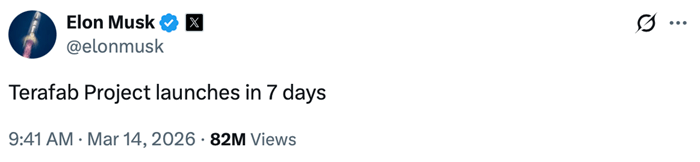
Announced on Saturday, Musk says his TeraFab Project, which is his own semiconductor manufacturing facility, launches in just seven days.
That puts the launch date on March 21. Incredible.
And the fact that he has given a date simply means that this project is well underway, in the same way that the SpaceX acquisition of xAI had been in process for months in advance, as has been SpaceX/xAI’s plan to launch 1 million AI data center satellites into low Earth orbit (LEO).
Critics are already saying that it’s impossible.
Rebuilding a semiconductor manufacturing supply chain will take “a couple of decades.”
Musk says he’ll get it done in one or two years.
Is it possible?
You bet it is.
Just look at what Musk and his team at xAI did with their Colossus AI data centers.
They did the seemingly impossible.
Without any prior experience, they commissioned the largest number of homogeneous GPUs in the shortest period. It wasn’t even close.
xAI went from a nobody in frontier AI models to arguably the leading AI model in a single year.
Musk and his teams rethought everything and optimized in ways that no other company had ever done before.
Yes, semiconductor manufacturing is more complex. But I am confident that Musk and his team at Terafab will find novel ways to optimize its semiconductor manufacturing that even TSM hasn’t thought of.
This is no joke. Musk has access to the capital to make this real.
The goal is to ramp up to 1 million wafer starts a month by 2030 at 2-nanometer process nodes. (A wafer start is simply the initiation of the semiconductor manufacturing process. On each wafer, hundreds or even thousands of semiconductors are etched onto the surface and eventually cut into individual semiconductors.)
This would enable the ability to produce 100 billion-200 billion AI chips a year.
That may seem like an impossible number, but consider this… more than 1 trillion semiconductors were made in 2025.
And we’re at the very beginning of this trend of manifesting AI into physical forms that are useful for us to collaborate with.
Tesla will produce millions of fully autonomous vehicles a year.
It will also produce tens of millions of intelligent Optimus robots in time…
And it will also continue to build massive AI data centers for training advanced AI models.
xAI will naturally do the same and build ever-increasing scale in its own AI factories.
While years away, I can see that it will likely replace NVIDIA chips with its own custom AI chips once it has its Terafab up and running at full production.
And the whole point of the acquisition of xAI by SpaceX is to build out a 1 million AI data center satellite constellation. All of which will be powered by AI semiconductors.
But what no one is talking about is that all of these systems will have redundancy built into them.
Every AI5 or AI6 chip in use has a redundant chip to check and confirm operations.
And if one fails, the other is there for backup.
This is an absolute necessity for autonomous cars/trucks, for Optimus robots, and of course for AI data center satellites.
So TeraFab is happening.
It will be great for certain semiconductor equipment manufacturing and testing companies, and other key companies in the supply chain.
Musk may be manufacturing his own chips, but he’ll rely on the rest of the industry for the supplies to make that happen.
Musk is crossing a line that virtually no one has crossed…
A non-semiconductor company will take on the monumental task of building its own semiconductor plant to secure its own supply of semiconductors.
TSM, Samsung Electronics, and the rest just weren’t fast enough or flexible enough.
Musk and his teams are going to show them how to get it done.
And in a couple years’ time, TSM is going to seriously regret not having tried harder to earn Musk’s business.
Accelerate,
Read the latest insights from the world of high technology.
While I maintain that the “AI Fear Trade” is largely overblown, that doesn’t mean there won’t be market shocks...

The more transactions that take place over Meta’s networks, the more money it makes. So why limit that to...

Cortical Labs has been developing a biological computing system based on human brain cells…
Thanks for signing up for The Bleeding Edge — we’re glad you’re here!
Want updates sent straight to your phone too? Sign up for SMS alerts to get the latest delivered via text.
Brownstone Research: By submitting your phone number, you agree to our SMS Terms & Conditions, Terms of Use, & Privacy Policy, and give express written consent to receive marketing text messages from BSR. Messages are recurring & frequency may vary. Reply STOP to 94703 to opt out. Reply HELP to 94703 for info. Consent is not a condition of purchase. Message and data rates may apply. For additional information, you may contact Customer Service at 888-512-0726 or smssupport@brownstoneresearch.com.