

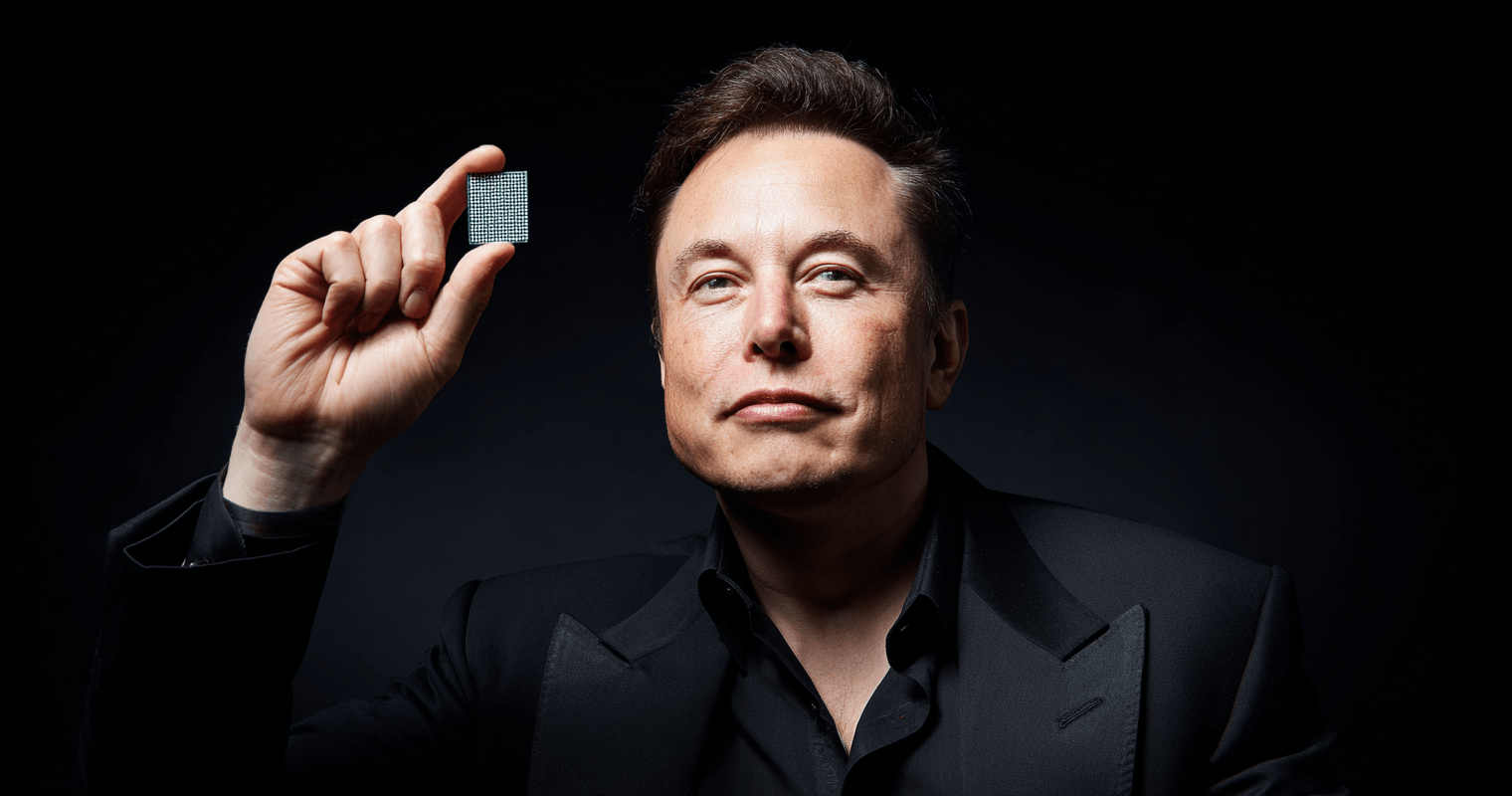
Musk Pulls the Trigger on the TeraFab
When Elon Musk stated he wanted to build his own semiconductor manufacturing plant, many assumed he was just bluffing…


Relativity Space has just proven the skeptics wrong…

Managing Editor’s Note: Before we get into today’s Bleeding Edge, don’t forget to go here to automatically sign up to join Jeff’s event on Thursday.
We are closing in on the next major leap in artificial intelligence… and with it, we’ll see a surge in productivity that’s going to trigger an economic “big bang” on a scale we’ve never seen before.
A new age of AI-powered prosperity is just around the corner. And Jeff’s revealing what this new age will look like and how you can position yourself before it begins.
One of the more ambitious, next-generation aerospace companies of the last decade has been Relativity Space.
It’s a company that many have discounted…
The company’s unorthodox approach to building rockets – namely through the use of additive manufacturing, often referred to as 3D printing – is the subject of great skepticism.
The skepticism was founded on a simple assumption that rockets and rocket engines manufactured using 3D printing wouldn’t be able to withstand the stresses of launching to orbit.
As it turns out, the skeptics were wrong.
On March 22, 2023, Relativity Space successfully launched its Terran 1 rocket into space. 85% of its mass was manufactured using 3D printing, including the rocket engines.
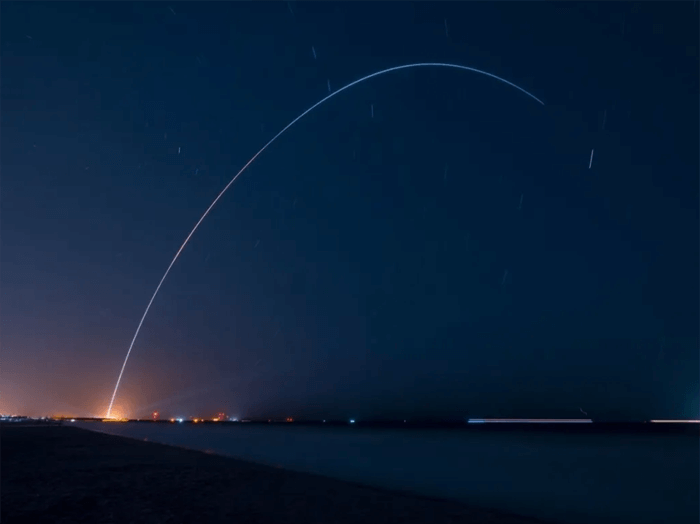
Terran 1 Launch, March 22, 2023 | Source: Relativity Space
It wasn’t a perfect launch, though.
Technically, it got into space by achieving an altitude above the Karman Line.
But it was not successful in achieving low Earth orbit (LEO), due to a failure in the second-stage rockets not producing enough sustained thrust to achieve orbit.
And yet, the launch was still a success.
In addition to reaching space, it also reached “Max Q,” the point of maximum aerodynamic pressure.
This was relevant because it demonstrated that a 3D-printed rocket could, in fact, endure the maximum pressures involved in launching a rocket and its payload into orbit.
Terran 1’s launch was a first for the world.
A few weeks after the Terran 1 launch, Relativity Space made a major – and somewhat surprising – announcement…
It was abandoning the Terran 1 development, which was targeting small payloads to orbit.
Instead, it would focus the company’s entire energy and resources on the Terran R, which is designed for medium-to-heavy payloads to low Earth orbit.
The move was clearly targeting the booming market that SpaceX had been serving, greatly expanding the potential addressable market, under the assumption that Relativity Space could bring Terran R to life.
On the back of the company’s strategic shift, it was able to raise $1.05 billion in November of 2023, at a post-money valuation of $6 billion.
It was on a path toward what many were expecting to be an IPO, once the markets improved.
But towards the end of 2024, Relativity was bleeding cash and struggling to find additional investment, given its struggles to make progress with the larger Terran R.
Then the big surprise came in March of this year…
This spring, former Google Chairman and CEO Eric Schmidt acquired the controlling interest in Relativity Space.
It was a major down round for the company (i.e., a significantly lower valuation than the previous raise).
Schmidt named himself as the CEO of Relativity Space after acquiring the company… and he joined the ranks of billionaires building rocket companies, alongside Jeff Bezos with Blue Origin and, of course, Elon Musk with SpaceX.
Most were wondering why.
Schmidt had never really shown interest in aerospace technology in the past, so why the sudden interest? Kind of makes you wonder what they know…
The clue was embedded in some comments made by Schmidt on April 9, 2025, during U.S. Congressional hearings led by the House Energy and Commerce Committee.
The session was titled, “Converting Energy to Intelligence: The Future of AI Technology, Human Discovery, and American Global Competitiveness.”

U.S. House Energy & Commerce Committee Hearing, April 9, 2025
The key thrust of what Schmidt said during the hearing was about the gap between AI data center energy needs and actual new energy production in the U.S.
He said that we would need to do whatever was necessary to produce more energy, renewable and non-renewable, to meet the needs of AI development.
Hence, his acquisition of Relativity Space…
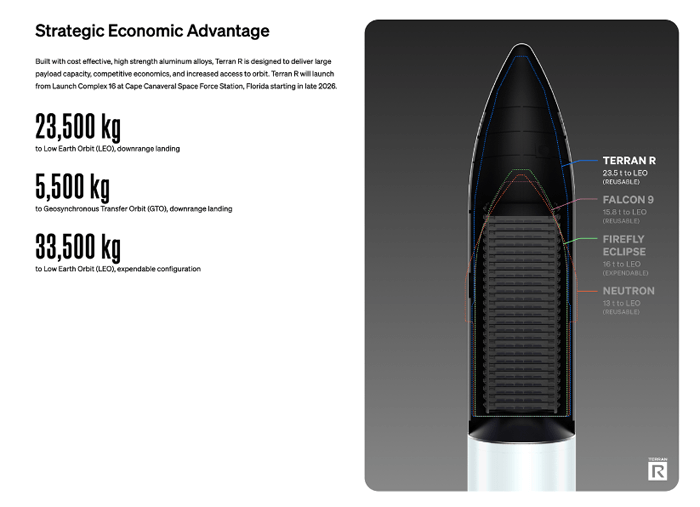
Source: Relativity Space
Terran R is designed to launch 23,500 kilograms (kg) to LEO in reusable configuration, compared to SpaceX’s Falcon 9 – capable of 22,800 kg to LEO.
And if you look closely at the picture above, inside the payload fairing, we’ll see the pallet-sized satellites, stacked one on top of the other for efficient delivery to space – just like SpaceX does for its Starlink satellites.
There are two things in Schmidt’s wheelhouse from his years at Google: advertising and data centers.
And the reason that he acquired Relativity Space is the latter.
Just like Musk with SpaceX, Schmidt wants complete control over the vertical stack of aerospace technology so that he can launch data centers into space.
The goal is to gain access to a whole lot of untapped, free, clean solar energy from space… in a sun-synchronous orbit.
Most have an image of multi-football-field-sized industrial warehouses when we think of AI data centers. It’s not wrong, because that’s what they look like… on Earth.
And that’s impossible to get to space, right?
Wrong.
Just days ago, the small, private company Starcloud made an exciting announcement…
A satellite that it launched in November 2024 – carried on a SpaceX rocket containing an NVIDIA H100 cluster of GPUs – has now trained an AI model and is currently running that model… in space.
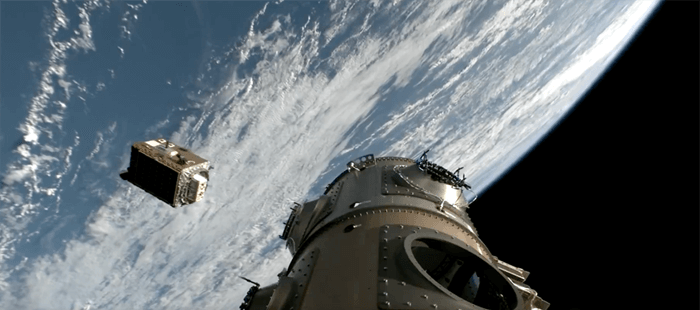
Starcloud’s Data Center Placed into Orbit | Source: SpaceX
This isn’t a gimmick. It is just a proof-of-concept.
In space, data centers – regardless of their shape – don’t require expensive and bulky cooling systems or massive amounts of electricity fed from a nuclear power plant or natural gas turbines.
In a sun-synchronous orbit, there is enough clean, free energy to meet all computational needs.
Starcloud envisions large, self-contained, in-orbit, container-sized data centers to be attached to a massive solar power array, capable of carrying out computational tasks far more efficiently than here on Earth.
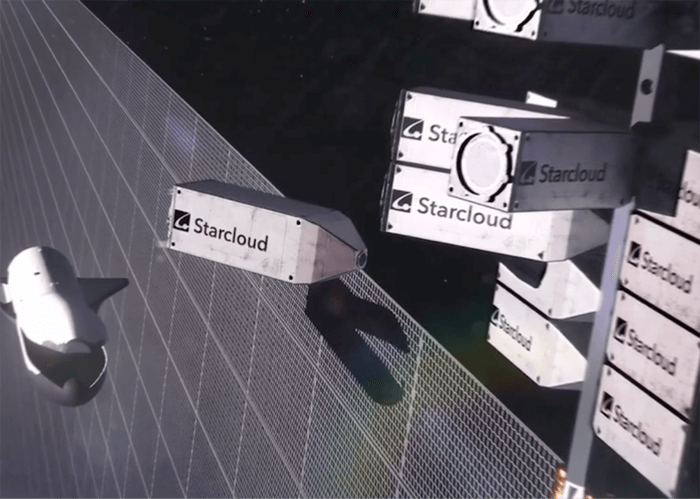
Starcloud Space-Based Data Center Modules | Source: Starcloud
Having raised only $27 million to date, Starcloud doesn’t have the money to make the above image a reality.
But that doesn’t mean its approach isn’t sound…
Schmidt, however, is now worth $35 billion – thanks to Google’s recent runup in share price.
Not only does he have the capital, but he has the street credibility to go out and raise a whole lot more to get it done.
Whether it’s containers like the ones shown above, or pallet-sized satellites that click together like Legos – with solar arrays on one side and computational hardware on the other – AI compute resources are going into orbit.
SpaceX Starship costs to LEO will drop to around $100 per kilogram.
Schmidt clearly thinks that he can make the economics work with Relativity Space’s Terran R.
Schmidt is going to build data centers in space. That’s the point of the acquisition.
And Terran R is currently scheduled for its first flight towards the end of next year, marking a new entrant to low Earth orbit to compete against SpaceX and Blue Origin.
Necessity is the mother of invention…
We have a shortage of energy production on Earth. Space has an abundance of it, and we have the technology to take advantage of it.
Jeff

Read the latest insights from the world of high technology.
When Elon Musk stated he wanted to build his own semiconductor manufacturing plant, many assumed he was just bluffing…

While I maintain that the “AI Fear Trade” is largely overblown, that doesn’t mean there won’t be market shocks...

The more transactions that take place over Meta’s networks, the more money it makes. So why limit that to...
Thanks for signing up for The Bleeding Edge — we’re glad you’re here!
Want updates sent straight to your phone too? Sign up for SMS alerts to get the latest delivered via text.
Brownstone Research: By submitting your phone number, you agree to our SMS Terms & Conditions, Terms of Use, & Privacy Policy, and give express written consent to receive marketing text messages from BSR. Messages are recurring & frequency may vary. Reply STOP to 94703 to opt out. Reply HELP to 94703 for info. Consent is not a condition of purchase. Message and data rates may apply. For additional information, you may contact Customer Service at 888-512-0726 or smssupport@brownstoneresearch.com.