


The Burgeoning Space Economy
The Artemis II team has now traveled farther from Earth than any humans in history…


NVIDIA’s new licensing deal with Groq may not be a formal acquisition, but in terms of antitrust regulations, it certainly is shady…

Managing Editor’s Note: Happy Holidays to all from the Brownstone Research team!
We hope you’ve had fun reading through Optimus’ adventures over the past few days. We certainly enjoyed handing things over to Grok for a little Christmas fun.
For those who want to revisit, we have the full poem right here. Put all together, it paints an incredible picture of topics we’ve covered in 2025, as well as a thrilling peek into what we’re expecting in the near future…
‘Twas [the night] before Christmas, when all through the house
Not a creature was stirring, not even a mouse.
The stockings were hung by the chimney with care,
In hopes that St. Nicholas soon would be there.But Optimus beat him – silent, precise, and neat –
He poured the hot cocoa and adjusted the heat.
Then dimmed all the lights, and with a smile on his face,
Said, “It’s time to dream big. Let’s go back to space.”The children were nestled all snug in their beds,
While visions of sugar plums danced in their heads.
Mama in her kerchief and I in my cap
Had just settled down for a long winter’s nap,When Optimus rolled in with a glow, soft and blue,
Refilled the uranium racks and said, “SMRs for you.”
“The future’s atomic,” he said with great cheer,
“Enough clean terawatts to train Grok for a year.”Then out on the lawn, there arose such a clatter,
I sprang from my bed to see what was the matter.
Away to the window I flew like a flash,
Tore open the shutters and threw up the sash.What appeared but a sleigh made of carbon and glass,
Pulled by eight Optimus bots moving scary-fast.
At the helm sat a driver with eyes sharp and bright—
“Blackwell clusters just dropped. Merry Christmas. Good night.More rapid than Raptors, his coursers they came,
He whistled and shouted and called them by name:
“Now Grok! Now Dojo! Now Colossus, let’s go!
We’re hitting AGI before spring, don’t you know?”Then up to the housetop, the Starship they flew,
With a sleigh full of GPUs – and St. Elon too.
With a smile, Optimus whispered, in the visor’s soft glow…
“Spring 2026. xAI. Told you so.”He sprang to his booster, to his team gave a whistle,
And away they all rocketed like the down of a thistle.
But I heard him exclaim, ’ere he blasted from sight—
“Merry Christmas to all, and to all a good flight!”
Again, we wish everyone a very happy holiday season. Now, on to this week’s AMA…
I hope that everyone had a wonderful Christmas holiday this week. I definitely enjoyed mine after this year’s torrid schedule. The fire has been roaring in my fireplace the entire week.
I have to say, I expected a sleepy week in the world of high tech, but that certainly wasn’t the case after seeing this headline:
NVIDIA buying AI chip startup Groq’s assets for about $20 billion in its largest deal on record.
Groq is a 10-year-old startup that manufactures semiconductors specifically designed for inference. They are easily one of the hottest AI-specific semiconductors and a company that represents one of the strongest challengers to NVIDIA in inference.
The company was valued at just $30 million in 2016 and was last valued at $6.9 billion this September before the $20 billion deal with NVIDIA.
This deal should not pass antitrust regulations. NVIDIA dominates the industry and has a near monopoly on AI semiconductors (GPUs) used for training. It’s worth $4.5 trillion. It should not be allowed to buy out one of its most promising competitors.
But wait! “It’s not a buyout!” Someone cried…
The deal is being positioned by both parties as a “non-exclusive licensing agreement with NVIDIA for Groq’s inference technology.” Another one…
Part of the deal is that Groq’s CEO and other senior leaders will join NVIDIA to manage the assets that NVIDIA acquired, leaving behind a shell of an “independent company” to carry on primarily managing Groq Cloud services.
NVIDIA’s CEO was careful to clarify that, “While we are adding talented employees to our ranks and licensing Groq’s IP, we are not acquiring Groq as a company.”
This is yet another example of a massive incumbent, basically a monopoly in this case, structuring a deal in a way to avoid antitrust issues. This is the latest in a string of shady efforts by massive tech companies to structure deals in this way. And it is no coincidence that it was announced on Christmas Eve when most people weren’t looking.
As much as I believe in free markets, I am not a fan of these kinds of deals. They are a clear antitrust violation as they eliminate the company as a competitive threat, and they typically screw most investors who gave the “acquired” company the capital to build something great.
NVIDIA already has products capable of inference. It doesn’t need to acquire its competition. It can compete on its own, and it certainly has the capital to invest and design even more competitive products.
I will say this, though, if NVIDIA gets away with this shady deal, it is bullish for NVIDIA. Groq has developed incredible technology for inference, which we now know is worth at least $20 billion.
See you all in the new year,
Jeff
Hey Jeff,
I know you just touched on this in a recent Bleeding Edge when talking about beaming electricity from space or sending AI data centers into space. I have just read this article. I wonder if this changes the game?
I know this topic hits right in your wheelhouse, and I know you will have something to say about it.
– Daniel K.
Hi Daniel,
I believe one of the links you provided is for an article that refers to some research presented by a team at the Nanyang Technological University of Singapore, which proposes “carbon-neutral data centers in space.”
The title is actually silly and not representative of what the team is proposing. Which is a shame, because the actual substance of the research is relevant, interesting, and uses the realities of Singapore as an example for the economics of space-based data centers.
The idea isn’t anything new, of course. Just use the unlimited free energy from the sun and the free cooling from space to power and manage heat from data centers.
The realities of Singapore-based data centers are what make this an interesting economic example. Today, data centers already use up 7% of national electricity use. By 2030, that number is expected to reach 12%. This is a huge issue as Singapore is a small island country with very limited natural resources and space. I’ve been there more than 100 times.
And it is very expensive as a result. The expense of real estate and electricity makes Singapore the second-most costly in the world for data center infrastructure. And that’s not to mention the significant limitations on the ability to get power distribution to new facilities, and the hard limitations on expanding any data center facilities to a larger scale.
It makes perfect sense for a nation-state like that to consider orbital data centers to solve these problems. Not only are they economically viable, but they also address the hard constraints that are economically unattractive to solve.
There are many places like that where land is expensive, and electricity cost is exorbitant. These locations are clearly early potential adopters of orbital data center services. There will soon be a market for that…
And as to the other related development that you were referencing, I believe it was Star Catcher, which bills itself as “The Space Energy Company.”
Before we dive in, we should keep in mind that Star Catcher is a very small, early-stage private company that only raised its seed round in 2024 – just $12.25 million.
The company is developing optical power beaming technology that it hopes to use in powering satellites and/or data centers in orbit. As of today, it has only tested an early version of this technology – and only on Earth – and hopes to demonstrate a prototype in orbit sometime in 2026.
From what I see, it doesn’t have the capital to do so right now, and it would need to raise a lot more money in the coming months to support in-orbit operations.
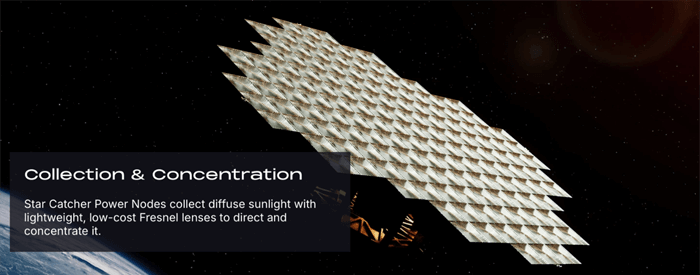
The idea is pretty simple… capture sunlight in orbit using low-cost Fresnel lenses, concentrate the solar power, and then beam it to other satellites that need it.
Source: Star Catcher
It’s important to note that Star Catcher isn’t developing technology for the purpose of beaming electricity from space to Earth. The plan is to capture free solar energy in orbit, concentrate it, and then beam it to satellites, space stations, or orbital data centers.
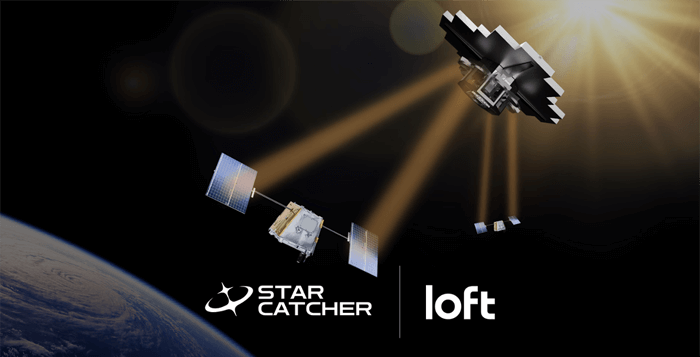
This November, it announced a power purchasing agreement with Loft Orbital to supply power to Loft’s orbital missions. But again, power purchase agreements (PPAs) are often signed years in advance and don’t mean much. Star Catcher doesn’t have any energy infrastructure in space to fulfill the agreement anytime soon.
Source: Star Catcher
The idea does make sense, though. Assuming that there was an abundance of energy-producing infrastructure in orbit, it would lessen the solar panel requirements of satellites, space stations, and data centers. That means lower weight and cheaper to launch. It would be like having a power utility in space.
But the reality is that this will take years to develop, and major players won’t be relying on this in their own business plans anytime soon. Google with its Project Suncatcher, Relativity Space owned by Eric Schmidt, SpaceX/Starlink, and many other smaller initiatives are all designing for their own power generation.
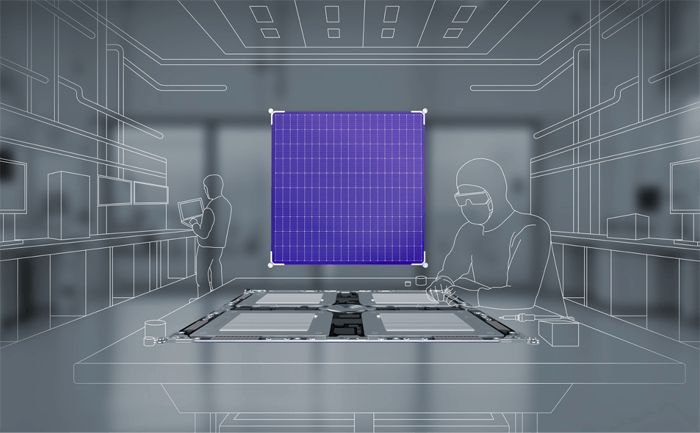
Sophia Space, for example, is building its own tile edge servers. These are 1-square-meter titles that interlink with one another. On one side of the title is a solar array, and on the other side are the computational resources.
Source: Sophia Space
So, Sun Catcher’s approach is supportive of the space economy at large, assuming it is successful in building energy-producing infrastructure in space. One thing is for sure: this will require billions of investment to build solar concentration and beaming infrastructure in orbit. SpaceX has the resources for something like that. At the moment, Sun Catcher does not.
If we step back and consider the bigger picture, these are clearly signposts that are symbolic of a vibrant future space economy. One that has commercial space stations, commercial flights to space, space-based power plants, space-based internet infrastructure, space-based defense systems, and even extraterrestrial mining and exploration.
2026 is the year of our space future. SpaceX’s Starship will collapse launch costs to just hundreds of dollars per kilogram to low Earth orbit (LEO), which makes the economics of our vibrant commercial space economy possible – in the very near future, in fact.
Hi Jeff and team,
Thanks so much for all your efforts to keep us informed on the latest technologies and their application. The pace of innovation never slows.
With new initiatives such as Project Suncatcher, our dependence on a “cooperative” sun only increases. Has there been any consideration given about potential coronal mass ejections (CMEs) that could seriously damage such data centers in space, along with communications satellites and our global electrical grid?
Please share any insight you may have on defenses that clever technologists have devised to mitigate the effects of another Carrington Event.
Modern satellites are designed with somewhat protective shutdown capabilities, but have there been any serious thoughts about how to protect our electrical grid with, for example, Faraday cages around substations or ground shunt bars for transmission lines during such CMEs?
Thank you, and keep up the great work.
– Bruce F.
Hi Bruce,
Fantastic question, as it speaks to the engineering and operational realities of managing various kinds of electrically powered infrastructure in space.
The short answer to your question is yes, there has been a lot of thought and planning to deal with coronal mass ejections (CMEs) and their impact on satellites, space stations, and data centers in orbit. However, there is no simple solution.
And for everyone’s benefit, the Carrington Event is a reference to a massive CME that happened in 1859, which was observed by British astronomer Richard Carrington.
There are a few things that can and are being done in space to mitigate against CMEs:
And it’s also worth mentioning that if it makes sense economically, if components get damaged, it is possible to provide in-orbit repairs. It is not very common today, but it will become very common within the next few years, given the advancements in AI and robotics.
As for ground-based power infrastructure, the solutions are different. While technically it would work, it isn’t economically feasible to build Faraday cages around power plants or substations. Only critical devices would have that level of protection.
Far more common is to install large capacitor banks to absorb and dissipate large energy surges at power stations. Obviously, critical infrastructure is where specialized shielding is most common, but in most cases, the defense comes in the form of capacitors. And transmission lines most commonly use ground shunt bars to divert large surges from a CME.
The reality is that the entire U.S. power grid – and that of most developed countries – needs to be upgraded… not only for better protection against CMEs, but also to support the inevitable increase in electricity demand due to the rapid electrification of products we use daily.
I first had conversations about how we defend against AI-generated attacks with a friend of mine back in 2023. While you note that it is not a “sodden battlefield”, it is still a battlefield. And if you think this was bad, wait until the malicious actors start using quantum computing against the current technology, followed by quantum attacks on quantum computers. It really is an “arms race.”
They build attacks, we build defenses. The issue at the end of the day is that the defenders have to defend the entire system (entry points, network devices, endpoint computers, etc.). Attackers need only to find one exploitable weakness. And this group of attackers found a big one.
– Dave A.
Hi Dave,
Thanks for writing in. Your concerns are absolutely valid. In fact, you have just summed up the entire cybersecurity industry of the last three decades. The points you raise are just as relevant to information technology, regardless of whether quantum computers are widely available.
For context for readers who might have missed it, Dave is responding to a recent issue, The Bleeding Edge – An Agentic Attack. I explained the details of what may well be the first large-scale agentic cyberattack perpetrated against leading AI company Anthropic…
Its software – Claude Code – was infiltrated by an agentic AI empowered by a Chinese state-sponsored group they called GTG-1002.
The group actually used the software itself to target high-level entities – large tech companies, financial institutions, chemical manufacturing companies, and government agencies – that were also using Anthropic’s Claude Code.
Anthropic described the cyberattack as “a highly sophisticated cyber espionage operation.” Most shocking was that the invasion was performed with minimal human intervention… and was instead carried out almost exclusively using agentic AI – an advanced type of artificial intelligence that we’ve written about extensively in The Bleeding Edge, and also in depth in our digital assets research service Permissionless Investor.
It’s an artificial intelligence with agency that has been empowered to carry out a human-designated task with little to no human oversight.
This particular tool has immeasurable potential in terms of productivity and advancement… it also has tremendous capacity to do harm when directed by malicious hands.
It was also, unfortunately, inevitable that this would happen.
Something important to bear in mind, however, is that as ill-intentioned agentic AI grow more advanced, and AI-powered cyberattacks become more elaborate… so does AI-powered defense and cybersecurity.
This is the never-ending IT battle between good actors and bad actors that I referred to at the start. If there were a perfect cybersecurity system that had no risk at all of a cyberattack, it would be a system that would be completely unusable.
Cybersecurity technology is as much about process and reducing risk as it is about fighting bad actors using the same technology for malicious purposes.
To your point about quantum computers getting the same treatment, that is also a concern that’s been raised a few times before in The Bleeding Edge.
Weeks ago, I highlighted the technology in the Brownstone Quantum Week, which actually turned into a week and a half due to everything that has been happening with quantum computing. I spent that time diving into the world of computing – present and future…
I also more recently dove into the quantum threat these advanced computer systems pose to our current encryption technology…
Quantum computing represents an unprecedented threat to the encryption systems that safeguard nearly all digital information and infrastructure today.
Most of our data privacy and security – whether online banking, confidential emails, financial markets, healthcare, or national defense – relies on public-key cryptography protocols.
These protocols are considered secure because, for classical computers, breaking their security would take millions of years using classical computing systems.
However, quantum computers operate fundamentally differently from classical ones. Using quantum superposition and entanglement, they can run special algorithms to factor very large numbers or solve discrete logarithms exponentially faster.
In practice, an advanced quantum computer could potentially crack the encryption security that currently protects nearly all digital information in just hours or maybe even minutes.
Certainly, we have a ways to go to ensure we’re protected as quantum technology continues to progress. If you caught some of our Quantum Week issues – namely, The Internet Urgently Needs an Upgrade – you’ll already know just how quickly it is progressing.
Fortunately, the groundwork is being laid for that, as I discussed at length in that issue…
The most urgent task right now is to accelerate the adoption of post-quantum cryptography – the next generation of encryption protocols designed to withstand quantum attacks […]
Over the next few years, every layer of global digital infrastructure – from cloud platforms and data centers to network routers and even semiconductors – will need to transition to quantum-safe encryption. This migration will be one of the largest technological undertakings since the birth of the internet itself, and it has already begun.
Yet the rollout of quantum-resistant encryption alone will not be enough.
As cryptographic research continues to evolve, no single algorithm can be guaranteed to remain unbreakable indefinitely. That’s why the next great cybersecurity priority is what’s called “crypto-agility.” It refers to the ability for systems to rapidly upgrade or replace encryption modules as new threats emerge.
To become crypto-agile, organizations must map their cryptographic dependencies and design modular frameworks that allow for quick algorithm replacement. This agility will be the defining trait of secure systems in the quantum era, and it’s critical to ensure that an organization’s defenses can evolve as fast as the attacks against it.
Crypto-agility will be absolutely essential to protect against quantum attacks. And there are technology firms and governments that are working tirelessly to ensure those protections are in place before these attacks come.
I wish there were a simple answer to the complex issue that you raise, but there isn’t. Our reality is that, regardless of the technology that is developed, bad actors or bad governments will try to use good technology for bad purposes. And the good actors will need to continue to work tirelessly to reduce the attack surface and reduce risk from those attacks.
Whether it is biotechnology, quantum computing, artificial intelligence, robotics, or autonomous technology, there will be those who use these incredible technologies for malicious intent.
And that’s why it is so critical that the good actors stay on the bleeding edge of technological development.
The more advanced the technology, the better the defensive capabilities.
Happy Holidays,
Jeff

Read the latest insights from the world of high technology.
The Artemis II team has now traveled farther from Earth than any humans in history…

Here at Brownstone, we know how invaluable a strategy that lets us leverage momentum anywhere disruption strikes can be...
Those who played the game paid Niantic to work for them. And none of them were told that Niantic...
Thanks for signing up for The Bleeding Edge — we’re glad you’re here!
Want updates sent straight to your phone too? Sign up for SMS alerts to get the latest delivered via text.
Brownstone Research: By submitting your phone number, you agree to our SMS Terms & Conditions, Terms of Use, & Privacy Policy, and give express written consent to receive marketing text messages from BSR. Messages are recurring & frequency may vary. Reply STOP to 94703 to opt out. Reply HELP to 94703 for info. Consent is not a condition of purchase. Message and data rates may apply. For additional information, you may contact Customer Service at 888-512-0726 or smssupport@brownstoneresearch.com.