



The Largest Merger in History
Tesla and SpaceX have now formed special committees to evaluate a potential merger between these two Elon Musk-led powerhouses.



NVIDIA announced it is acquiring Hugging Face for $12.9 billion... and its interest in owning the platform is obvious.

It was another massive week in high tech…
NVIDIA announced it is acquiring Hugging Face for $12.9 billion, OpenAI released GPT-6 – which it is calling a “generational leap” into an “AGI era” – Apple put John Ternus into the CEO role, and Tesla has officially released Cybercabs into the streets of Austin for autonomous ride-hailing services available to all.
I’ll plan on spending some more time on these topics next week in The Bleeding Edge.
As for NVIDIA, if it can pass antitrust, this is a massive deal for Hugging Face. Hugging Face – a private company that has been around for the last decade – was last valued publicly at $4.5 billion in a 2023 venture capital round.
Hugging Face is an artificial intelligence and machine learning platform for open-source models. It has become the primary distribution hub and repository for more than 3 million open-weight models (yes, there are already that many) and is used by more than 18 million software developers.
As a refresher, open-weight models allow access to the weights of an AI model. This allows the user to customize the model for their particular application, without having to train a model from scratch. They are more transparent than, say, a closed-model AI, but not as much as completely open-source models. That’s because open-source models give you access to the full source code and training data. They offer the utmost transparency and customization.
This acquisition is reminiscent of Microsoft’s 2018 acquisition of GitHub for $7.5 billion. If there are any antitrust concerns over NVIDIA’s acquisition of Hugging Face, I’m confident its lawyers will use the Microsoft acquisition as a reference.
NVIDIA’s interest in owning the platform is obvious.
NVIDIA benefits from a vibrant open-source community in AI, and Hugging Face is one of the best resources available to that community. And controlling Hugging Face gives it the ability to influence the community to build on NVIDIA’s software tools and GPUs.
There will definitely be regulatory scrutiny given that NVIDIA is the most valuable company on the planet and dominant in its sector (i.e., GPUs), but Hugging Face isn’t AMD (AMD).
If Microsoft can buy GitHub without any issues, and there are other competitive alternatives in the industry available to all (GitHub, GitLab, etc.), and NVIDIA doesn’t force anyone to use its technology (it won’t), then there is no reason the deal shouldn’t go through.
Have a great weekend,
Jeff
Hi Jeff and team, I have two questions… I am Canadian, and I see that your app is not available to me. When will that be sorted out?
My second question has to do with a news item on our CBC network about a Canadian AI company called Xanadu. I have not heard or found anything about this company’s potential. Would you have any insight? I also see that BlackBerry has been making some waves in the markets, and its stock has come alive. Thank you for your advice.
– George S.
Hello George,
Thanks for writing in and bringing this issue up about the Brownstone Research app in Canada.
We worked very hard to build the smartphone app with great functionality and design, and we want you – and all Canadians – to have access to it.
We are aware of the issue with regard to the iPhone app availability outside the U.S. In Canada, there are some unique configurations required to make it available. We’re aware of this and are working to get this done as quickly as we can.
For the benefit of everyone else, the Android OS app is available worldwide. It’s very important to have the smartphone Brownstone Research app because we have built messaging natively into the app.
Now, whenever we publish an alert, buy/sell recommendation, etc., our subscribers are alerted immediately on their phone. That way, if you miss an email, no problem. We’ll always be able to alert you directly on your phone if you have the Brownstone Research app.
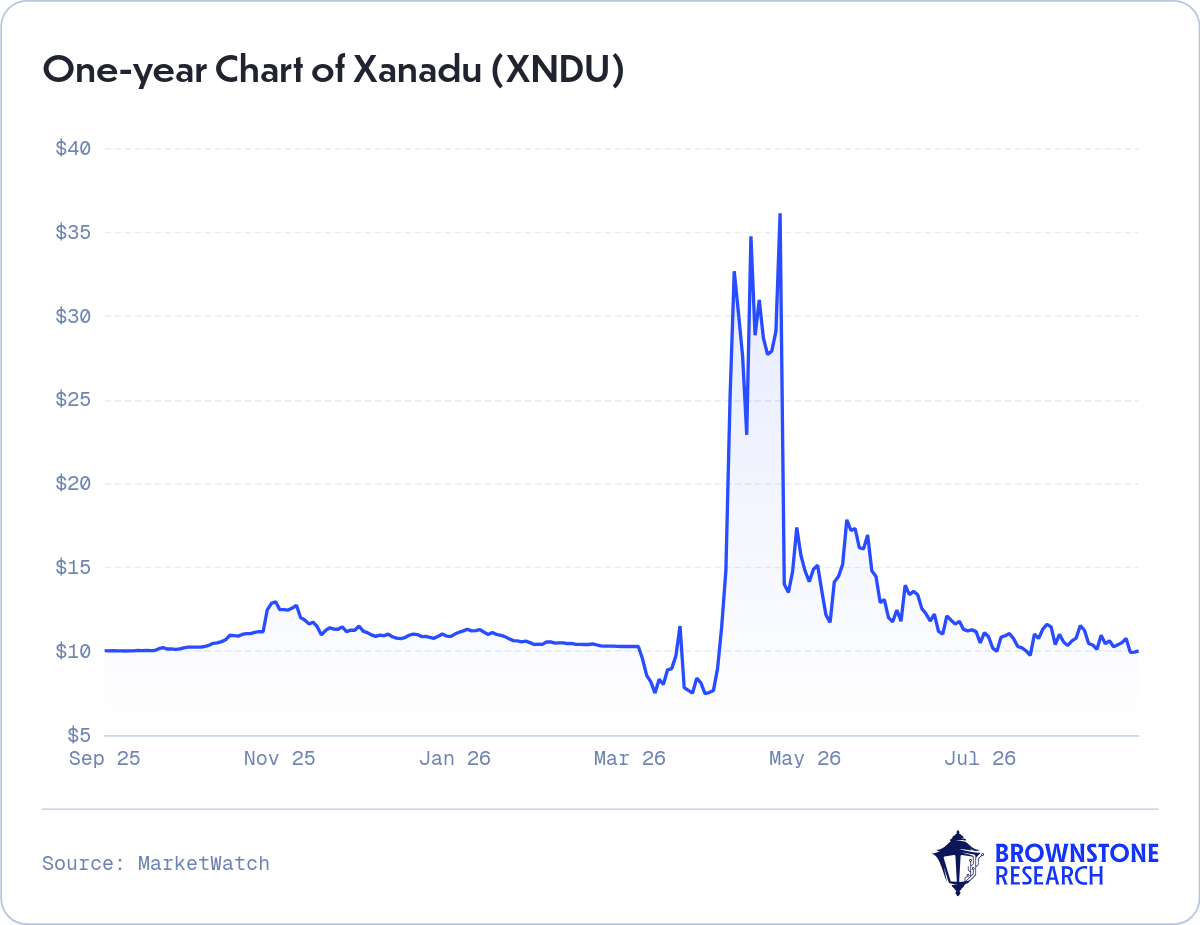
As for Xanadu (XNDU), a Toronto-based company, it has been around for about a decade as a venture capital-backed tech company. It recently went public via a reverse merger with a SPAC this March.
Almost all SPACs trade at $10 a share up until the reverse merger with a target company, and then the stock begins to trade based on the company that the SPAC merged with. That’s why the chart below looks the way that it does.
Xanadu isn’t an artificial intelligence company; it is a quantum computing company. Its focus is on building photonics-based quantum computing systems.
The last time I wrote about Xanadu was in The Bleeding Edge – The Answer to “What’s Next” in Computing.
There are five major camps of quantum computing. These are technological approaches to building quantum computers (not in any particular order):
The race for a universal fault-tolerant computer is as much of a race that pits technological approaches against each other as it is companies racing to win. Some approaches have different advantages, and all of them have the potential to succeed.
In time, however, economics and performance will determine the winners.
The photonics camp claims the advantages of being able to operate at room temperature, operate at the highest gate speeds, and have high fidelity close to the trapped ion approach.
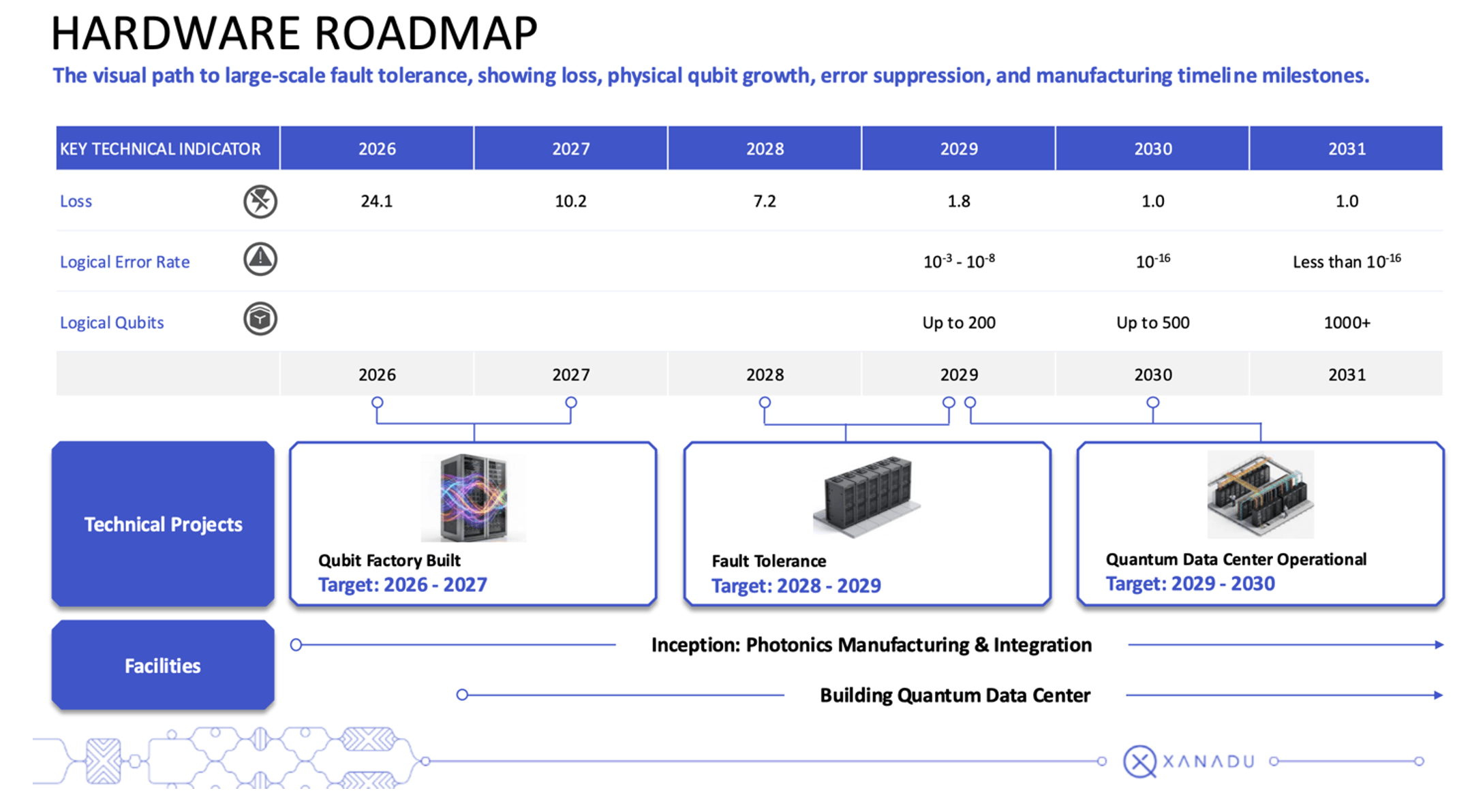
Xanadu just recently released an updated product roadmap shown below. You can find that, and their entire investor presentation right here.
Source: Xanadu
In general, Xanadu’s product roadmap is behind some of the other leaders in the industry in getting to a 1,000-qubit quantum computer. There is a lot of nuance in quantum computers, but there are larger players that have access to a lot more capital than Xanadu to invest to win.
It is important to note that Xanadu is still very early stage. It has nominal revenues, and very little expected for years to come. It has only $312 million in cash, which will probably only last about 18 months.
It will need to raise a lot more capital to even have a shot. And it currently trades at a $2.8 billion valuation, which is about 330 times annual sales.
Xanadu has a bumpy road ahead of it, but photonics-based quantum computers do show promise.
As for Blackberry (BB), it is hard for me to get excited about this company.
As a company, it has been in a horrible downtrend for about 20 years. It does appear that it has finally stopped shrinking and started growing slowly again. The largest part of its business is supplying real-time operating systems to the automotive industry.
It is expanding to other market segments like robotics, medical devices, and industrial automation, but there is a lot of bleeding-edge technology that it is competing against – companies that don’t have the kind of baggage that Blackberry has.
The latest rise in the share price (and subsequent fall) was driven by the acknowledgement that Blackberry has finally turned the corner and is back in growth mode again, albeit slow growth mode.
The automotive industry is notoriously difficult to grow quickly in, which is why Blackberry is trying to diversify outside of automotive in search of other sources of high-growth revenue.

What if you could PROFIT when your bills go up? Sounds crazy… But hedge fund legend Larry Benedict has given his readers a chance at gains like $8,704 in six days… from one ticker that could pay you when your bills rise. Click to get the FREE ticker.

If you’ve given up on cryptocurrencies, you could be making a massive mistake… Because now that we’re seeing signs of a bottom, Jeff is getting ready for a NEW boom that could help you grow a tiny stake into a six-figure payout. Click here to see the details because the next 60 days will be critical.
Hello Bleeding Edge Team,
Could you let Jason know [Tuesday’s] article was exceptional? We talk about and read about all kinds of details of AI, chips, transistors, etc. But describing all of it was great.
It reminds me of an incredible book I read many years ago that Microsoft published called Code: The Hidden Language of Computer Hardware and Software (Microsoft Press).
It started with two kids using two cups and a string to communicate with each other, and built the complete history of the development of the computer and software. It was brilliant.
– Kevin M.
Hi Kevin,
Jason here!
I loved the book Code and how it described base 10 because we have 10 fingers. If we were Mickey Mouse, we would have derived base 8. I recall that passage.
I’m glad you enjoyed my issue of The Bleeding Edge, and I really appreciate you writing in!
Hi Kevin,
It’s Jeff now.
The semiconductor industry is absolutely fascinating. And it’s not just the technology, but the industry structure and players and how they all interconnect with each other.
Most people don’t realize how massive the semiconductor industry actually is. Global semiconductor sales in the second quarter of 2026 were $403 billion… in just one quarter. I remember when annual sales in the industry were about that much.
What’s even more exciting is that global semiconductor sales increased 35% quarter on quarter and 123% year on year. For an industry this large, these kinds of growth figures are stunning. Global semiconductor sales will easily exceed $1.5 trillion this year given the growth that we are seeing right now.
Other interesting facts about the industry are:
I could go on, but as we can see, there are several companies that are critical to the semiconductor industry, and without them, economic growth would cease.
The semiconductor industry is such an incredible proxy for economic growth and technological transformation.
And as we can see, it is booming right now.
Why does Jeff recommend things that are bad for his subscribers?
Example # 1: SpaceX IPO. If I had invested in it, I would be sitting at a significant loss. My conclusion: Jeff recommended it so he could cash out on his personal early investment in the company.
Example #2: Buy tokens secured by U.S. Treasuries. I never got a response to my question, “What happens to the value of these tokens ‘when’ the US defaults on its debt?” My conclusion: Jeff recommended this to increase the value of his ownership in the companies sponsoring the tokens.
Example #3: Why do almost all of his Deep Access, Neural Net Profits, Permissionless Investor, and Early Stage Trader recommendations have negative returns? My conclusion: Jeff is simply a storyteller trying to get more subscribers to make more money for himself. You can see this more so now with all the marketing of new products. Of course, he needs to get more subscribers now to offset all he will lose when the next recession hits. Sounds like a Wall Street tactic to me.
So specifically, 1) Did Jeff cash out on the SpaceX IPO? 2) Does Jeff have ownership positions in the crypto companies offering US Treasury-secured tokens? And 3) why do we rarely, and most times never, hear from Jeff about why his recommendations didn’t work?
– Dennis H.
My question is, what will happen to stablecoins when the U.S. Treasury defaults on its enormous and rapidly growing debt?
Thanks. I look forward to your response!
– Dennis H.
Hello Dennis,
Despite the nature of your conclusions, I still appreciate you writing in with your questions.
I have always had a policy at Brownstone Research that prohibits me – and any one of my analysts – from owning something that we recommend, or recommending something that we own. This is in place to avoid any conflicts of interest. Brownstone Research is the antithesis of Wall Street, which is rife with conflicts of interest and bad actors.
To address your points directly.
Example #1: I have not recommended anyone buy shares in SpaceX (SPCX).
In fact, I specifically recommended not buying the IPO because I accurately predicted that the market makers would open up the stock way above where the IPO priced, and that the stock would collapse, resulting in retail investors getting hurt.
And that is exactly what happened. The stock immediately gapped up to over $200 and then collapsed almost 50% by the end of July.
And to be very clear, I was never an investor in SpaceX. I never had access to the early venture rounds of SpaceX (unfortunately).
Long-term, I am very bullish on SpaceX, but there are a lot of shares whose lock-up needs to expire, so I still expect quite a bit of selling pressure in the coming months.
Example #2: Tokens secured by U.S. Treasuries are U.S. dollar stablecoins. They are the equivalent of holding U.S. dollars.
I have never and will never recommend buying U.S. dollar stablecoins as an investment. That is simply because it is not a growth asset. A dollar is a dollar.
And also, to be clear, I do not have any investments in companies that issue these U.S. Treasury-backed stablecoins like Circle, Tether, Paxos, or Anchorage Digital.
I was a very early investor in Ripple Labs, which is still private, and which has issued a USD stablecoin, but it is a very small player in that industry, as it is not its primary business.
U.S. dollar stablecoins are the gateway for financial institutions into the world of digital assets. It’s the stable currency that allows financial institutions and investors to move into and out of digital assets quickly and securely.
And U.S. stablecoins, thanks to the GENIUS Act, have become an important buyer of U.S. Treasuries, as all U.S.-based issuances of U.S. dollar stablecoins must be backed by U.S. Treasuries and U.S. dollars.
Example #3: There are two key points that my team and I have been consistent about over the last two years with regards to digital assets.
The first is about position sizing. Digital assets are highly volatile and oftentimes very speculative, which is why we recommend putting much smaller amounts into any digital asset. This is especially true in the absence of clear regulations, a point that we have made hundreds of times.
Digital assets are a unique asset class that can fall 50% and then turn around and run for hundreds of percent. It has volatility unlike any other asset class, which is why position sizing is so important.
The second is about the CLARITY Act, which is the market structure bill. We have published so much research about the CLARITY Act and its importance.
My senior blockchain analyst, Ben Lilly, has been closely tracking its progress and publishing on it over at our free Chain of Thought e-letter.
We’ve also been very consistent and clear that the passage of the CLARITY Act – and seeing that signed into law – would be a massive catalyst for crypto and blockchain technology as a whole, as well as ensuring these technologies will be protected from experiencing anything like Operation Chokepoint ever again.
With that said, we are still going to continue to publish great research on the most promising digital assets and blockchain projects that will become the foundation for the next-generation financial system.
And we want to do that before the CLARITY Act is passed into law. We want to inform our subscribers which digital assets are the most important and exciting assets to hold before they become well known and written about in the mainstream financial media.
Getting in early, before the crowds, is where the largest gains are made.
I recommended NVIDIA in February 2016 when people thought it was just a gaming company. Some of my subscribers have walked up to me on the street to thank me because they became a millionaire on that single recommendation.
The same is true for Bitcoin, which I recommended at $240. It has gone even higher.
The largest gains happen when we build positions in advance of the major moves and major catalysts. I’d always rather be a little early than be too late when it comes to investing.
As for the U.S. defaulting on its debt, I’m sorry to say this…. But it is not going to happen.
The debt levels infuriate me as a taxpayer, as do the fiscal deficits, which I want to see dramatically reduced.
What infuriates me even more is the sheer level of institutional fraud that “they” have put in place. What has been uncovered in New York, Massachusetts, Minnesota, California, Ohio, New Jersey, etc. is just mind-blowing.
It needs to be cleaned up. It is being cleaned up, but it needs to be completely eliminated. Doing so will go a long way to putting the fraudsters behind bars and dramatically reducing fiscal deficits.
But the U.S. will not default on its debt.
It will, however, continue to devalue the U.S. dollar by running deficits and printing money. Sadly, every country does this, and I don’t see it coming to an end.
But in the U.S., thankfully, the current economic environment and regulatory environment is fueling an incredible technological revolution that will bring about the largest productivity boom in history.
Debt and deficit as a percent of GDP will actually decrease significantly, which is the answer to how the U.S. will deal with its current debt levels and reduce levels of inflation (i.e., because technological advancement is deflationary).
That’s all for this week’s AMA. Thank you all for writing in. As always, you can send your questions and comments right here. My team and I love hearing from you, and I really enjoy diving into the questions you all send in.
As a reminder, markets – and Brownstone offices – will be closed on Monday for Labor Day. You can look forward to a spotlight issue from Ben on the cost of trust in today’s financial system…
Have a great weekend, everyone.
Jeff
Add Brownstone Research as your preferred source on Google to see our latest stories in your feed.
 Add as a preferred source
Read the latest insights from the world of high technology.
Tesla and SpaceX have now formed special committees to evaluate a potential merger between these two Elon Musk-led powerhouses.
This isn't about simply recreating the old system on new infrastructure…

As companies give digital workers more responsibility, protecting their systems becomes part of the cost of putting AI to...