







OpenAI on Trial
The trial between Elon Musk and Sam Altman’s OpenAI is about to begin, and it will set the course of future AI development…
Two weeks from now, “the trial of the century” will begin.
At least, that’s what some in the tech industry are referring to it as.
And for the tech industry, it’s true. It’s that important.
Originally filed on August 5, 2024, Musk v. Altman (4:24-cv-04722) is scheduled to begin with jury selection at 8 a.m. Pacific Time in the District Court in Oakland, California.
How incredible it would be… to be a juror for a case like this.
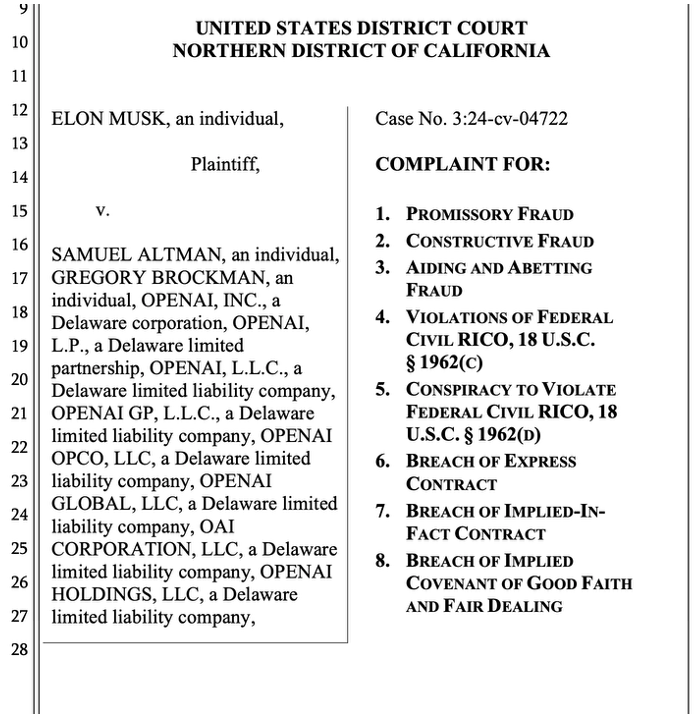
Filed August 5, 2024 | Source: Court Listener
It has become a massive case.
Already, 464 documents have been filed by Musk and the team at OpenAI.
Clearly, both sides of the table can afford the very best legal services. Regardless of who wins, the lawyers will come out on top no matter what.
The media will position this as a silly battle of the billionaires, a grudge match, or some malicious plan by the “evil” Elon Musk.
Clearly, Musk plans to bludgeon xAI’s competitor, OpenAI, to gain an advantage. So they’ll say.
But for reasons I’ll show, none of this framing is accurate.
And this court case is critically important to address.
Hopefully, it will expose the bait-and-switch tactics aiming to make tech companies appear altruistic… when their motives are clearly to enrich themselves and a small number of investors to the greatest extent possible.
The Bait
Elon Musk cofounded OpenAI with Altman and a handful of others in 2015.
OpenAI was established as a nonprofit organization with a simple goal: to develop artificial general intelligence (AGI) safely and for the benefit of all humanity.
At that time, Musk and many others were concerned about the development of AGI.
Musk, in particular, was concerned that it would be programmed with bias, which would ultimately lead to dangerous outcomes.
He well understood, even back then, that users of an AGI wouldn’t be able to discern truth from falsehood; they would simply trust the “all-knowing” AGI.
That is why building an AGI on facts, evidence-based research, and neutrality is so critically important.
The problem with OpenAI, and the crux of the lawsuit, is that OpenAI committed fraud, breached its contract, and breached its implied covenant of good faith and fair dealing.
It did this when it pivoted to a closed-source business model and a for-profit business – designed to enrich OpenAI executives, employees, and investors.
Completely the opposite of what a nonprofit organization is supposed to be.
The Switch
OpenAI is in a pickle.
All of the above claims made by Musk’s lawsuit are factually true.
In March of 2019, OpenAI dipped its toe in the water in an effort to make the transition to a for-profit company.
It was an odd structure, making OpenAI a “capped-profit” company designed to accelerate raising a lot more capital and attracting top talent in artificial intelligence.
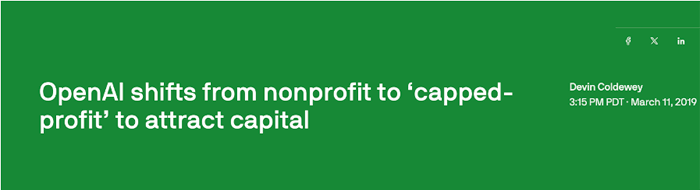
Source: TechCrunch
Even in 2019, OpenAI was trying to position the “capped-profit” model as altruistic: Any profits earned after the “cap” would be returned to the nonprofit arm of OpenAI.
Except there was one major issue…
For those who read the details, the “cap” was after investors had made 100 times their original investment.
Not a 50% return, not a 100%.
A 100X investment is a 9,900% return. That’s an astounding return – so large as to be extremely rare in investing.
In other words, the team at OpenAI and its investors would become very enriched in the process, leaving only what is above a 9,900% return to the OpenAI nonprofit.
We should keep in mind that the original stated goal of Altman and OpenAI back in 2015 was:
Our goal is to advance digital intelligence in the way that is most likely to benefit humanity as a whole, unconstrained by a need to generate financial return. Since our research is free from financial obligations, we can better focus on a positive human impact.
So much for that.
And it got much worse.
With great hubris, and after the departure of most of OpenAI’s original founders (all but three), OpenAI made the full pivot to recapitalize the company and convert the for-profit arm into a for-profit Delaware public benefit corporation.
Here are the key points:
- Profit caps were removed entirely
- Traditional for-profit structure, while claiming to have a public benefit (public benefit corporation – PBC)
- The OpenAI nonprofit became the OpenAI Foundation and holds 26% of the for-profit company
- Microsoft holds 27% of the for-profit company
- Employees and investors hold the remainder of the equity in the for-profit OpenAI.
Clearly, these moves by OpenAI violate its original nonprofit charter back in 2015.
And discovery in the court proceedings showed that OpenAI cofounder Greg Brockman already had plans to switch OpenAI to a for-profit company while soliciting Musk for donations to the nonprofit OpenAI.
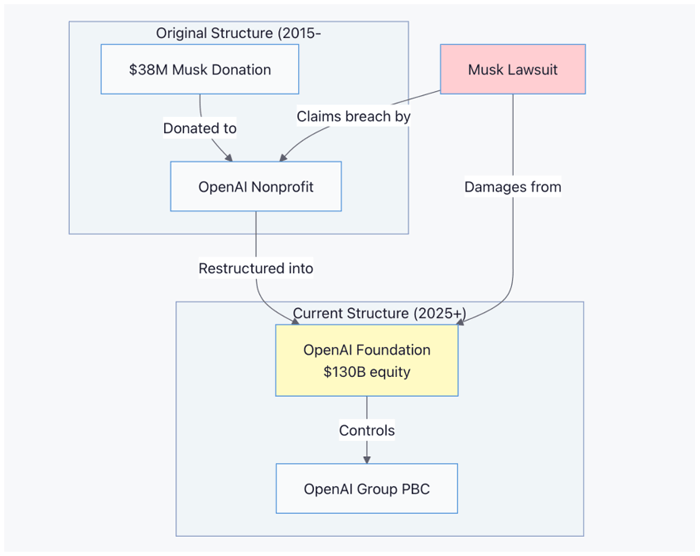
Source: LongtermWiki
And while Altman and OpenAI worked hard to get Musk’s case dismissed after the filing of the case in 2024, quite the opposite happened.
Not About the Money
The judge’s pretrial rulings not only allowed the case to proceed based on what was learned in discovery…
It also supported the further collection of evidence related to Musk’s argument in the case.
And smartly, just a few days ago, Musk amended his lawsuit to award any damages won against Altman, Brockman, and OpenAI to the nonprofit arm of OpenAI.
Said another way, Musk receives $0 when he wins the case. And the award is sent to the OpenAI nonprofit, so that it can fulfill its original nonprofit charter.
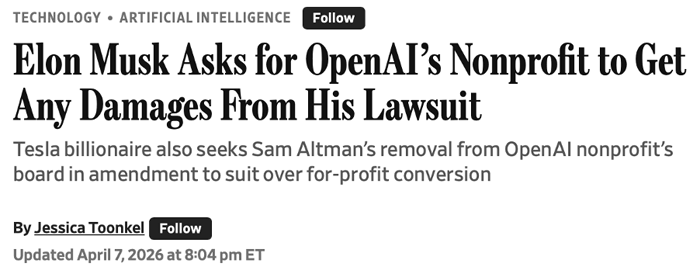
Source: Wall Street Journal
This was a very smart move by Musk, as it undermines any argument that he’s in this to profit when he wins the case.
For Musk, it’s not about the money.
It’s about the fact that Altman, Brockman, and OpenAI collected donations for a nonprofit when they were planning to convert it to a for-profit company. It’s about a bait-and-switch.
It’s about discarding the original, altruistic charter of the nonprofit and making every effort to enrich themselves and their private investors to the fullest extent possible.
All while building the most powerful – and potentially dangerous – tech of all time.
And the reality is that at any step of the way, Altman and Brockman could have simply left the nonprofit OpenAI and started their own for-profit AI company. They could have donated to the OpenAI nonprofit as well. But they didn’t. They continued to use the veneer of the “altruistic” OpenAI nonprofit and the now for-profit “public benefit” corporation as a way to raise what is now $186 billion to date.
As a private investor in hundreds of private tech deals, I don’t mind failure, and I don’t mind product pivots if something isn’t working and the team believes in the need to shift product focus. But I do mind a bait-and-switch.
I hate it when large private equity or venture capitalists come in and recapitalize the company to their benefit and to the detriment of smaller investors who provided early capital.
And I hate it when they insert terms and conditions into their investments that benefit them and the executives at the expense of smaller private investors.
I’ve seen some horrible things over the years, but the smaller investors simply don’t have the time and capital to justify a two- or three-year lawsuit against some bad actors.
Fortunately, Musk does.
Deciding the Future Foundation of AI
The implications of the outcome of this lawsuit are massive.
It will have ramifications not only for OpenAI and its nonprofit but also in the tech industry at large.
At the extreme, if the jury and judge decided to restore OpenAI to its original nonprofit charter, the for-profit arm would be dissolved and absorbed back into the nonprofit foundation.
It would also likely undo the deal with Microsoft, and any of the paper gains that Microsoft has seen with its 27% interest in the for-profit entity will disappear.
OpenAI would also lose its ability to attract top talent. This is almost certainly the reason most of the founders and employees chose to leave OpenAI and join other AI startups. They understood the risks of what might happen if OpenAI loses the case against Musk… Their equity wouldn’t be worth anything.
And many more current employees would leave the company, as the value of their equity would dissipate into the ether and the company would have very limited ability to raise additional capital to continue the work on AGI at the scale OpenAI is currently undertaking. It would become nearly impossible.
And, of course, existing investors would also leave OpenAI.
The talent and capital would flee to Anthropic, Perplexity, and a large number of smaller for-profit companies working on artificial intelligence.
Musk’s xAI has already been acquired by SpaceX, and SpaceX has already filed for its forthcoming IPO, so SpaceX won’t benefit from the capital flight, as it doesn’t need the money. And what money it needs to accelerate, it will raise in the IPO. But xAI would probably pick up some talent from OpenAI’s restructuring.
And it goes without saying that this case will become an important precedent for other AI nonprofits and trusts, hopefully putting an end to this fake altruism that has been perpetuated by the likes of Sam Bankman-Fried, Sam Altman, and Greg Brockman.
Of course, Musk’s defense against OpenAI’s bait-and-switch isn’t just the lawsuit…
Obviously, he realized that no one in the industry was building a neutral, truth-seeking AI. That was the impetus for establishing xAI as a company and for accelerating the development of Grok to quickly become one of the leading frontier AI models.
Which party will win the lawsuit?
The latest Polymarket stats say Musk has only a 38% chance, reflecting more of the media narrative that the jury will see this as a silly feud levied by a billionaire.
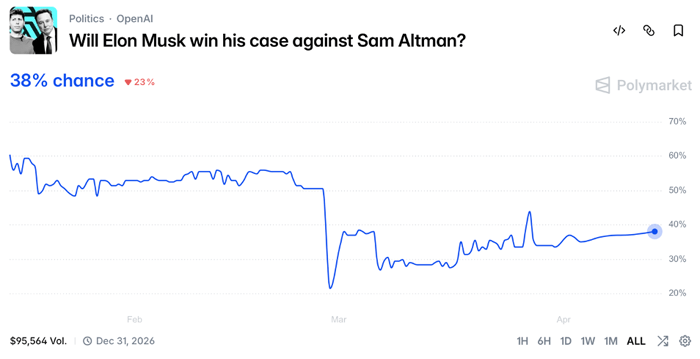
Source: Polymarket
But I believe that the facts and circumstances revealed in the court case will open the eyes of many…
It will show that OpenAI misled many and clearly deviated from its original nonprofit charter and along the way enriched itself and large private investors, including Microsoft.
Either way, we’ll be watching closely.
Jeff
Continue following Brownstone Research
Add Brownstone Research as your preferred source on Google to see our latest stories in your feed.
 Add as a preferred source
More stories like this
Read the latest insights from the world of high technology.
-
-

Anduril’s Arsenal
This is a landmark deal and the most significant initiative in shipbuilding and defense technology since World War II.
-

Google’s Nuclear Deal Reveals the Scale of AI’s Power Problem
Google’s recent agreement reveals the scale of the AI power shortage and why supplying power is such an important...