



Airborne Wind Energy
It’s hard to imagine that developments will continue to pick up at an even faster pace than what is...



Last night, the skies over Cape Canaveral lit up as a Blue Origin New Glenn rocket exploded in a massive ball of fire.
Boom…
I mean a really big boom.
Last night, the skies over Cape Canaveral lit up as a Blue Origin New Glenn rocket exploded in a massive ball of fire.
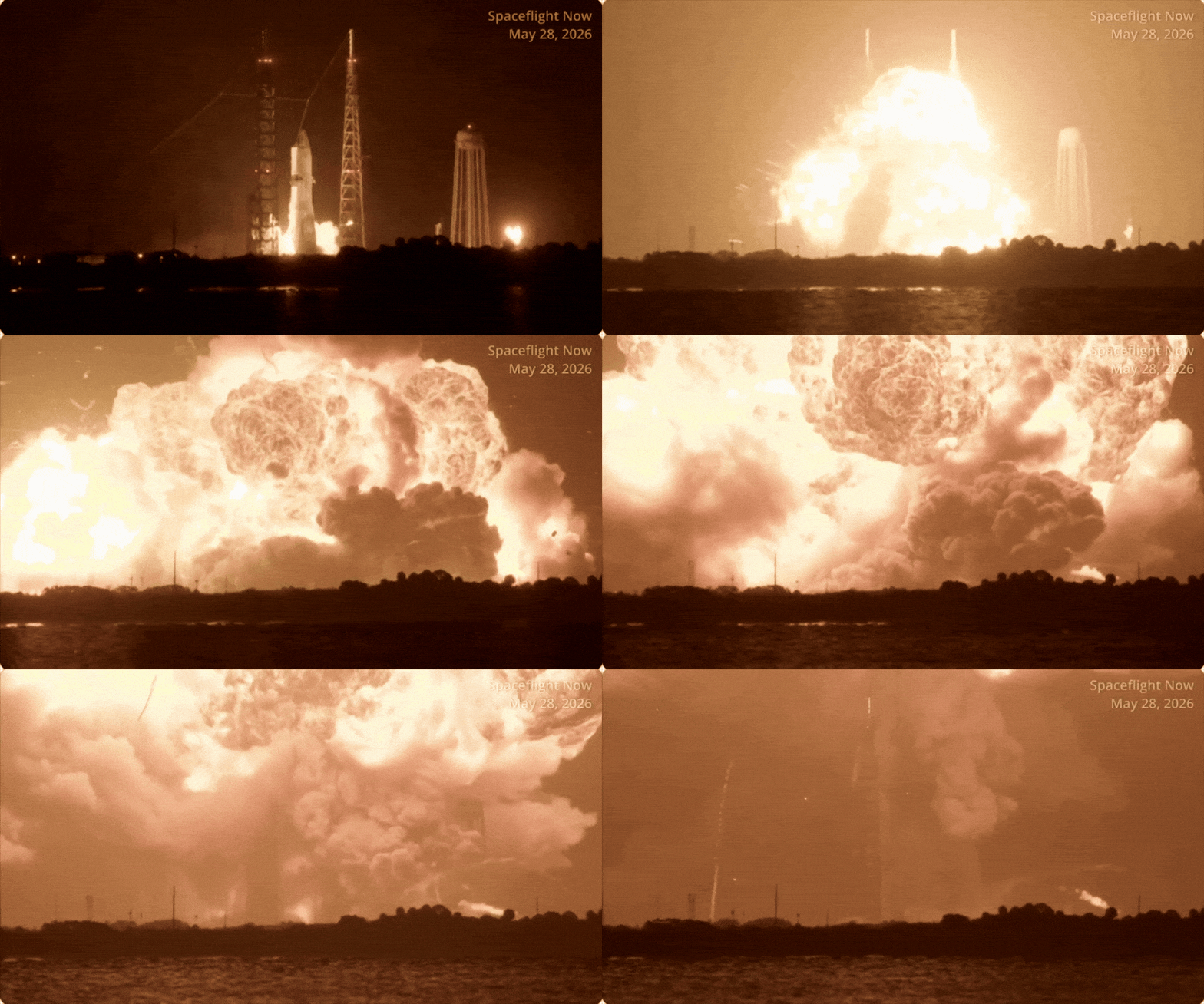
New Glenn explosion | Source: Spaceflight Now
As we can see above, it is an extraordinary sight.
It wasn’t even a launch attempt. Blue Origin was simply testing its rocket engines in preparation for the next test flight of its New Glenn rocket. The explosion came as a surprise considering that the last test launch of the New Glenn rocket went so beautifully.
This is a catastrophic setback for Jeff Bezos and the team at Blue Origin. And it couldn’t have come at a worse time.
Bezos has been working feverishly to catch up with SpaceX so that he can launch satellites for Blue Origin and for Amazon so that he can compete against Musk in both broadband internet from space and in orbital web services (OWS).
And Bezos has been aggressively battling for more of NASA’s business – in particular NASA’s Artemis program – for returning to the moon.
This is a setback that will negatively impact its chances with Artemis and give SpaceX an even larger upper hand.
And it couldn’t come at a better time for SpaceX as it prepares for its June 12 IPO.
Think about it… Blue Origin is the only company that has a rocket that could potentially compete with SpaceX’s Starship. And it just went up in a ball of fire on the launchpad. SpaceX literally has no competition in launch services as it sets up for its June IPO.
Incredible timing.
Blue Origin and Bezos won’t give up, but they will lose precious time to the advantage of SpaceX.
On another topic, I hope you enjoyed hearing from my team this week. I was enduring a very heavy travel schedule, and my team stepped in to provide some incredible research and editorial in The Bleeding Edge.
Have a great weekend,
Jeff
With SpaceX building data centers in space, shouldn’t we rid ourselves of companies involved in building data centers on Earth? Lots of problems with Earth data centers: water usage, electrical shortages, community backlash.
– Duke M.
Hi Duke,
This is such a hot topic right now, and a very interesting subject as it is widely misunderstood.
Most of those who are opposing data centers are either politically motivated or extremely ill-informed.
I wrote about this topic in one of my April AMAs in The Bleeding Edge – Cybercab Mass Production Has Begun. In that issue, I wrote:
And then there are those who claim to oppose the “environmental destruction” from the data centers, while at the same time are perfectly fine with golf courses. The context here is important. In 2023, data centers consumed about 6.4 billion gallons of water. It sounds like a lot, and it is, but data centers use closed-loop cooling systems where the water is reused after it cools down.
By comparison, golf courses in the U.S. use about 547 billion gallons of water a year. And it’s not a closed-loop system. Golf courses need that much water every year. Data centers only use about 1% of that one time.
Obviously, water utilization will grow with more data center construction, but it will always be a tiny, tiny percentage of golf course consumption.
Now, at a very high level, 40–50% of all data center plans have been delayed or canceled. The primary reasons for that have been access to power and/or permitting.
Should we ask everyone to stop golfing because of the water consumption, and, for that matter, because of the chemicals used to maintain the golf courses that leach into the water?
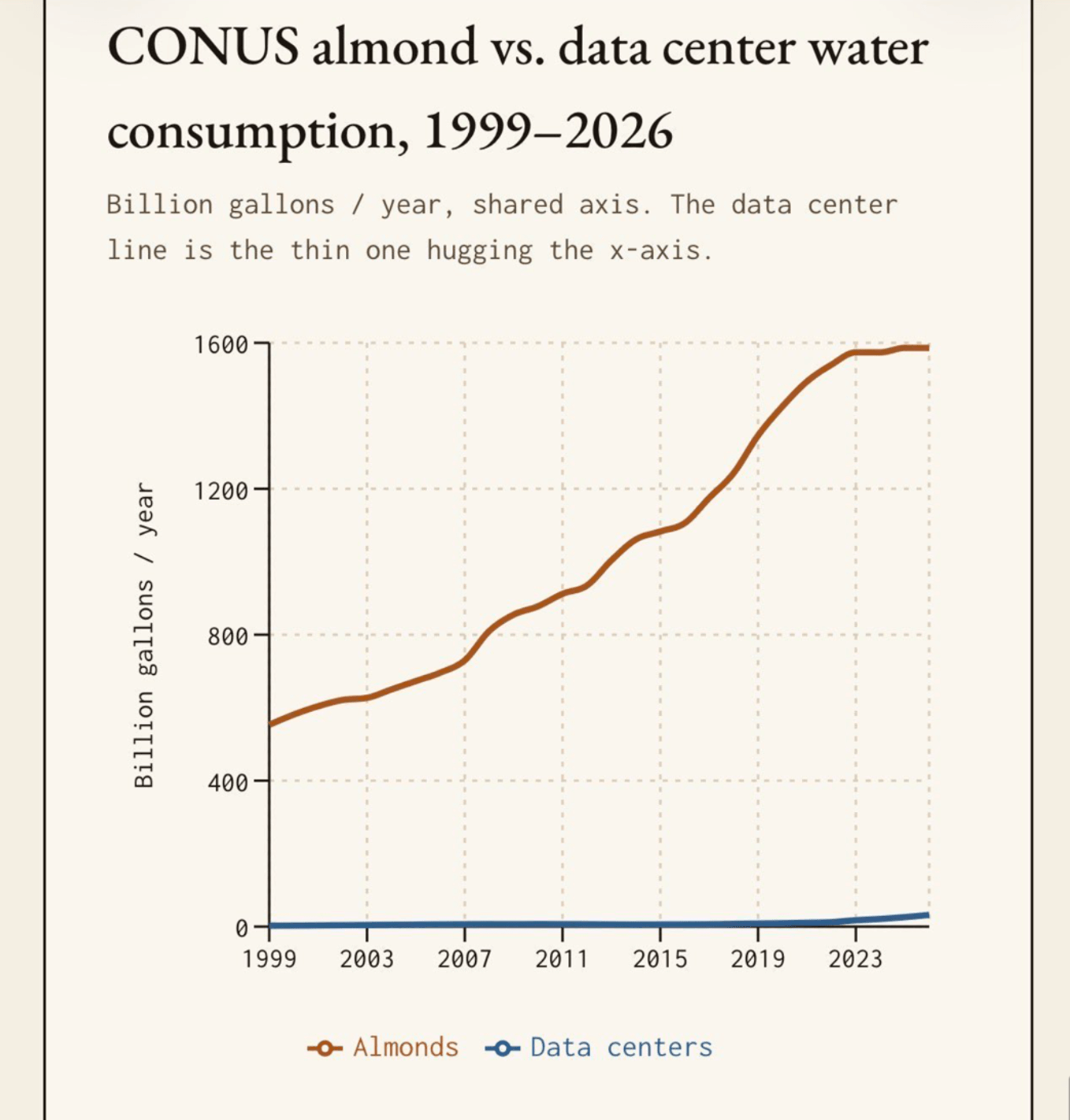
Here is another interesting example. How about almond production? Let’s have a look at the chart below:
Source: X @Jason
CONUS stands for CONtiguous United States. It might come as a surprise, but California supplies about 80% of the world’s almond supply, and 100% of the almond supply in the U.S. Almond orchards alone account for as much as 16.75% of California’s total agricultural developed water consumption.
Almond production is extremely environmentally damaging. It’s why I choose to drink only oat milk or real milk. That’s my personal choice, because almond production is environmentally terrible.
I mean, just look at that chart above. Water usage by data centers is absolutely insignificant compared to almond production. It’s silly. Should everyone stop eating almonds and drinking almond milk with their coffee?
One point I do agree with is that I don’t believe that any costs associated with electricity production for data centers should ever be passed on to homeowners.
Any related costs associated with additional power generation should be borne by the AI data center operator. And, in almost all cases, this is precisely what happens. And as stated earlier, when there isn’t sufficient power generation, data center projects are being delayed.
This is, of course, the impetus for recommissioning nuclear power plants, utilizing natural gas turbines for dedicated power generation for an AI data center (just as xAI has done with its Colossus data centers), and accelerating the development of small modular fission reactors as an entirely new source of power generation.
Putting the above aside, though, and to your question… Shouldn’t we just rid ourselves of terrestrial data centers and go to space?
The answer is, we can’t. Unless, of course, we want to materially impede economic growth and technological progress.
The real issue here is time frame. SpaceX is about 30 months away from putting its own AI data centers into orbit. And while other companies like Starcloud and Sophia Space are planning to do the same, as well as Relativity Space and Google, they all have similar timelines to do this at any kind of scale (i.e., the kind of scale that would provide comparable computational resources to terrestrial data centers).
So, in reality, what will continue to happen is that terrestrial data centers will continue to be built as quickly and wherever there is power generation available until such a time that orbital data centers are able to reach the scale needed to meet demand.
And that all depends on one single company… SpaceX and its Starship, which is the only rocket that will provide the economics for orbital data centers to make sense.
Hi Jeff, what are your biggest criticisms of Elon Musk and more specifically, SpaceX? To be maximally truth-seeking, it is important to debate the best arguments from the opposing side.
I know you have already addressed the decels, but there can certainly be legitimate criticism of individuals you are mostly bullish on. I frequently see concerns regarding Musk’s overly optimistic timelines, SpaceX’s losses, and Tesla’s decline in the global EV market.
There is also a point to be made about China being light-years ahead of the rest of the world when it comes to humanoids and technology in general.
Like you and most subscribers, I admire Musk and what he has achieved, but I’m sure you’d agree that it’s important to acknowledge credible issues so that we never end up in a cult-like situation, which is unfortunately far too common in politics. Thanks for your insights as always. Regards.
– Shivam S.
Hello Shivam,
That’s a fair question, and one no one has asked me before. And you may be surprised that I do have criticisms.
One example is that he falsely claims that solar energy can provide all the energy production that we need here on Earth. While theoretically true, it is practically impossible.
Even if we bulldozed all of Nevada and made the entire state row upon row of solar panels, it wouldn’t solve the problem. The losses over long distances are too great to have one giant solar panel field in one location to serve the entire country.
And beaming down solar energy collected from space is something I’ve written about a lot before. While it can be demonstrated at extremely small scale, it simply isn’t practical or anywhere near proven at megawatt or gigawatt scale.
Musk also refrains from saying anything negative about China at all. No matter what the country does, no matter what U.S. technology it steals, never a peep from Musk on the topic.
The same is true when it comes to defending freedom of speech on X. Musk gave the greatest gift to Americans by restoring freedom of speech through his $44 billion acquisition of Twitter, now X. But those freedoms don’t extend into many other countries around the world that have totalitarian censorship policies.
I know why he takes these positions. It’s for one simple reason: he is talking his book and protecting his companies.
Tesla sells solar panels, so it’s natural he talks up solar energy and rarely mentions nuclear fusion. He doesn’t have a nuclear fusion company.
Tesla also does an incredible amount of business in mainland China. So that’s why he never says anything that might anger Beijing or the Communist Party.
And he wants X and xAI to be successful everywhere in the world, so he follows the direction of totalitarian governments with regards to X. He doesn’t want to get banned or sued in those countries.
I don’t like it, but I also recognize that he is doing these things to protect the interests of his companies. He is acting in the best interest of his investors. He has a fiduciary responsibility to do so.
I am not, however, critical of his aggressive timelines and the visions that he has for his companies. As a leader, he has to set a target. He sees what he believes is possible, and he and his teams work towards those targets. They may not hit them every time, but they do try.
Musk operates with a sense of urgency, and regardless of whether he hits his planned timelines, he and his teams still achieve things that were thought impossible, and long before anyone else can figure out how to get them done.
And one final point… China is not light-years ahead of the U.S. or Tesla in humanoid robot technology. China is remarkably good at manufacturing hardware, which is actually the easiest part of building a humanoid robot.
The most valuable technology, and the hardest to develop, is an intelligent autonomous humanoid robot. This is something Tesla is light-years ahead of China in developing. This will become very obvious later this year.
I don’t ever see Musk becoming a politician. He thrives off building and solving complex engineering problems that no one has solved before.
I think you’re right, though. There will be an ever-growing cult-like following of Musk over time. SpaceX will enable a return to the moon and the establishment of a lunar outpost. SpaceX will enable missions to send humans to Mars and establish a Martian outpost within the next ten years. He will launch the most successful product of all time – the Optimus robot.
And for that, he will attain cult-like status. He will be revered after his death for his contributions to human civilization. There will be monuments in his name. Hopefully, that time won’t come anytime soon, though.
Just imagine what incredible things he and his teams will build over the next 20–25 years if he is able to stay healthy and productive.
I can’t wait to see what comes next. He is inspiring an entirely new generation of builders and engineers to do incredible things.
It’s hard to imagine anyone taking an issue with that, or, for that matter, taking an issue with freedom of speech.
Jeff, just curious about the lock-up period after the SpaceX IPO. How long might it be, since it is my first experience with an IPO? BTW, I enjoyed meeting you in DC a few years ago. I follow all of your services and appreciate the profits that I receive due to your advice.
Thank you.
– Ken P.
Hi Ken,
Thanks for this question, as the answer is quite unique to SpaceX.
Normally, IPOs have a 180-day lockup period. This means that investors and employees of the company going public can’t sell their shares until 180 days after the IPO.
This is done because the company going public doesn’t want a huge number of shares being sold on the market immediately following the IPO. That could negatively impact the share price. The lockup period is designed to avoid that.
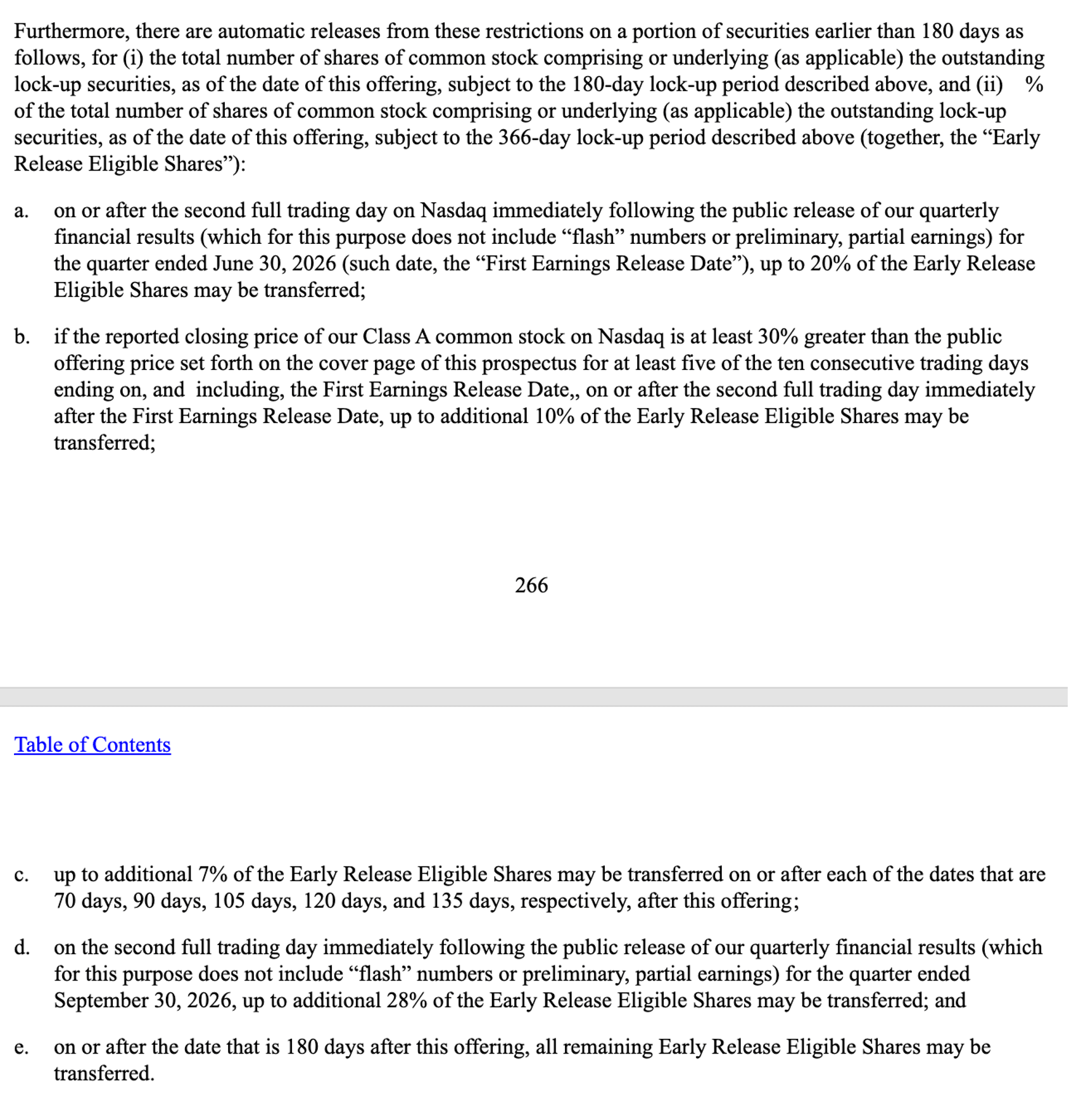
But SpaceX is doing something different. I’ll just share what it’s doing by showing SpaceX’s approach with a relevant section from the SpaceX S-1 filing:
SpaceX’s S-1 Filing | Source: SEC
This amounts to a staggered lockup structure that releases shares to be sold in a series of tranches based on certain metrics. This avoids all the shares unlocking at the same time. It’s a smart approach that makes a lot of sense.
Thanks for writing in. It really feels like D.C. was a very long time ago, a different era almost. Congratulations on your success applying my research, and thanks for being an Unlimited member.
That’s all for this week’s AMA. As always, you can reach my team or me right here with any questions or comments.
Have a great weekend.
Sincerely,
Jeff
Read the latest insights from the world of high technology.
It’s hard to imagine that developments will continue to pick up at an even faster pace than what is...
An “insider” from Anthropic has quit his job – walked away from a ton of money, in fact –...

OpenAI announced that Astra is a “generational leap in capability.” AGI has most certainly arrived...