



What Wall Street Is Still Missing About Tokenization
This isn't about simply recreating the old system on new infrastructure…



Imagine if a small number of elites – with tight coordination with the U.S. government – had a chokehold on U.S. artificial intelligence development.

Demis Hassabis has been at the forefront of neural network development for the better part of 15 years.
He founded DeepMind in 2010, which was subsequently acquired by Google in 2014.
His background is in computer science with a focus on AI.
Most don’t know this, but in the late 90s, Hassabis began his career as a video game developer.
In 2005, he left the industry to pursue a PhD at University College London in neuroscience…
And after completing his PhD, he founded DeepMind.
Perhaps not surprisingly, Hassabis’s early pursuits at DeepMind were applied to gaming.
He led his team to develop forms of AI capable of playing 7 Atari 2600 games.
That eventually led to AlphaGo, an AI capable of crushing the world’s grandmasters at the ancient Chinese game of Go.
Go is a game with a nearly infinite number of outcomes – so many that an AI system can’t possibly memorize them all.
After that, Hassabis turned his sights on life sciences.
One of the grand challenges of science is accurately predicting how proteins fold.
DeepMind solved that challenge with AlphaFold, and Hassabis and his colleague John Jumper won the Nobel Prize in Chemistry in 2024, despite Hassabis not having any background whatsoever in chemistry.
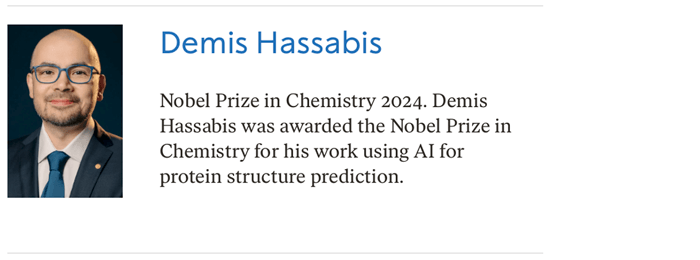
Source: The Nobel Prize Organization
Life sciences have been a particular focus for Hassabis, as he firmly believes that the most important impact that AI will have on society is in drug discovery and development.
If you ask me, the number one thing AI can do for humanity, it would be to solve hundreds of terrible diseases. I can’t imagine a better use case for AI.
If you could revolutionize the drug discovery process, make it 10x faster and more efficient, and more likely to pass through the clinical trials because you can predict the properties better, that has to also be of enormous commercial value.
– Demis Hassabis
The success that he had at DeepMind led to him to a promotion – leading all AI research at Google – in addition to continuing as the head of Google DeepMind and also of Isomorphic Labs, a spin-out from Google DeepMind designed to accelerate drug discovery and development.
Hassabis and DeepMind are responsible for some of the most incredible AI-enabled breakthroughs to date… which is why tracking any related developments is always a worthy use of time for those interested in bleeding-edge AI.
Yesterday, Hassabis spun up a lot of industry chatter with a rare post on X, titled: A Framework for Frontier AI and the Dawning of a New Age.
It was both exciting and disappointing at the same time.
Over the years in my research, I have been doing my best to both inform and help position my subscribers for what is happening in AI and to be prepared for what will happen next.
I’d like to highlight the key points that Hassabis made in the post, as some of Hassabis’ comments are directionally useful as a framework for what’s coming. He says…
When we look back on this time in the decades to come, I think we will realise we were standing in the foothills of the singularity – nothing less than the dawning of a new age for humanity.
I’ve long been predicting the arrival of AGI in late 2025/early 2026.
I firmly believe it is here, a point that NVIDIA CEO Jensen Huang, venture capitalist Marc Andreessen, and many others now agree with.
Hassabis’s opinion is that AGI is still under development, but he is positioning AGI as something closer to artificial superintelligence (ASI), which I have long predicted will arrive no later than 2030. He also asserts…
AGI cannot be compared to standard technological breakthroughs, not even ones as consequential as the internet or mobile – it is much more akin to the discovery of electricity or fire.
The magnitude of this technology’s impact will be unprecedented, perhaps 10x the Industrial Revolution at 10x the speed.
The above comments are a useful framework for how to think about what has already begun.
The magnitude of this technology will be 10X that of the Industrial Revolution at 10X the speed.
Artificial intelligence has already developed novel solutions to problems in physics and mathematics – unaided by human experts.
Perhaps not surprisingly, Google DeepMind’s AI technology has been behind many of these discoveries:
Like it or not, AGI is already here, and the pace of development continues to accelerate every month.
AI models are already capable of recursive self-improvement, which means that their only constraints are computational resources and electricity.
And for the moment, there is enough capital to ensure that there are plenty of both.
Hassabis deeply understands how fast things are moving.
He is in a very unique position to do so, considering his current roles.
This was the main reason for his post yesterday.
Hassabis recommended establishing a new AI standards body to oversee and gate AI development…
It could establish a new Standards Body modelled on a federally overseen public-private partnership or self-regulatory organisation, much like the Financial Industry Regulatory Authority (FINRA), with a board that includes independent leading technical experts and open-source representatives.
For context, FINRA is not technically a government agency.
It’s funded by industry, but the government backs FINRA to enforce whatever standards it develops.
Hassabis’s idea is that “Frontier Labs would voluntarily share models with the Standards Body for review up to 30 days before release.”
And that this standards body “could coordinate a slowdown in development among the Frontier Labs if deemed necessary.”
This idea may sound relatively harmless, magnanimous, or even desperately needed by those who want to “keep everyone safe from AI development”…
But it is a horrible idea that should not be pursued, as it would almost certainly lead to worse outcomes.
Imagine if a small number of elites – with tight coordination with the U.S. government – had a chokehold on U.S. artificial intelligence development. This would only lead to regulatory capture by the large tech firms that are working on leading frontier AI models and programming their AI models in ways that fit whatever radical, politically driven narratives are being pushed.
Google (GOOGL), Anthropic, Meta (META), and Microsoft (MSFT) – who all aggressively censored scientists and experts during the pandemic at the direction of the government and also influenced the outcome of elections in the past due to their own biases – would almost certainly be involved with such a standards body.
Are these the people that we would trust to be a neutral party and the arbiter of what AI models are “approved” or not?
Heck no.
Most people don’t know this, but Elon Musk himself was an early investor in DeepMind back in 2011.
His goal was to help keep DeepMind independent and ensure that it was aligned with humanity’s interests. Namely, that it would be neutral and truth-seeking.
Musk was upset that Google wanted to acquire DeepMind. It was the acquisition he feared the most.
Musk actually led a group of investors to acquire DeepMind so that Google wouldn’t. But sadly, Google won the bidding contest.
Google had promised DeepMind – as a condition of the acquisition – that there would be no military use for its AI technology, and that there would be an independent ethics board for the use of AI.
These are points that Google later reneged on, as Google is now selling that technology to the Pentagon for “any lawful government purpose,” as defined by the U.S. government.
Musk’s loss of the DeepMind acquisition is precisely what led him to found OpenAI in 2015.
Since Google had DeepMind, he felt that there needed to be a counterweight to Google that had the same mission that he envisioned for DeepMind.
Sadly, as we’ve been following closely in The Bleeding Edge, key executives at OpenAI departed quickly from its non-profit status, breached the rules of the charitable trust, and made themselves and OpenAI employees and investors extremely rich in the process as a for-profit entity.
Just as the loss of DeepMind to Google prompted the founding of OpenAI, what happened with OpenAI was the catalyst for Musk to found xAI and build Grok, the world’s first and only maximum truth-seeking AI.
And truth is what “they” fear the most…
Can we imagine a standards board… controlled/compromised by the government… led by the companies mentioned earlier… reviewing SpaceXAI’s frontier AI model Grok?
Musk and his team at SpaceXAI (SPCX) are the greatest defenders of freedom of speech the world has ever seen…
And that means that they are the greatest threat to those who are opposed to freedom of speech and believe that only frontier AI models that regurgitate the “approved narrative” will be approved for human use.
They want to “keep us all safe” by ensuring that we can’t access the truth.
No thanks. We’re smarter than that.
Not only is this “governance board” a threat to the underpinnings of democracy and this republic… it is an anticompetitive mechanism that would slow development and access to this powerful technology.
Do we think that China, Iran, Russia, North Korea, or any other adversary would agree to be held to the same standards? No way. And they aren’t slowing down either.
The best defense is a strong offense.
Which is why the latest announcement by New York, announced just yesterday, is absolute lunacy.
New York is banning the development of all data centers using 50 megawatts or more.
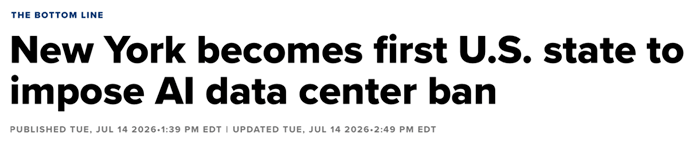
Source: CNBC
Senator Fetterman summed up the ban concisely:
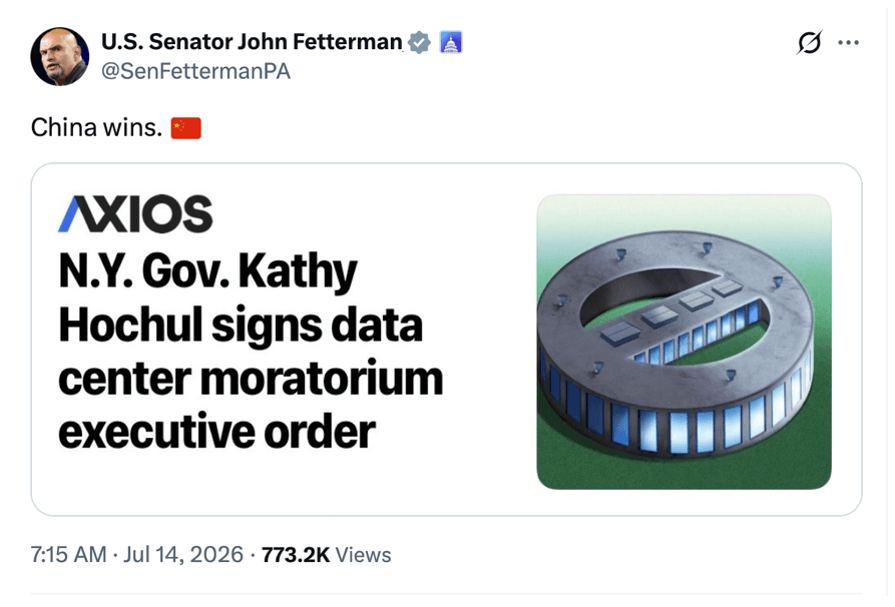
“China wins”…
As I’ve written in the past, China is the main protagonist of anti-data-center propaganda – by way of spreading false information through social media and on the internet.
This is a Chinese Communist Party-funded initiative, designed to brainwash Americans into supporting programs to slow AI development down so that China can catch up and dominate.
When we understand this truth, we can’t unsee it.
The most ironic part about Hassabis’s proposal is that he has openly acknowledged the futility of a governance board – precisely what Hassabis himself has proposed.
Here is his comment from a worthy read about DeepMind – The Infinity Machine:
Safety isn’t about governance structures. I mean, even if you have a governance board, it probably wouldn’t do the right thing when it came down to the crunch.
He’s right about that.
And when money, power, control, and politics are involved, not only will the right thing not be done, but typically the opposite of the right thing will be done.
Need some examples?
How about the pandemic?
Or the new “rules” that big finance put in place after they created the financial crisis in 2008? The big banks have even more control over the industry today.
Or how about Big Pharma’s regulatory capture of the FDA and the medical system, for that matter?
Or the big banks’ all-out effort to subvert the passing of the CLARITY Act for digital assets to “keep us all safe?”
The fact is: Open-source AI models don’t need a standards body to approve them.
By definition, it is open source and can be inspected.
The weights are public information.
And even closed systems can be evaluated to determine if they are trustworthy or not.
Just because we are experiencing technology development at a pace that we don’t fully understand… does not mean that we need something akin to Orwell’s “The Party” in 1984 to gate or control technological development.
That would be the beginning of the end.
We already came dangerously close in the U.S., and the U.K. is sadly already there.
We must remain skeptical of anyone who virtue signals and just wants to “keep us safe.”
That is never the end game.
Never.
Add Brownstone Research as your preferred source on Google to see our latest stories in your feed.
 Add as a preferred source
Read the latest insights from the world of high technology.
This isn't about simply recreating the old system on new infrastructure…

As companies give digital workers more responsibility, protecting their systems becomes part of the cost of putting AI to...

The technology connecting the world's fastest computers may be one of AI's most underestimated opportunities…