




The Largest Merger in History
Tesla and SpaceX have now formed special committees to evaluate a potential merger between these two Elon Musk-led powerhouses.



In today’s AMA, we dive into the DOE’s Reactor Pilot Program, nuclear-powered naval vessels, the philosophical nature of reality, and more…

And the results are in…
Following the July 4, 2026, deadline for the Department of Energy’s Reactor Pilot Program that we last checked on in my June 29 issue of The Bleeding Edge – The Remarkable Success of the Reactor Pilot Program, I thought it would be fun to review the final results.
As a reminder, the Reactor Pilot Program was the most ambitious nuclear energy program in decades, giving private industry less than 12 months to develop a prototype nuclear fission reactor and demonstrate criticality, a self-sustaining nuclear reaction.
The objective of the program was for three companies to attain the goal and thus demonstrate that nuclear energy technology can be developed at speeds previously thought impossible.
In short, it was a great success. In fact, four companies achieved criticality:
The other two companies in the race – Atomic Alchemy, which is a division of Oklo (OKLO), and Radiant – will likely demonstrate criticality later this month.
The success of this program is so bullish for the nuclear energy technology sector as it demonstrated a pace of innovation and iteration never seen before in nuclear energy. It basically forced a reset on the way of thinking in the entire industry and what was thought to be impossible.
Given the energy production shortages, I can’t imagine a better time for an initiative like this. And given the billions already raised as a result of this program, we have a lot to look forward to in the years that follow.
The industry has been reborn, and we will be the beneficiaries of this technological revolution.
Have a great weekend,
Jeff
I just read the Bleeding Edge article titled Are We in a Simulation? I’m surprised that Jeff didn’t mention a little book called “The Case Against Reality” by Donald D. Hoffman.
He argues that our biological evolution is biased toward survival so that we can pass our genetic material on to the next generation. And furthermore, understanding “reality,” whatever that may be, is not related to survival. Hence, for all our scientific achievements, we have no idea what reality is. It’s an interesting and thought-provoking book.
– Joseph B.
Hello Joseph,
I have to say, I had never heard of The Case Against Reality and Hoffman’s work.
I’m not sure how I missed that one, but I really appreciate you bringing it to my attention. I spent a bit of time getting up to speed on Hoffman and look forward to reading his book.
This is such an interesting philosophical topic – the nature of reality – that it might be worth discussing the major “camps” of thinking.
The first camp, and the one that most people believe, is that reality exists independently of our minds. It exists whether anyone observes it or not. And we can perceive this world that we live in accurately in the way that it is. This is called realism.
Idealism is dependent on each individual’s mind and is fundamentally mental or spiritual. A major form of idealism is Berkeleyan Idealism, which posits that there is no independent material substance and that only minds and ideas exist. That objects, things, people, etc., exist only when we perceive them.
The third major camp is solipsism, which believes that only our own mind exists. The world as we know it is uncertain or unknowable. Only the self is real. Everything else is a projection of our own minds.
Hoffman’s work is a modern form of idealism. We do not see reality for what it is. Our perceptions of reality are shaped by evolution and our need for survival and reproduction.
One of the more interesting points that Hoffman makes is that in our complex reality, attempting to see the truth of reality doesn’t lead to positive outcomes. Those who perceive reality through the lens of survival and reproduction experience far better outcomes.
It’s easy to get lost thinking about anything other than Realism. It can be quite uncomfortable to imagine that reality is quite different from what we understand it to be. And simulation theory is just an additional possibility that is probably among the most uncomfortable. That we are just a bunch of sentient beings living in a massive simulation run by a corporation, a government, or some far more advanced civilization.
Either way, we’re all in this together. Our reality, as we know it, is what we have to work with. Fortunately, we’re sentient, so we can enjoy the life we have with the people we care about, whether it is “real” or not.
Thanks again for the book recommendation.
Hi. I am a Brownstone Unlimited member. Please enlighten me about SMRs. Don’t U.S. naval ships, like aircraft carriers, have SMRs? What else would you call the nuclear reactors on these ships? Thanks.
– Anthony V.
Hello Anthony,
What an interesting question, thank you. I’ve often wanted to write about this but haven’t had the occasion to do so.
It’s so interesting because for decades the U.S. Navy has powered its aircraft carriers and submarines with nuclear power. Literally nuclear reactors on ships and submarines. It raises the obvious question…
Why aren’t we doing the same thing on land for commercial applications?
Technically, no, these are not SMRs. They kind of look like it, though. They are small and compact and tend to produce tens to hundreds of megawatts of thermal energy. They are also manufactured at a central location and then installed on-site.
We can kind of think of them as small, mobile nuclear power plants. They are all made by one company, BWX Technologies (BWXT), a powerhouse in nuclear energy and nuclear fuel. BWXT, for obvious reasons, has also been one of the leaders in developing technologies for SMRs.
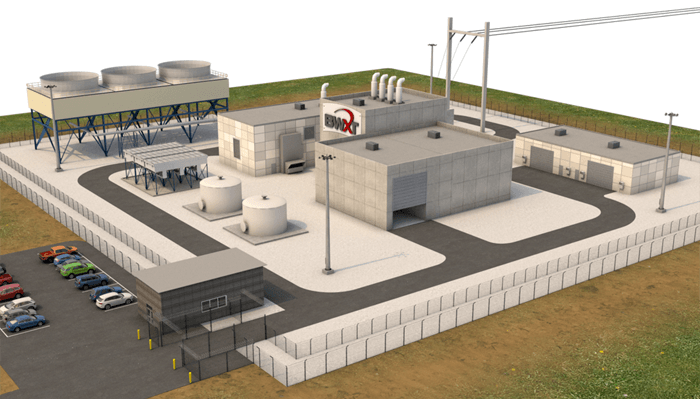
SMR Concept | Source: BWXT
BWXT’s technology that is used on naval ships is a pressurized water reactor (PWR). As shown below, basically, there is a primary coolant loop that circulates high-pressure water through the reactor core. The heat from the nuclear fission reaction is transferred to water, which stays liquid due to the high pressure (i.e., it doesn’t boil).
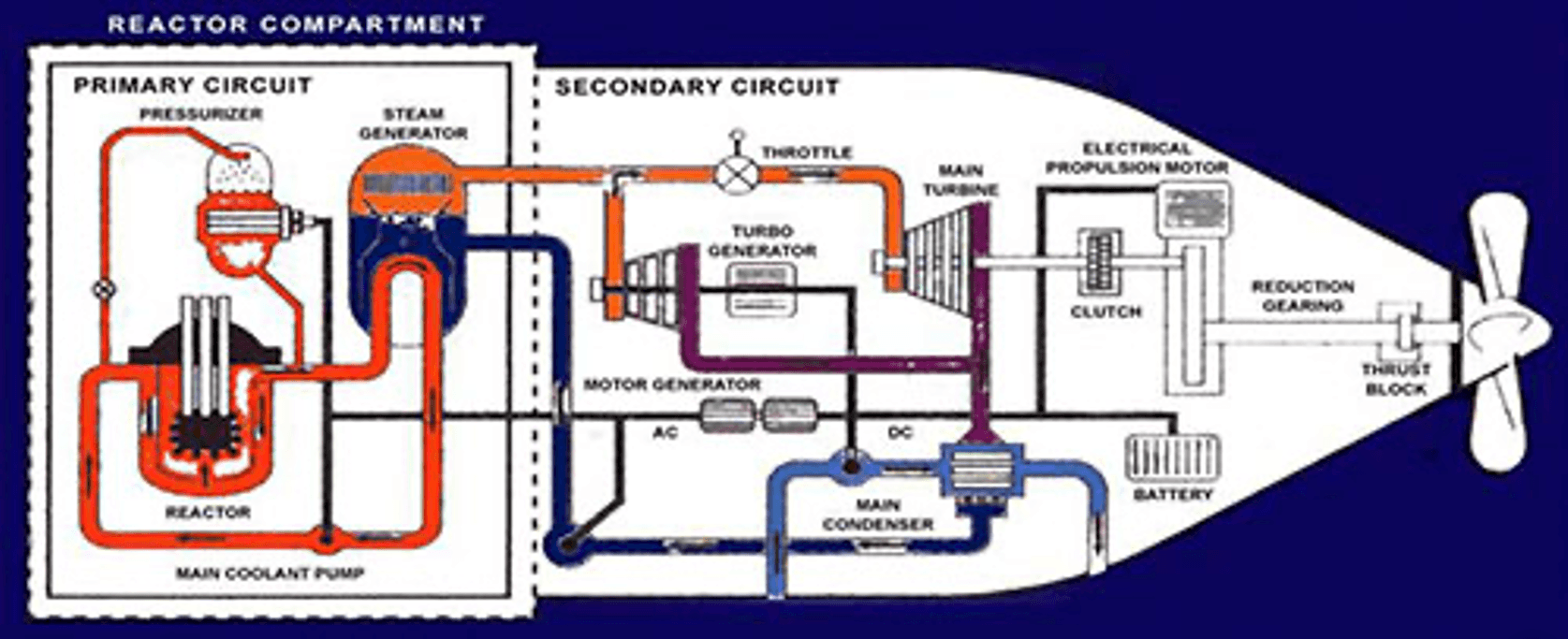
Naval Nuclear Reactor Diagram | Source: Naval Supply Systems Command
The loop transfers the heat into a steam generator to a secondary loop at a lower pressure so that the water can boil, producing steam. The steam is used to drive the propulsion as well as to create electricity.
These are extremely compact reactors and perfect for their designed purpose.
And one of the key differences from terrestrial SMRs is that they use highly enriched uranium (HEU) for fuel. Usually, the fuel is about 93% U-235, which is weapons-grade. This is why it is only used by the U.S. Navy.
The benefit, however, of using HEU is that it allows for a very long operational life of the core reactor measured in decades. Most submarines have core reactors that last the entire life of the submarine without needing refueling. And aircraft carriers typically need only one refueling during the entire life of the aircraft carrier.
By contrast, SMRs will use fuels like:
So, to summarize, we would call the naval nuclear reactors compact pressurized water reactors fueled by weapons-grade uranium.
Commercial SMRs would obviously operate far more efficiently if they also used HEU as a fuel, but the risks of nuclear weapons proliferation are simply too high for us to ever have nuclear regulations to allow that.
Jeff and Team…
Appreciate all the great research you bring to us.
I came across an article talking about a “Cancer Hunter” platform being developed by GT Biopharma (GTBP), called TriKE, which may be programmable to target multiple cancer types.
What do you know of this company and its research? Love reading your insights as a Brownstone Unlimited member.
– David C.
Hi David,
I always have mixed feelings about providing my thoughts on a company like GT Biopharma (GTBP).
I worry that giving a company like this airtime isn’t good for anyone. But I’ll use this as an example of how to view/analyze a company like this. I hope it is useful.
There are a lot of companies like this that appear to have a good story. For the uninformed, I wouldn’t fault anyone for thinking that GT Biopharma “might have a cure for cancer.”
Using the body’s own natural killer (NK) cells to fight cancer is a very exciting therapeutic approach that has incredible potential. What GT Biopharma is working on with its technology is interesting because:
This is GT Biopharma’s TriKE – Tri-Specific Natural Killer (NK) Cell Engagers.
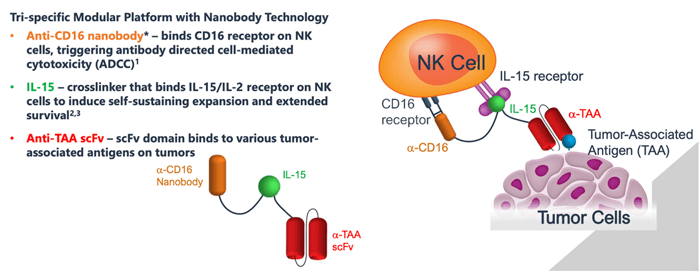
On the surface, it looks exciting. The therapy binds to the body’s NK cells and then takes those cells to various cancer proteins to destroy the cancer.
With that said, it has some challenges as well. These are small protein molecules that have a relatively short half-life, and the therapy is administered through an IV for a period of 72 hours. Definitely inconvenient, but if it worked, most patients would probably tolerate it.
This therapy is also designed for heavily pre-treated cancer patients, which means that natural killer cells may already be exhausted from those prior treatments.
This is simply to say that while the concept looks promising, making a therapy like this work effectively across numerous forms of cancer is a completely different story.
But let’s put the science aside for now. Viewing the company through the science alone is a horrible way to develop an investment thesis.
After all, if a company doesn’t have the right people or the capital to fund its research and trials, then it’s a moot point.
Here’s a five-year chart of GT Biopharma:
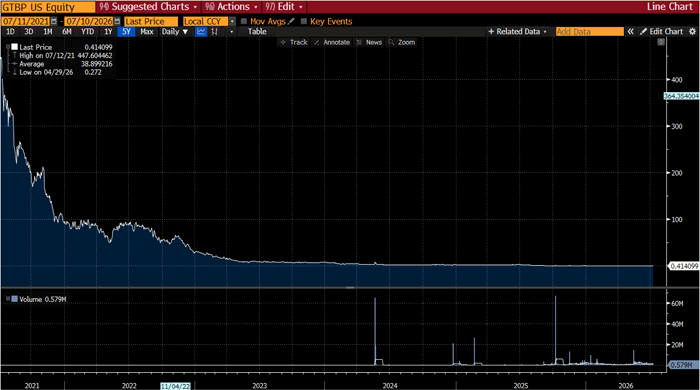
This is a disaster.
More importantly, the company has about a $15 million market cap and a $5.4 million enterprise value with only about $9 million in cash on hand, and it’s burning through $2.5- 4 million a quarter.
The company used to be known as OXIS International. It changed its name to GT Biopharma in 2017, along with shifting its focus to oncology. This was affected by licensing the TriKE technology from the University of Minnesota.
It hasn’t gone well.
The company has been suffering from chronic cash shortages, repeated secondary offerings that forced dilution on shareholders, multiple reverse stock splits in an effort to remain compliant with NASDAQ listing rules, leadership turnover, and very slow clinical progress, which doesn’t come as a surprise as the company seems like it is always just a few quarters away from bankruptcy.
And the team makes no sense at all.
Michael Breen is the executive chairman and CEO. His background is as a managing director for the Sports and Entertainment Division of a wealth management division of BNP Paribas. To ask the obvious question… what does his background have to do with oncology?
Jeffrey Miller is only a consulting medical director from the University of Minnesota, clearly tied to the licensing agreement. The company currently has no chief medical officer or chief science officer.
The board is equally a joke with two more bankers with no biopharma background, and only one director with a healthcare background.
GT Biopharma doesn’t have the people or the money to make any serious progress with its therapy. It desperately needs to raise capital, and any press release is designed to create enough hype to fuel some kind of secondary offering.
It is hard to imagine a company like this, with a decade of failure, being able to raise $100 million or more to hire the right people and make a concerted attempt to make meaningful progress with clinical trials.
That’s just how I objectively look at a company like this.
Hope that is useful,
Jeff
Add Brownstone Research as your preferred source on Google to see our latest stories in your feed.
 Add as a preferred source
Read the latest insights from the world of high technology.
Tesla and SpaceX have now formed special committees to evaluate a potential merger between these two Elon Musk-led powerhouses.

This isn't about simply recreating the old system on new infrastructure…

As companies give digital workers more responsibility, protecting their systems becomes part of the cost of putting AI to...