




The Next Great Leap in Automation
The fundamental relationship between man and machine has remained largely unchanged… Humans gave machines instructions, and the machines followed...



Since Moore’s prediction more than 20 years ago, a number of industry experts and media outlets have proclaimed an end to Moore’s Law.
In early 2005, Gordon Moore – whose research begot Moore’s Law – predicted a future end to the exponential scaling of semiconductor technology:
“We have another 10 to 20 years before we reach a fundamental limit.”
As a reminder, Moore’s Law says that the number of transistors in semiconductor integrated circuits doubles every 18–24 months. That, of course, increases computational performance accordingly.
For most, Moore’s 10-20 year prediction was easy to believe.
After all, he’s the “expert,” right?
Since Moore’s prediction more than 20 years ago, I’ve lost count of the number of industry experts and media outlets that have proclaimed an end to Moore’s Law.
They are too numerous to list. And I’ve always maintained that their dire predictions were wrong.
And here we are, 21 years later… and we continue to see an exponential rate of technological improvement in semiconductor technology.
I was reminded last month of the irony of these dire predictions of the last two decades by an announcement from IBM (IBM).
The announcement was about its self-proclaimed “major semiconductor breakthrough.”
IBM’s breakthrough, shown below, is a sub-1-nanometer semiconductor that contains almost 1 billion transistors on a chip just a bit bigger than a thumbnail.
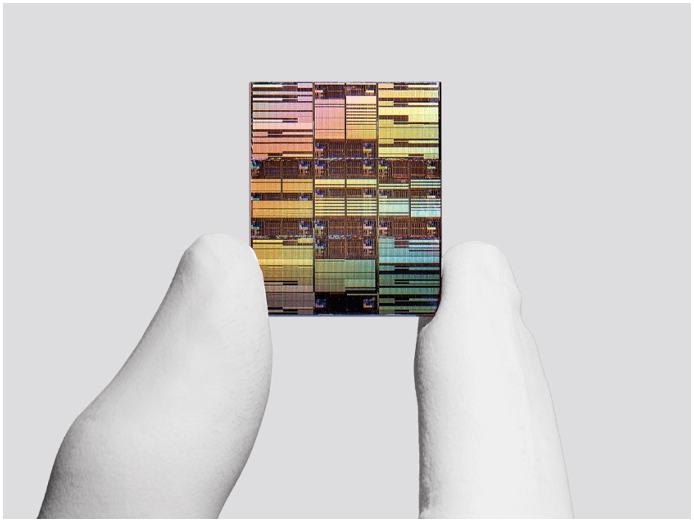
IBM’s Sub-1 nm Semiconductor | Source: IBM
The chip above was manufactured at a 0.7-nanometer process node, or 7 angstroms.
Historically, each generation of semiconductors would reference some kind of nanometer manufacturing process node. That nanometer designation has been used to specifically reference the smallest dimension of a transistor for a given node.
But as the technology advanced and manufacturing processes became dimensional by layering transistors, the nanometer designation became more of a reference to transistor density per unit of space.
As transistor density increases, semiconductors get smaller and more powerful.
And they also become more efficient in terms of power consumed per unit of compute.
This is the exponential scaling that underlies Moore’s Law.
It’s precisely why, every year, new generations of semiconductors have dramatically better performance than the previous generation.
The level of constant innovation and improvement in the semiconductor industry is incessant.
Semiconductor companies that pull back from investment or miss a major industry shift suffer badly… as the industry adopts the most advanced semiconductors for the best performance and efficiency.
Intel (INTC) has long been a poster child for what not to do over the last 20 years in the semiconductor industry.
It got mired in process and bureaucracy, its pace of innovation slowed, and it missed out on major trends like wireless semiconductors, artificial intelligence semiconductors, and power-efficient semiconductors for edge devices.
Intel has even been beaten in its own wheelhouse – CPUs for servers – by AMD, which continues to eat market share from Intel with higher-performance products year after year.
Intel even has to use TSMC to manufacture its highest-performance semiconductors because its own manufacturing processes have failed miserably at keeping up with TSMC. It is incapable of manufacturing them itself.
Intel has recently seen bullish movement in its share price. However, that’s based only on the hope that it will be able to turn itself around.
I certainly hope that it does, but it has years of work ahead of it.
Intel’s success is far from certain, given the shifts happening right now in the semiconductor industry.
Getting back to IBM…
IBM’s announcement is significant, as many in the industry over the years firmly believed that semiconductors could never be manufactured at a 2-nanometer process node or smaller.
And yet, here we are. A functional semiconductor at 0.7 nanometers.
Moore’s Law is alive and well, and the industry continues to do the unthinkable to find unique solutions to increase transistor density and scale exponentially.
It may seem odd to see an announcement like this from IBM.
Many in the media write about it like IBM is a semiconductor manufacturing company. It’s really not.
In 2015, IBM “sold” its semiconductor technology and manufacturing business to GlobalFoundries.
I say “sold” because IBM actually had to pay GlobalFoundries $1.5 billion to take over its semiconductor business and its manufacturing facilities in Essex Junction, Vermont, and East Fishkill, New York.
The semiconductor business was a failure. So much so, IBM paid another company to get out of the business.
Which is what makes its sub-1-nanometer announcement so interesting.
What IBM still does is conduct advanced semiconductor research.
And then it licenses out its semiconductor technology to companies that it hopes will manufacture semiconductors using its technology, and thus pay royalties back to IBM.
The financial media loved the announcement of its latest sub-1-nanometer technology.
IBM’s stock is up about 17% since the news was released.
Even reputable outlets like Barron’s celebrated the news and used IBM’s previous “breakthrough” of a 2-nanometer process node technology back in 2021 as another example of IBM’s semiconductor prowess.
Even a research director of IBM referenced the 2-nanometer reference design and made a misleading statement that “we highlighted the research, and now all leading foundries are manufacturing these.”
The gap between the news as presented and reality is what was surprising to me.
What is true is that the world’s leading semiconductor manufacturers are producing 2-nanometer semiconductors, but none of them are using IBM’s technology.
None of them uses IBM’s technology.
And only one company has licensed IBM’s 2 nanometer: Rapidus in Japan.
Rapidus is a Japanese state-sponsored semiconductor company that was established in 2022 as a last-ditch effort to create a domestic semiconductor company capable of manufacturing advanced semiconductors on par with Taiwan and the United States.
It hasn’t been going well.
Japan’s government owns about 40% of the equity of Rapidus, and a number of Japanese companies like Denso, Kioxia, MUFG Bank, NEC, NTT, SoftBank, Sony, and Toyota own the rest.
Of that list, only NEC, Sony, and Kioxia (formerly Toshiba Memory) have any experience with semiconductor technology.
Rapidus continues to burn capital.
Other than some small government research projects, it isn’t generating any revenue.
And it has no semiconductor product revenue because it is not yet manufacturing semiconductors. How’s that for a semiconductor company? No semiconductors.
That’s an obvious problem for both Rapidus… and for IBM.
Rapidus hopes to have some level of 2-nanometer production by the end of 2027, but that could easily slip, given how slow most Japan-based companies operate.
In the meantime, TSMC, Samsung Electronics, and Intel are all manufacturing 2-nanometer chips right now.
IBM’s sub-1-nanometer technology is certainly impressive.
To be able to layer transistors three-dimensionally to further increase transistor density and keep Moore’s Law alive is nothing to sneeze at.
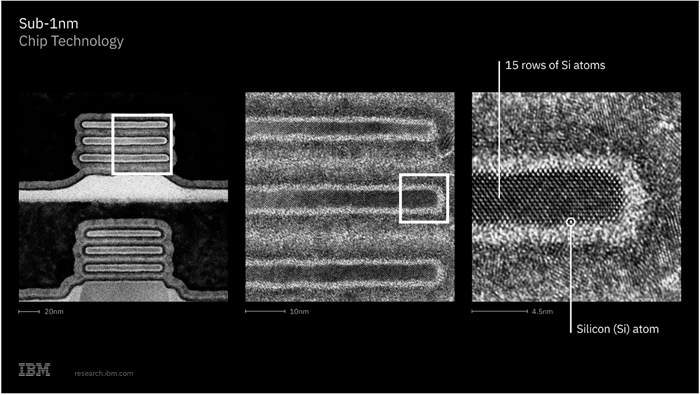
Source: IBM
And yet, despite the usefulness of the technology, the other major semiconductor foundries are developing similar technology at a far faster pace – and bringing it to production.
What IBM has done in a laboratory has not been proven in a production environment. And for that matter, neither has its 2-nanometer process.
Even more ironic is that IBM is using ASML’s (ASML) High Numerical Aperture Extreme Ultraviolet (High NA EUV) lithography machines to manufacture the prototype sub-1-nanometer semiconductor.
IBM is spending billions on semiconductor research, which generates an insignificant amount of revenue for the company. It consistently fails to commercialize its research.
And I’m confident that this will still be the case regardless of the most recent announcement.
It makes absolutely no sense for IBM’s stock to rise 17% on the back of the news.
It’s a perfect example of analysts/media not understanding the technology, not understanding the competitive semiconductor market, not understanding the business model, and just falling for a fancy marketing message.
But there is one key takeaway…
Moore’s Law is outliving all the predictions made about its demise.
Exponential scaling in transistor density, power efficiency, performance, and declining costs continues to bring us radical improvements year after year.
Semiconductors are the most critical enabling technology for artificial intelligence and all of its current and future applications.
Without semiconductor technology, we would be nowhere.
Add Brownstone Research as your preferred source on Google to see our latest stories in your feed.
 Add as a preferred source
Read the latest insights from the world of high technology.
The fundamental relationship between man and machine has remained largely unchanged… Humans gave machines instructions, and the machines followed...

Tomorrow’s loans won’t be written by the banks of today. The deposits will flow to where the yield is....

Figure AI had a problem to solve. It couldn’t decide how to decommission its previous generation of Figure 02...