







How “Clean” Is Nuclear Energy?
Before we get into today’s AMA, we want to acknowledge how incredibly special this weekend is in the U.S…

This weekend is incredibly special in the U.S…
It’s the 250th anniversary of the signing of the Declaration of Independence.
What started as an experiment – something never tried before – has evolved into the most successful country and economy in world history.
It is nearly impossible not to be ridiculously bullish right now on the future. I have never witnessed a regulatory environment that is proactively and positively engaging with private industry to develop frameworks for technologies, products, and services that will benefit society.
This single and simple regulatory shift has opened the floodgates for investment and innovation in all technological sectors. The breakthroughs that we will see in the next two to four years will be mind-blowing as a result, including artificial superintelligence.
I have never been more busy or more excited about the future to come. I hope all of you share that feeling as well. I do my best to bring the latest bleeding-edge developments to you all in The Bleeding Edge every week and answer your specific questions every Friday.
You are my motivation. Thank you.
It has also been heartening to see and hear all of the feedback and comments from visitors to America from around the world to attend the exciting World Cup games in the U.S.
The comments have been remarkable. Apologies to America have been everywhere. They have realized that they have been lied to and fed propaganda from their own countries’ media outlets about what it is like in America.
They have been having a fabulous time, enjoying this incredible country, something that is only possible with individual freedom, freedom of speech, a country that thrives on innovation, and protects individual rights.
I’ve traveled to and worked in about 70 countries around the world in my career. There is nothing like the U.S.
And even aside from the freedom to build, the freedom to innovate, and the freedom to live, there is no market in the world better to invest in than the United States.
Freedom reigns – Happy Fourth of July,
Jeff
What’s Up With Ripple (XRP)?
Jeff,
What do you know/think about XRP in the blockchain/tokenization world?
Thanks.
– Richard G.
Hi Richard,
Ripple is an interesting project when it comes to virtually any trend or narrative that is popular or emerging in the digital asset industry.
Ripple and its native digital asset, XRP, have an interesting history. Ripple was always buttoned up and proactive, making efforts to be compliant with existing regulations and working hard to engage regulators for regulatory clarity where none existed.
Despite its efforts, Ripple was tied up in a series of court cases, rulings, and regulatory purgatory starting back in December 2020. It was the victim of a political regime that saw its technology as a threat.
At the time, the SEC alleged Ripple raised $1.3 billion through the sale of its digital asset, XRP. The case has gone through many appeals and has created substantial impacts as it relates to how tokens are viewed by regulators. From my perspective, Ripple did an outstanding, buttoned-up job defending both itself and many common practices throughout the crypto industry.
Ripple, along with Coinbase, fought the battle against an antagonistic regime towards digital assets. Both companies took leadership positions in the industry, and their efforts have paid off, benefiting the entire industry.
The SEC dropped its lawsuit against Ripple just over a year ago. And shortly after, Ripple dropped its cross-appeal, effectively closing the case. Ripple settled with the SEC for just $50 million.
Over the years, Ripple’s token has been delisted on exchanges and seen periods of volatility as judgments have been delivered. Ripple itself has had its future called into question on multiple occasions.
What we need to be aware of is that Ripple has, in fact, been held back from growing its presence in the industry largely due to the SEC’s former regulation-by-enforcement mentality against it and the rest of the crypto industry.
Despite this, Ripple has done some work as it relates to creating applications on its network, has made XRP an asset used for cross-border instant settlement transactions on its network, and has acquired companies. It has its own RLUSD stablecoin. And is now diving headfirst into tokenization.
We can see the recent growth over the last year in its push towards tokenizing offchain assets.
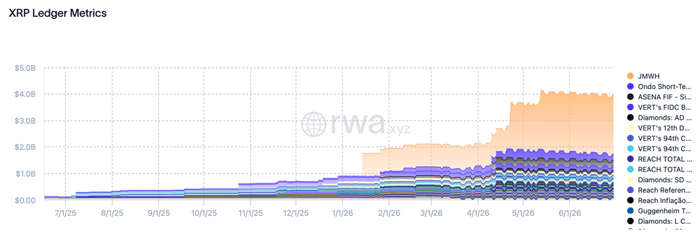
The biggest share of their market is a token called JMWH.
Each JMWH token represents one megawatt-hour (MWh) of energy backed by energy companies. The total amount of tokens represents the contractual commitment backed by the energy generation capacity of the generators. Once the energy is delivered and consumed, the token is burned.
We can think of this as a guarantee or almost like a transparent receipt. It’s a good start. But where most tokenized assets thrive is in what we call composability… Which is a way of saying the token itself can be used as collateral, can generate yield, or can simply interact with various protocols onchain.
We should wait until more assets on Ripple embrace composability before getting too excited about their foray into the tokenization trend.
Nonetheless, JMWH is a novel use case. And we can be certain there will be more use cases coming.
That’s because Ripple has one of the largest war chests of capital at its disposal thanks to the programmatic selling of its currency, of which it holds nearly 42 billion XRP as of their last report from Q1 2025. That’s a massive sum considering each XRP token is worth a little more than $1.
This means Ripple has plenty of runway to find product-market fit. Whether it’s in tokenization, DeFi, cross-border payments, or something else.
We should never underestimate how important capital can be, and it’s why it’s short-sighted to ever write off XRP as one of the dominant blockchains.
After all, Ripple has emerged victorious after standing up against the SEC and the anti-crypto administration over the span of four years.
Both the vision and the technology are great. Now with the freedom to operate, it’s all about execution.
Is Toyota’s Solid-State Upgrade Legitimate?
Is Toyota really developing a solid-state EV battery that can charge to 80% in five minutes and can go about 900 miles on a charge?
– Ken H.
Hi Ken,
I’ve written about solid-state battery technology a lot over the last decade. It has proven to be one of the topics Bleeding Edge subscribers are most interested in.
It makes sense. Pretty much everyone understands at a basic level lithium-ion batteries and how large the market is for them. And there are a lot of hypesters and hucksters on the internet proclaiming breakthroughs in battery technology all the time. Even well-known media outlets are guilty of getting the facts wrong all the time.
Toyota does have an aspiration to make a solid-state EV battery system capable of charging to 80% in 10 minutes with a 900-mile range. The five-minute claim is nonsense, and from what I can tell, it was perpetuated on social media.
To be very clear, Toyota has been promising solid-state batteries for more than a decade. Long ago, projects were that Toyota would have them ready in the 2020–2025 timeframe. And yet, here we are. Absolutely nothing to show.
This is a topic that I am directly familiar with. I lived and worked in Japan for 20 years, and I also worked in the semiconductor industry serving the automotive industry in Japan. Toyota was a customer at that time, and I was deeply involved in the Japanese automotive industry.
I think you might find this issue of The Bleeding Edge – The Battery Graveyard useful as it relates more generally to the challenge of developing solid-state batteries.
The chemistry of solid-state batteries is very complex. There has been limited success in laboratory settings, but no one, and I mean no one, has been able to commercialize solid-state batteries for electric vehicles.
The harsh realities are:
- Achieving interface stability between a solid electrolyte and electrodes is difficult
- Dendrite formation is a massive problem in solid-state batteries, which leads to short circuits and also fires
- The technology has proven very difficult to scale commercially and economically
And it’s that last bullet point that is the most important one. It’s fine if a company might be able to get a solid-state battery working in a laboratory. But if the technology can’t be scaled in manufacturing to mass production, and at a cost similar to what it costs to produce lithium-ion EV batteries, then adoption won’t follow.
Regardless of all of Toyota’s delays, it is now targeting a 2027–2028 timeframe for limited-production solid-state battery EVs. We’ll see. I’m very skeptical.
QuantumScape (QS) appears to be the farthest along in solid-state EV battery development. Note: this is not a recommendation. QuantumScape has built a pilot production line for its QSE-5 solid-state lithium-metal cells, which it is trialing with Volkswagen.
I do not, however, expect mass production or even large-scale commercialization anytime in the next couple of years. We’ll have to see how the testing is with Volkswagen first.
I hope this helps.
And believe me, if there is a major breakthrough in EV battery technology, particularly something investable, my subscribers will be the first to hear about it.
How “Clean” Is Nuclear Energy, Really?
Jeff,
I hate to throw cold water on a nuclear reactor, no matter how small it is, but the phrase “clean nuclear energy” is an oxymoron. Producing energy using nuclear power is by far the dirtiest way to create electricity.
Sure, today it produces ‘clean power,’ but in 5-20 years, when the SMRs need to be decommissioned?
I can already predict the future headlines: SMR company files for bankruptcy. Leaves dozens of reactors behind with no safe repository to dispose of the toxic sludge and equipment. Cities scramble to find a solution. Taxpayers left holding the bag. It’s an ever-repeating story.
– Richard K.
Hi Richard,
I don’t mind the skepticism at all, and I’m glad you wrote in.
But I will have to disagree with your position that “nuclear power is by far the dirtiest way to create electricity.”
Nuclear power, when in operation, has near-zero carbon dioxide emissions and uses zero fossil fuels for energy production. This is why the International Atomic Energy Agency, the International Energy Agency, the U.S. Department of Energy, the Center for Climate and Energy Solutions – whose work was tied to the Inflation Reduction Act – and so many other notable groups/agencies are now referring to nuclear energy as “clean energy.”
This is true even when we look at nuclear energy production on an entire lifecycle basis, which includes fuel extraction (mining), construction, operation, fuel processing, decommissioning, and waste management.
There is a lot of research on full lifecycle assessments of all energy sources, and nuclear energy is always on the cleanest end of the scale, comparable to wind energy. Below is a useful synthesis of existing research from the perspectives of “safest” and “cleanest.”
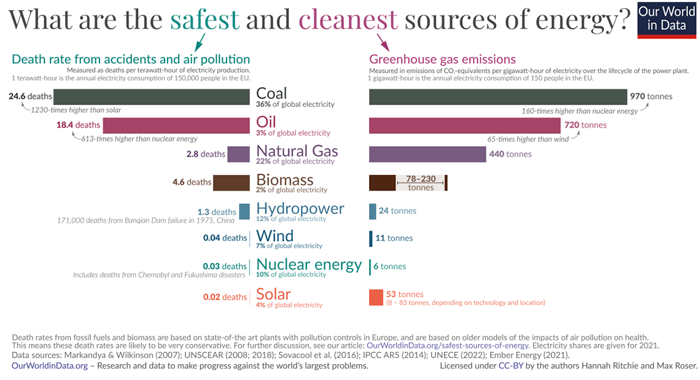
Source: Our World in Data
Nuclear energy is right on par with wind and solar for the “safest” and is the “cleanest,” even better than wind and solar.
It is worth differentiating between nuclear fission and nuclear fusion. The above analysis relates to existing nuclear fission energy production, which refers to the second- and third-generation nuclear fission technology in use today.
Fourth-generation nuclear fission technology – often referred to as advanced nuclear – has an even safer and cleaner profile than what is in use today.
And concerning nuclear fusion, some forms of fusion technology don’t even have short-lived nuclear waste. Other forms have very limited nuclear waste to manage – a tiny fraction of what a nuclear fission reactor would produce.
Nuclear energy will lead to a world of cheap, clean, emission-free energy that benefits society and also increases economic activity and productivity. I am ridiculously excited about that future.
And I am much more worried about U.S. taxpayers footing the bill for trillions of dollars of systemic corruption in welfare services, hospice care, childcare facilities, healthcare clinics, homeless/drug facilitation, pandemic aid in states like California, Minnesota, Illinois, Ohio, Massachusetts, Washington, Michigan, New York, New Jersey, and other places yet to be discovered.
We end up paying the bills while “they” get rich siphoning off our hard-earned dollars.
We’ve had enough. Time to clean it up. Prosecute the criminals and the politicians who enabled it. And lean into an incredibly bright, technology-enabled future of abundance.
Jeff
Continue following Brownstone Research
Add Brownstone Research as your preferred source on Google to see our latest stories in your feed.
 Add as a preferred source
More stories like this
Read the latest insights from the world of high technology.
-
-

Anduril’s Arsenal
This is a landmark deal and the most significant initiative in shipbuilding and defense technology since World War II.
-
Google’s Nuclear Deal Reveals the Scale of AI’s Power Problem
Google’s recent agreement reveals the scale of the AI power shortage and why supplying power is such an important...