



SpaceX to Launch a Mobile Network in the U.S.
Starlink Mobile is coming, and it can’t arrive soon enough.



Many are wondering if that fiction is actually our reality…

In 1964, science fiction author Daniel Galouye explored a topic that was far ahead of its time.
In Simulacron-3, Galouye envisioned a corporation that creates a hyper-detailed model of an entire city and all its inhabitants.
The creators of the model are an advanced society. The purpose is to model human behavior and societal dynamics, thereby creating a simulation that can be studied and learned from.
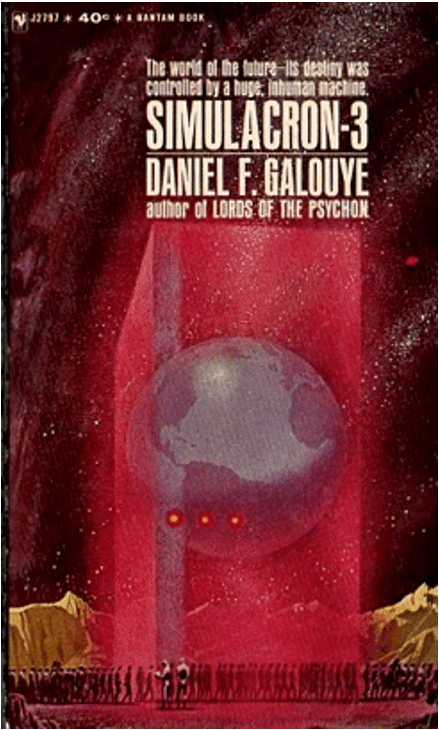
First Edition Cover of Simulacron-3, 1964
Iain M. Banks went one step further with the idea with his book Surface Detail, published in 2008. Part of his monumental Culture series of books, Banks envisioned full scale simulations for entire societies that were created and run by artificial intelligences known as “Minds.” These Minds and their simulations became part of Culture’s governance.

First Edition of Surface Detail, 2008
The simulations were used for learning and studying behaviors and possible future outcomes, as well as for the purpose of testing new approaches, policies, or ideas to guide and shape societal outcomes.
Banks went so far as to explore the ethics of creating these simulations, the issue of sentience within the simulations, and whether or not those sentient beings within simulations have any rights.
After all, if the Minds were to shut down a simulation full of sentient beings, would that amount to genocide?
It makes for great fiction.
But given the latest developments in semiconductor technology and artificial intelligence, many are wondering if that fiction is actually our reality.
Known as simulation theory, it essentially proposes that our entire reality is a simulation, one that is being hosted by a far more advanced civilization with far more computational power and energy to do so.
It’s an uncomfortable thought, but not an unreasonable theory.
Swedish philosopher and futurist Nick Bostrom contextualized the theory with his 2003 paper Are You Living in a Computer Simulation?
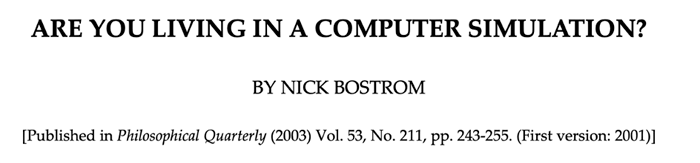
His basic assumption in the paper is that “a technologically mature “posthuman” civilization would have enormous computing power.” It would therefore pursue complex simulations for precisely the purpose that Banks and Galouye envisioned.
Bostrom concluded that “the simulation argument shows that at least one of the following propositions is true:”
The implications are:
Simplifying it a bit…
If we believe that a civilization can reach a post human state (an advanced civilization full of abundance) and that there could be enough computational resources to run civilization-scale simulations, then the probability that we are in a simulation is extremely high.
Ironically, the critics of Bostrom and the simulation theory have very weak arguments. They mostly center around the “impossibility” to have the computational resources to run such a simulation, and that there is no experiment that can be run to prove or disprove the simulation theory from inside the simulation.
It’s easy to forget that semiconductor technology, and thus computational resources are growing at an exponential rate. We’ve already hit the inflection point, the curve in the hockey stick where each doubling has an even more extraordinary impact.
The implications are that computational resources within just three or four years will be almost unrecognizable from what we have today. We will see the birth of an artificial superintelligence within that timeframe. And that progress will only be compounded with the advent of a universal fault tolerant quantum computer.
Given these latest developments, it was inevitable that a company began to pursue the development of powerful simulations.
Earlier this year, Simile AI raised $100 million led by Index Ventures to do exactly that.
The company was only founded in late 2025 and came out of the gate with a $100 million raise early this year, giving it the capital to develop meaningful simulations.
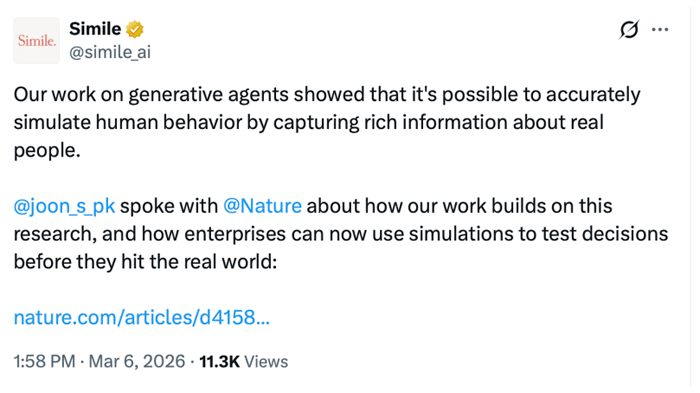
Source: X.com/@simile_ai
Simile’s approach is common sense.
It aims to create simulations full of AI agents to simulate human behavior and complex systems for the purpose of gaining insights and understanding predictive outcomes.
The company’s product or service is very much enterprise- or government-facing. For example, if a company has a new concept, a new product idea, or a new marketing message, they can test that within an AI-powered simulation.
Or if a company wanted to run 100 or 1,000 simulations about competitive outcomes with a variety of different products, it could do so using Simile’s technology.
One of the examples that the CEO of Simile gave was to simulate the effect of an earnings call.
This is done using a multi-agent simulation. A simulation can be used to generate and test 100 different ways to frame and deliver an earnings call, and the best outcome of the simulation could be used as a framework for the actual earnings call.
There are also simulations that could be very useful to a government.
For example, if the technology were available last year, the Western world could have run simulations on how to best eliminate the nuclear threat of the IRGC in Iran, and how best to return control of Iran to the Persian people.
Macroeconomic simulations are also a great application of this technology.
One of the most relevant ones is a simulation on the deflationary impact of the adoption of AI in the U.S. and how best to implement interest rate policy to offset the deflation. Optimized decisions of interest rate policy can lead to an optimized economic outcome.
The kinds of simulations that Simile envisions could be immensely useful for simulating the impact of a new policy on the economy or on society.
If used properly, it could be an extremely helpful tool to guide policy making and effect the best possible economic and societal outcome, assuming that is the end goal. I sincerely hope that it is.
While we are just at the beginning of developing these complex and powerful simulations full of AI agents capable of representing human behavior, the implications are profound. And the acceleration in simulations will be exponential.
Many more companies will follow Simile. Billions will be invested to better understand future outcomes.
In time, we will have the computational resources to model entire civilizations in a simulation.
And I certainly hope that humanity survives the next decade and evolves into the world of abundance that I have been predicting is coming…
Which begs the question…
Are we in a simulation or not?
Jeff
Add Brownstone Research as your preferred source on Google to see our latest stories in your feed.
 Add as a preferred source
Read the latest insights from the world of high technology.
Starlink Mobile is coming, and it can’t arrive soon enough.

Most Bitcoin predictions are not about being right... They're about grabbing a headline.
The fundamental relationship between man and machine has remained largely unchanged… Humans gave machines instructions, and the machines followed...