


The Largest Merger in History
Tesla and SpaceX have now formed special committees to evaluate a potential merger between these two Elon Musk-led powerhouses.



Last Friday, Apple dropped a bombshell lawsuit…
In May this year, a U.S. District Court Judge dismissed the lawsuit against OpenAI – levied by Elon Musk.
The lawsuit stated that Sam Altman and Greg Brockman breached the laws concerning OpenAI as a charitable trust and used the trust unlawfully as a means for self-enrichment.
Sadly, the merits of the case were never heard.
Had they been, I believe Musk would have prevailed against OpenAI.
The judge dismissed the case on a technicality, specifically that Musk had missed the opportunity to bring his case against OpenAI due to the statute of limitations.
The argument was over whether Musk waited too long to sue.
It was a disappointing outcome, as the case should have been heard.
The implications are vast as well, as they would have impacted the abuse of charitable trust structures for the purpose of self-enrichment in the present and the future.
OpenAI got lucky, very lucky, as a verdict against OpenAI would have likely required a complete restructuring of the company.
Equity values held by investors and employees of OpenAI would likely have collapsed at the private company and would have been followed by an exodus of talent.
Musk has vowed to file an appeal with the Ninth Circuit, which is the right thing to do.
But for now, in the short-term, OpenAI appears to have gotten away with it.
With the case being dismissed, OpenAI was able to turn around and raise $520 million of debt from Bank of America.
And OpenAI is now gearing up for a potential IPO later this year.
But it’s not out of the woods yet…
Last Friday, Apple (AAPL) dropped a bombshell lawsuit against Chang Liu, Tang Yew Tan, OpenAI Foundation (i.e., OpenAI, Inc.), OpenAI Group, and IO Products.
Liu and Tan were both key employees at Apple – now employed by OpenAI.
For those interested, the filing can be found here.
And there is zero chance that this case could be dropped on a technicality. It will be heard.
Apple’s lawsuit demands a jury… and alleges that former Apple employees have stolen “Apple’s trade secrets for the benefit of OpenAI.”
It is directly referencing Apple employees who have gone on to become OpenAI employees, of whom Apple maintains there are more than 400 who made the switch to OpenAI.
This is a massive lawsuit, as Apple outlines in very clear detail the range of trade secrets that it claims have been stolen by former Apple employees, including:
Reading the above, which is all outlined in the lawsuit, basically represents Apple’s entire business, intellectual property, and industrial know-how. Knowledge and intellectual property that is the result of hundreds of billions of dollars in investment made by Apple over the last few decades.
Haters and detractors of Apple are already taking the position that this lawsuit is an anticompetitive move by Apple designed to stifle future competition.
The Wall Street Journal referred to it as a “thermonuclear response” to the “OpenAI threat,” referring to OpenAI’s open plans to develop a new AI-enabled communications device that would compete with Apple’s iPhone.
The same article in the Wall Street Journal claimed that Google, Samsung, Meta, Microsoft, and Amazon have all tried to supplant Apple but have failed.
I found this the most interesting because Apple has about 58% market share in the U.S. versus 41.6% for Google’s Android OS. For a long time, the U.S. mobile market has been split between Apple and Google mobile operating systems.
And worldwide, Google’s Android OS has about 70% market share, with Apple capturing only about 31%. The facts are clear… Google dominates the global market for mobile operating systems. And most of Google’s advertising revenue comes from its Android OS for mobile devices.
Globally, Google dominates the smartphone market with its operating system, not Apple.
What’s striking about the lawsuit, however, is the level of specificity involved in its claims.
Just for some color, here are a few examples:
The filing gets so much worse, as Liu was just an example.
Tang Yew Tan, also named directly in the suit, was the former vice president of product design for the iPhone and the iWatch, after 24 years with Apple.
According to Apple, other former employees who left for OpenAI e-mailed Apple’s confidential information to private e-mail accounts before they left Apple.
The breadth and scale of this lawsuit are extraordinary.
And two things can be true at the same time:
And from an industry perspective, when I think about competitive dynamics in the smartphone industry, two things are obvious:
Whether legally – through acquisitions – or illegally through the help of former Apple employees, it appears that OpenAI has done everything it can to acquire as many of Apple’s trade secrets as possible in its desire to develop and launch its competitive product.
That’s what’s spelled out in the Apple lawsuit.
What’s happening now indicates a massive inflection point in the smartphone industry.
It’s the point at which AI-native consumer electronics devices are being developed, which will eventually supplant what we know today as a smartphone.
Even SpaceX (SPCX) was reported to have shown a prototype for a new form of AI handset when it was conducting its roadshow for its public offering.
Musk has been public that he has no interest at all in developing a new phone, but if he had no choice for competitive reasons, he would do it. To no surprise, Musk was quick to call out OpenAI CEO Sam Altman for his business practices.
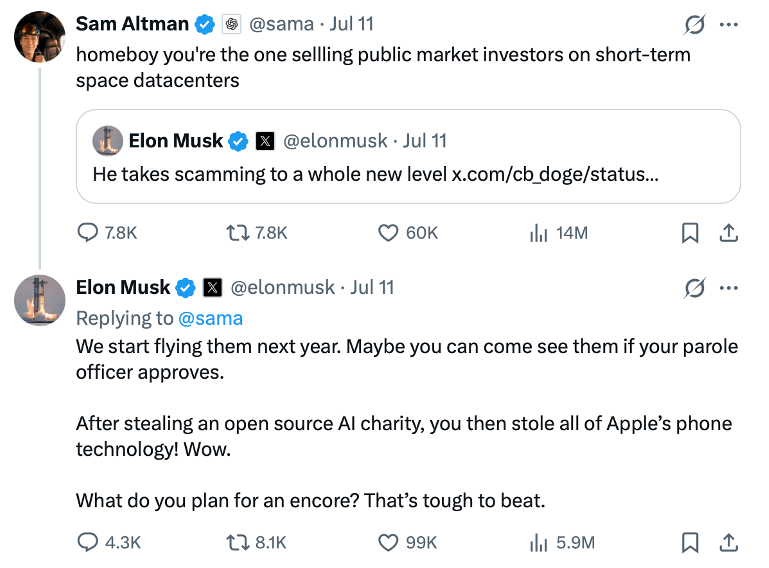
OpenAI and its antics may very well be enough reason for SpaceXAI to develop a new handset…if SpaceXAI did it, we can be sure it would be built around Grok and would connect to Starlink.
Either way, we’re in for a major battle between Apple and OpenAI.
And it will get its day in court.
And as consumers, we’re also due for some incredible innovation in new “communications devices” that will be AI-first electronics.
I believe that these devices will have spatial and contextual awareness.
The embedded AI will be capable of understanding all audio within range and will have sensors and vision to have a complete contextual understanding of the surrounding environment.
And its embedded intelligence will be capable of using that information to both deliver utility to its users, as well as mine information for learning, and ultimately advertising/commerce.
We’re in for some radical changes.
And privacy issues aside, the new technology will be adopted like wildfire. It’s been about 20 years since Apple’s release of the first iPhone, and the rest of the industry has copied Apple’s design.
Whether the market knows it or not yet, it is hungry for the convenience and utility that will be provided by intelligent personal communicators, the next generation of mobile devices.
Add Brownstone Research as your preferred source on Google to see our latest stories in your feed.
 Add as a preferred source
Read the latest insights from the world of high technology.
Tesla and SpaceX have now formed special committees to evaluate a potential merger between these two Elon Musk-led powerhouses.
This isn't about simply recreating the old system on new infrastructure…
As companies give digital workers more responsibility, protecting their systems becomes part of the cost of putting AI to...