



Coastal Transportation Redefined
We’ve been waiting for future forms of commercial transportation for decades, and finally that time has come.



By boxing Starlink out with their JV, they will force SpaceX’s hand to offer services directly to consumers...

It’s an odd and unexpected partnership.
Three giant companies compete aggressively with each other every day to win each other’s subscribers. And they just announced a joint venture (JV) together.
Verizon (VZ), T-Mobile (TMUS), and AT&T (T) are the three mobile network operators (MNOs) that dominate the U.S. market, with an approximate 96% market share between them.
All three MNOs have incredible scale to their businesses. Each has more than 100 million subscribers.
It’s very rare to see this kind of balance in a major market amongst three strong competitors fighting tooth and nail to grow in an already saturated market. That makes their JV that much more unusual.
Announced just in the last month, the three wireless operators are establishing a JV to pool together spectrum resources in an effort to boost “coverage and connectivity for underserved communities in remote regions.”
The announcement’s stated goal is to end dead zones in the U.S. These are areas where there is no wireless network coverage. The population densities are too small to justify the wireless network buildout.
As with most announcements like this, there was plenty of virtuous language like “the partners will be able to enhance convenience for their customers, enable competition and foster innovation and growth in the industry.”
On the surface, the announcement sounded great. It was positioned as if there currently wasn’t any solution to provide coverage to remote areas of the U.S.
However, the opposite is true.
Direct-to-Device (D2D) technology has been in use for years now, specifically by the three members of the JV.
All three wireless operators already provide nationwide coverage for all remote areas in the U.S.
What this means is that the JV isn’t really about providing coverage to remote areas. The real motivation is to address a competitive threat from a player outside the industry.
That would be SpaceX (SPCX) and its Starlink D2D service.
The competitive threat to T-Mobile, AT&T, and Verizon is twofold.
First, the exclusive deal that T-Mobile signed with SpaceX comes to an end this July. It was only for a one-year duration from the commercial launch. That frees up SpaceX to pursue additional partnerships and business models.
The second issue is something that I most recently wrote about in The Battle for Orbital Web Services. Namely, SpaceX has made a series of strategic acquisitions from Echostar (SATS) to acquire wireless spectrum that is used to provide advanced wireless services, including D2D services.
D2D technology companies like AST SpaceMobile and Lynk Global don’t have the resources to acquire their own spectrum for services. They have to partner with wireless operators around the world and deliver their services over the wireless operator-owned spectrum in each country.
SpaceX doesn’t have that problem…
The company, and to a lesser extent Globalstar (GSAT), acquired their own spectrum and can deliver those services without relying upon the wireless operators.
Historically, D2D firms and the MNOs have been partners. Now, they’re being seen as a potential competitors.
The catalyst was a recent announcement by Amazon (AMZN).
In April, the company revealed it would acquire Globalstar for $11.57 billion. This acquisition was entirely for spectrum. As I wrote in The Bleeding Edge on April 15:
Globalstar was the next best option. But SpaceX’s spectrum is like the prime spectrum real estate. Amazon is left with the scraps.
The worst part is that Amazon ended up paying more than SpaceX on a per MHz basis. SpaceX paid about $340 million per MHz on its initial deal. Amazon ended up paying about $1 billion per MHz because it snoozed.
Amazon’s acquisition of Globalstar raised the hair on the back of the necks of the MNOs. They realized that both SpaceX and Amazon could now become wireless competitors to terrestrial mobile network operators.
Some are concerned that SpaceX, or Amazon, will become a mobile virtual network operator (MVNO) that competes directly with other wireless operators under the Starlink or Amazon brand. This would require SpaceX or Amazon to strike a deal with one of the terrestrial wireless operators to use their wireless network for their service in areas that already have wireless coverage.
Examples of MVNOs in the U.S. are companies like Mint Mobile (runs on T-Mobile’s network), Xfinity Mobile (runs on Verizon), or Cricket Wireless (runs on AT&T).
These companies are basically marketing companies that offer discounted services utilizing one of the big three wireless networks in the U.S. MVNOs exist everywhere around the world.
SpaceX Starlink, and eventually Amazon, bring a lot more to the table as an MVNO. They bring valuable spectrum and satellites that enable the D2D services which will give them more leverage in any future negotiations with MNOs.
But that’s not the largest perceived competitive threat.
What the wireless operators are really worried about is that SpaceX Starlink will become its own nationwide wireless operator and circumvent the three MNOs in the U.S. entirely.
With the spectrum that SpaceX now owns, this is technically possible, but with shortcomings.
D2D technology only works outside and with direct line of sight to the satellites. Obviously, being able to use your mobile phone indoors is important to us all. The only way that happens is if a mobile phone connects to a Wi-Fi network. That would enable calls over the Wi-Fi network as opposed to the Starlink constellation of satellites.
For subscribers who know that they will always have Wi-Fi access whenever indoors, this kind of service would be sufficient.
But for those who are on the move and frequently visiting new places, it would be problematic.
But SpaceX poses enough of a threat to Verizon, AT&T, and T-Mobile that the three are willing to band together. It’s all about protecting the business they already have.
And it will almost certainly backfire.
After the announcement, the president of SpaceX, Gwynne Shotwell, implied that the three wireless operators were trying to box out SpaceX’s Starlink D2D service from the U.S. market.
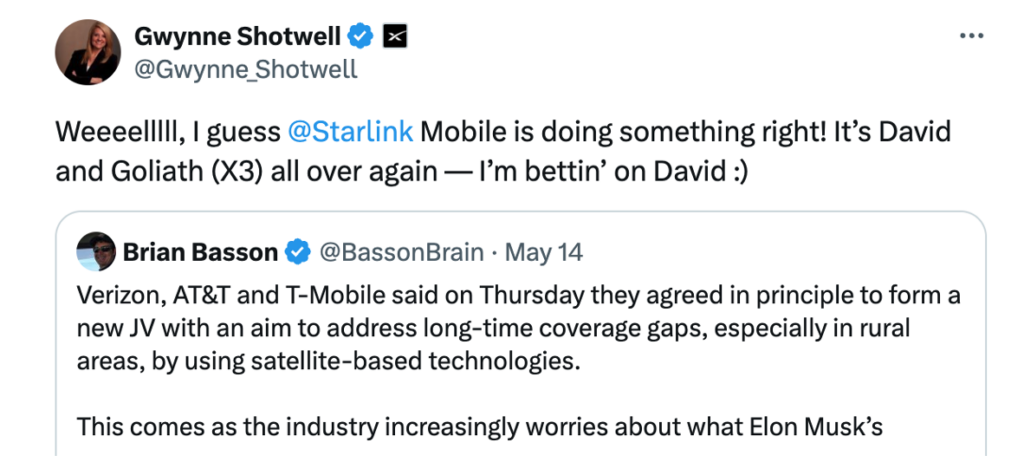
Source: X.com
The irony is that the JV will almost certainly help create what it’s designed to stop – SpaceX as a real competitor.
Think about it.
Had the wireless operators partnered with SpaceX for D2D services and leveraged its Starlink direct-to-cell satellites, they would have received best in class services from the largest and most advanced satellite communications network in history.
By boxing Starlink out with their JV, they will force SpaceX’s hand to offer services directly to consumers rather than in partnership with the wireless operators. That’s exactly what the MNOs wanted to avoid.
It’s foolish, old-school thinking by the heavily indebted legacy incumbents. And it will cost them dearly.
SpaceX and Amazon have both the technology and the spectrum. Just as important, they have the cash to build a competing business.
They can. And they will.
Jeff
Add Brownstone Research as your preferred source on Google to see our latest stories in your feed.
 Add as a preferred source
Read the latest insights from the world of high technology.
We’ve been waiting for future forms of commercial transportation for decades, and finally that time has come.
It’s now very clear that Tesla and the NHTSA have been working closely together…

These two IPOs will be nothing more than liquidity events for the effective altruists, venture capital firms, and private...