




Beware of Biased Billionaires
Over the last week, we have discovered that this is a massive, well-coordinated psyop carried out by some powerful...



Announced yesterday, the DOE has selected the Prometheus project to receive a $60 million award as part of Phase II of the Genesis Mission…

The U.S. Department of Energy (DOE) hasn’t wasted any time at all.
In less than 12 months, the ridiculously successful Reactor Pilot Program selected 11 nuclear energy projects – managed by 10 companies – with the stated goal of demonstrating criticality (a self-sustaining nuclear fission reaction) by July 4, 2026.
It’s unusual for me to use language like that associated with any government program…
But the results are hard to argue with.
We’ve never seen such short time frames in nuclear energy technology, which is typically measured in years, if not decades.
This happened in months.
The DOE’s stated goal was to have three companies demonstrate criticality by July 4, 2026…
And four companies succeeded in achieving the audacious goal, namely:
But that’s not the end of the story at all.
In the weeks since the deadline, other companies that were in the race have continued their efforts to complete their mission and are closing in on criticality.
They may have missed the July 4 deadline, but their future accomplishments in the weeks that follow are equally as significant as the four named above.
This kind of momentum in the nuclear energy industry is unheard of. I’ve never seen anything like this in my lifetime.
Which is why the DOE wants to keep the momentum going.
Announced yesterday, the DOE has selected the Prometheus project to receive a $60 million award as part of Phase II of the Genesis Mission.
The Genesis Mission was originally established in November 2025 by Executive Order 14363, designed to drive “AI-accelerated innovation and discovery that can solve the most challenging problems of this century.”
The Prometheus project is a public-private partnership led by the Idaho National Laboratory (INL). It includes the resources of the Oak Ridge National Laboratory, Argonne National Laboratory, Sandia National Laboratories, several university laboratories, and several prominent technology companies like:
The above names, both public and private, are all names for us to keep an eye on. They have been working closely with the DOE over the last couple of years and have strong traction in supporting and ultimately achieving commercialization of advanced nuclear reactors onto the power grid in the U.S.
In addition to the $60 million grant from the DOE, the 32 partners in the Prometheus project are contributing about $200 million of in-kind services and $30 million of capital in an effort to accelerate advanced nuclear reactor development.
In a world where billions or hundreds of billions of dollars are invested in artificial intelligence (AI) infrastructure annually, the amounts related to the Prometheus project may not seem like much.
But in this case, it’s not the dollar amount that is significant…
It’s the much-needed public-private partnership, collaboration, and ultimately acceleration that is so materially important.
Without the focus of the DOE and the Nuclear Regulatory Commission (NRC), advancements in nuclear energy technology would be impossible.
The whole point of the Prometheus project is to leverage AI “to design, license, manufacture, construct, and operate nuclear reactors.”
This is precisely why companies like NVIDIA and Amazon Web Services are involved in this project.
The goal of Prometheus is simple and clear: a 10X reduction in design and licensing workflow time, a 3X reduction in manufacturing cycle time, and a 50% reduction in operational staffing requirements.

Source: Idaho National Laboratory
These types of aggressive targets aren’t normal for government entity programs.
They are more indicative of what we might see from Silicon Valley.
And that’s exactly the point.
Private industry just demonstrated that it could develop prototypes of advanced nuclear reactors and demonstrate criticality in less than 12 months.
These are Silicon Valley timelines for deep tech… something that is rare to see.
And while most people typically think of large language models (LLMs), chatbots, or perhaps software coding when they think of artificial intelligence…
Nuclear energy technology and reactor operations are a perfect example of the profound impact that AI is already having in deep tech sectors, where commercialization used to take decades.
Now, with artificial intelligence, commercialization can be achieved in just a few short years.
For example, Aalo Atomics is on track to commission a commercial-scale, 10-megawatt electricity (MWe) reactor on Idaho National Laboratory (INL) grounds to power an onsite data center next year (2027).
Antares is on track to do the same with its Mark-1 reactor, powering first customer deployments in 2027 and a first military application in 2028.
Small modular reactors (SMRs) are very attractive to defense in remote locations that aren’t close to a commercial power grid.
And TerraPower, with its Natrium sodium fast reactor, is well under construction in Kemmerer, Wyoming, a site that I visited not too long ago.
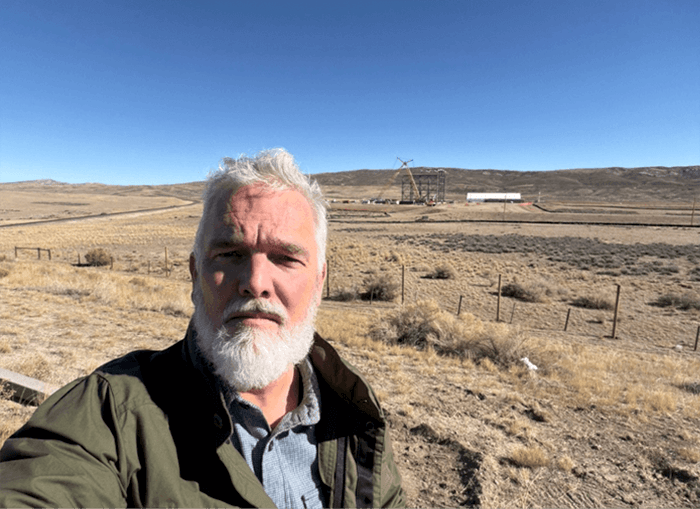
The TerraPower Natrium reactor plant construction site | November 2025
TerraPower and X-Energy have a strategic relationship with the DOE.
Both companies have already received $80 million in federal funding towards power plants that need to be operational within seven years.
The grants are part of the DOE’s Advanced Reactor Demonstration Program (ARDP), which provides up to $3.2 billion in funding on a 50/50 cost-shared basis between the named partners.
This engagement by the DOE and NRC, combined with the employment of AI to generate, analyze, and verify reactor designs to accelerate licensing and manufacturing of advanced nuclear reactors, is precisely what is giving private capital the willingness to invest billions of dollars into promising nuclear energy technology companies.
In any industry that is heavily regulated, this is critical to affecting desired outcomes.
In Greek mythology, Prometheus stole fire from the gods of Olympus and gave it to humanity.
It was this act that accelerated technological progress and civilization.
The story of Prometheus also symbolizes the importance of balancing the benefits that new technology will bring with the necessity to use that technology responsibly.
We sit on the cusp of a radical change and improvement – in safe, clean energy production from advanced nuclear fission reactors and nuclear fusion reactors.
And we are just months away from the first prototypes producing sustained electricity.
Add Brownstone Research as your preferred source on Google to see our latest stories in your feed.
 Add as a preferred source
Read the latest insights from the world of high technology.
Over the last week, we have discovered that this is a massive, well-coordinated psyop carried out by some powerful...

Last month I was excited to see an announcement made by a leading humanoid robotics firm, Figure AI, for...

When demand exceeds supply, something has to give…