




Beware of Biased Billionaires
Over the last week, we have discovered that this is a massive, well-coordinated psyop carried out by some powerful...



Today is an exciting day for SpaceXAI…

Today is an exciting day for SpaceXAI (SPCX), as its 13th Starship test launch is looking good for this evening.
The launch window will open at 5:45 Central Time for 90 minutes. For anyone interested in watching, you can view it right here on X. Coverage will begin around 5:10 Central Time.

Starship | Source: X @SpaceX
Having been on site and seen the SpaceX facilities up close, these launches are that much more real for me. Each launch brings the world one step closer to unlocking a vibrant space economy and incredible economic growth.
The 13th test flight of Starship and the Super Heavy booster is a special one as SpaceXAI is testing out its third generation of Starship and booster. It is also carrying 20 Starlink version 3 (V3) satellites for testing deployment and functionality.
These Starlink V3 satellites will test the deployment of their solar arrays and antennas, as well as attempt to connect with the existing Starlink constellation in low Earth orbit (LEO).
Starlink V3 satellites are massive at nearly 2,000 kilograms and have a 1-terabit-per-second downlink, which is more than 10X that of Starlink V2 mini satellites. They will be transformational for the Starlink constellation, which is now planned to be increased to 100,000 satellites. The current constellation is about 10,000, so that will be a 10X increase.
Commercializing the Starship is the key to both the future Starlink satellite constellation, as well as the forthcoming Starmind constellation of AI data center satellites.

The kind of volatility that we witnessed this week is just short-term noise in the markets.
The underlying investment and growth in robotics, AI, aerospace, autonomy, automation, and reindustrialization are economic forces that don’t care about market volatility.
They are generational changes in technological advancement and economic growth, and the most exciting part is that we are still at the early stages of growth and adoption in each one of these sectors.
Have a wonderful weekend,
Jeff
Ben,
If tokenized stocks are on the blockchain, then doesn’t it make sense that actual equities will migrate to the blockchain in time?
P.S. It seems to me like tokenized stocks are very similar to “tracking stocks” that had limited popularity in the 1990s. Best Regards.
– Kevin W.
Hi Kevin, Ben here.
To address your question directly, yes. Equity will be issued natively onchain… In fact, it already is.
But to understand the nuance to it, let’s break down some of the various “flavors” of tokenized stocks that exist. We’ll go from a version that gives a holder the least number of legal rights to the version that is natively onchain.
The first bucket is essentially speculative versions of tokenized stocks, the synthetic derivative bucket.
This appeals to traders wanting exposure to the price of the asset but aren’t overly concerned with owning the rights attached to a stock.
The most popular version of this is the pure derivative form, such as what sits on Hyperliquid’s trade.xyz markets. There are oil, commodities, stock, ETF, and even pre-IPO markets. These contracts do not claim to have any ownership rights as it relates to the asset they track. It’s purely a market mechanism that helps the contract track the price of the underlying asset it depicts.
The next bucket is custodial tokens with no governance.
This includes offerings like xStocks by Kraken and Robinhood’s stock tokens. The tokens have 1:1 full backing, custody, and audits.
The token itself is better viewed as a debt instrument or depository receipt between the company issuing the token and the holder. It’s not the worst model, as the holder does have legal rights to the underlying stock it represents.
The main shortfall here is the lack of governance that a shareholder might expect. In all actuality, this model likely suffices for what most retail investors want – price exposure with some legal rights to the underlying.
Then there are the tokens that go a step further. They operate similarly to xStocks and Robinhood, but add governance functions.
These are the tokens coming out of Ondo Finance and Dinari. Even the DTCC’s solution most closely sits here. In this bucket, the token holder essentially holds the same rights as they can expect from their brokerage account.
Shares are held in conventional custody, and economic as well as governance rights are passed along to the holder.
But even this falls short of what is viewed as the truly native or onchain model. We call this last bucket the Issuer-Sponsored Token (IST).
ISTs don’t use an intermediate custodian, no wrappers, and no special debt vehicle setup.
The token is the share.
Companies like Superstate, Galaxy Digital, and Securitize are pursuing this model. Injective, a blockchain network, recently filed paperwork with the SEC to attempt to compete in this arena. Ondo Finance is another name that has the legal standing to also compete here.
The IST world is likely to be the end destination for these tokenized equities. The reason has to do with topics like composability, settlement, and cost of capital.
In a world where we are trading 24/7, globally… There suddenly becomes a pressing need for a bank to be able to settle the trading of assets in almost real-time.
This settlement time frame is most realistic with ISTs because there is no offchain updating that needs to occur, as seen with custodial solutions. This opens up better capital efficiency and reduces risks that can arise from holding an asset on your books as you wait a day or two for settlement.
It also means a bank, fund, or other entity is no longer sitting on idle capital waiting for that settlement. With near-instant settlement, that capital can move faster than ever before. This allows for greater risk management and even higher returns as capital can be continuously at work.
ISTs have the least amount of friction for onchain stocks. And it’s where I expect the future of finance to settle on as time passes. It might not happen fully at first. But in time, we should expect this to become the de facto way we hold assets.
Ben
Jeff,
Your view on AGI-driven prosperity assumes endless demand to match the explosive supply. But AI and robots don’t consume – humans do.
If AGI displaces most workers faster than new meaningful jobs emerge – and especially if it outpaces human ability to reskill – the majority will lack income. Poor people cannot sustain sophisticated consumption. In that world, hyper-productivity becomes economically irrelevant because there’s no one with money to buy the output.
You celebrate abundance, but abundance without purchasing power is just unsold inventory and unused capacity.
This isn’t theoretical pessimism. It’s the demand-side reality you’re not addressing. True prosperity requires mechanisms to distribute the gains widely – something your analysis largely ignores.
Optimism about technology is warranted. Blindness to its distributional consequences is not.
– Nian Y.
Hello Nian,
I hope that I can provide you with some more context that might help you become a lot more optimistic about the future.
Your suggestion concerning “abundance without purchasing power” assumes a static environment with fixed prices. It completely ignores the deflationary impact that technology has on the price of goods and services.
The reality is that there will be historically large productivity growth that will drive the prices of goods and services towards the marginal costs of the energy and materials needed to produce them.
What this means is that stagnant or even lower nominal income will be capable of buying a lot more. To use your language, a household with reduced labor income will be capable of “sophisticated consumption” when the costs of those goods fall by 90% (for example).
Don’t believe me? Let’s look back on history for clear examples of when this has happened in the past:
Just to name a few. The proven reality has been that real living standards rose for the median person despite there being technologically driven job displacement.
Your position also assumes that job displacement from this new technology will be faster than new job creation.
Again, the reality is that many people assumed the same thing with regard to the past technological innovations listed above. In fact, the job displacements due to those technologies happened faster than most predicted.
Yet, in every instance, new categories of work emerged, as did higher overall levels of employment. Not ironically, we are already starting to see early signs of this same dynamic as a result of AI.
One of the early areas of adoption of AI has been in software development. Many assumed software programmers would be adversely affected by the employment of AI. The opposite has happened; more are being hired to leverage this incredible technology.
And let’s not forget how free markets work. Companies don’t continue to manufacture products that they cannot sell, or that they cannot sell for some level of profit. When demand is insufficient at current prices, then prices fall, and production tends to decline. There is no permanent equilibrium. Production scales to meet demand economically.
The reality is that the employment of AGI, and in particular manifested AI, AGI employed into useful forms of robotics, will allow the world’s population to meet basic material needs at an extremely low cost. This in itself will be a massive gain for the welfare of the world’s population.
Let’s not forget that today’s lower-income populations now have access to medicine, nutrition, information, transportation, and longevity at levels that wealthy elites just two generations ago didn’t have access to.
History is a great guide as to how free markets, institutions, and even policy decisions have avoided the very outcome that you believe will happen.
I hope that you can see clearly now.
Hi Jeff,
I’m interested in possibilities around companies with the capability to connect SMDs to the grid and move a lot of power. It seems a key piece in that kind of rollout. ITC Transmissions seemed a great choice, but they were purchased by Fortis Corp in 2016. Are you watching any companies in this realm? Thanks and blessings.
– Brooke M.
Hi Brooke,
Wow! Not a question I would have ever expected, as most people have never heard of such things. Very interesting and a fun topic to explore given the surging realization that the power generation and transmission infrastructure needs investment and upgrades to deal with the increased demand for electricity.
For everyone’s benefit, SMDs are synchronized measurement devices which are also referred to as synchrophasors. We can think of these devices as sensors that are installed on power transmission infrastructure to get a real-time understanding of the transmission system.
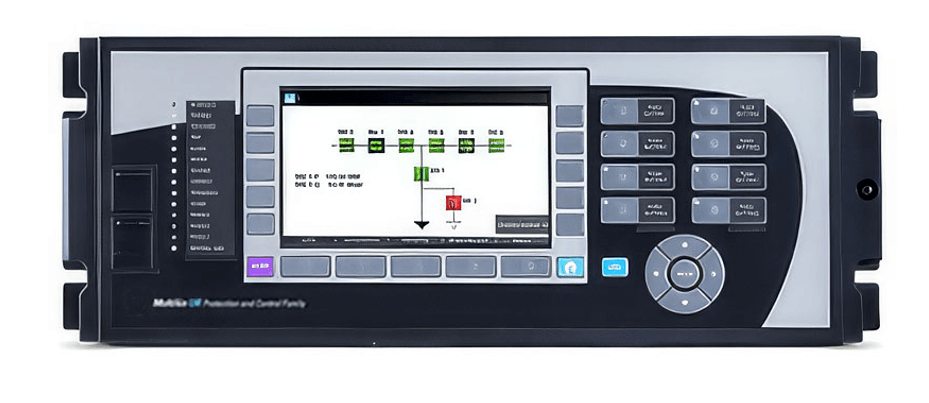
Synchrophasor Measurement System Multilin N60 | Source: GE Vernova
The most common type of SMD is the phasor measurement unit (PMU), which measures voltage, current phasors (magnitude and phase angle), frequency, and rate of change of frequency.
ITC Transmission was/is a leading company that owns and operates high-voltage electricity transmission networks. ITC’s infrastructure is in Michigan, Iowa, Minnesota, Illinois, Missouri, Kansas, Oklahoma, and Wisconsin.
ITC owns about 16,000 miles of transmission infrastructure capable of a peak load of 23,500 megawatts. ITC was acquired by Fortis (TSX: FTS), a Canadian power company, in 2016.
As for your specific question, I don’t know of any way to gain investment exposure in a pure play for SMDs/PMUs as they are product lines within much larger publicly traded companies:
After the big leaders shown above, there are other players with much smaller market shares like Eaton (ETN), Schweitzer Engineering Laboratories, and Arbiter Systems.
Of the above-mentioned companies, GE Vernova is a company that I recommended back in October 2025 in The Near Future Report, and my subscribers are already up about 80% in that position as we near the one-year mark to capture long-term capital gains.
GE Vernova is a company that I remain bullish about in the broad energy production and transmission sector. However, only a minority of the company’s business is related to SMD/PMUs, as it is a massive, $266 billion company.
I hope that perspective helps. Thanks for the unique question.
That’s all for this week’s AMA. If you have a fun tech question of your own, feel free to send it right here. I love hearing from you all, and it may be featured in a future AMA.
Jeff
Add Brownstone Research as your preferred source on Google to see our latest stories in your feed.
 Add as a preferred source
Read the latest insights from the world of high technology.
Over the last week, we have discovered that this is a massive, well-coordinated psyop carried out by some powerful...

Last month I was excited to see an announcement made by a leading humanoid robotics firm, Figure AI, for...

When demand exceeds supply, something has to give…