




An Atlas for a Future Free of Disease
Last Tuesday, September 8, Google announced AlphaGenome Atlas: A predictive map of every possible DNA letter change in the human...



We have spent the last two years focused on the obvious AI constraints: semiconductors, high-bandwidth memory, networking equipment, and power. Those constraints still matter. But a county in Virginia just exposed another one…

Residents of Prince William County, Virginia, had reason to celebrate over the Fourth of July weekend.
They had just helped stop one of the biggest AI infrastructure projects in America.
The Prince William Digital Gateway was supposed to transform roughly 2,100 acres near the Manassas National Battlefield into a massive data center corridor. The approved plan could have supported up to 37 data centers across nearly 30 million square feet.
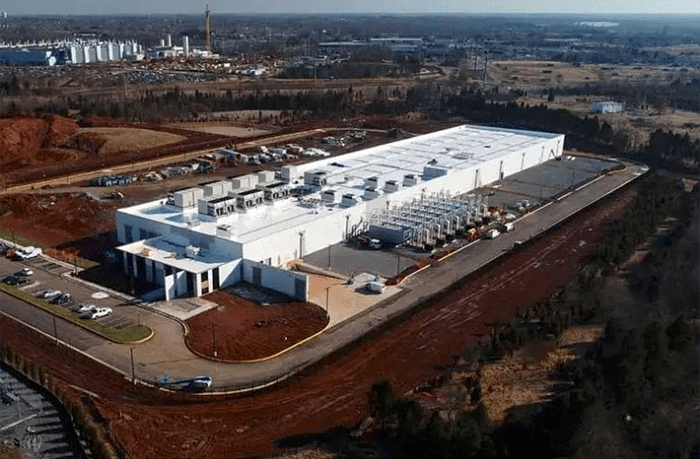
QTS Data Center in Manassas, VA | Source: QTS
In AI terms, this was not just real estate. It was the physical infrastructure needed to turn advanced semiconductors into useful intelligence.
But to residents, it meant something very different.
More construction. More transmission lines. More noise. More pressure on the grid. More industrial development near homes, parks, and historic land. And a growing fear that local families would pay for the AI boom through higher electricity bills.
So they fought. Residents showed up at hearings, challenged zoning approvals, and even took the case to court. And they won.
QTS, the developer owned by Blackstone (BX), withdrew its final appeal to the Virginia Supreme Court, effectively ending the Digital Gateway project.
Blackstone is not some undercapitalized developer. It is the world’s largest alternative asset manager, with more than $1.3 trillion in assets under management. It owns QTS. And it has been one of the most aggressive financiers of digital infrastructure in the world.
But even Blackstone could not force this project through.
This is where the market may misread the story.
Just days before QTS walked away from Digital Gateway, Blackstone agreed to sell its interest in three fully leased Northern Virginia data centers to Digital Realty (DLR). The portfolio totals 288 megawatts of IT capacity. The deal valued the assets at $7.8 billion, with Blackstone receiving $3.5 billion in cash and stock for its interest.
By stopping development and selling three data centers, some investors believe Blackstone is saying we have reached a top in the AI buildout. And that would be a major sign of a top. Back in 2007, Blackstone had some very well-timed exits from its real estate portfolio before the crash.
But they don’t understand the business.
Blackstone did what great real estate investors do. It developed scarce, high-quality assets, leased them to investment-grade hyperscale customers, and monetized part of the position at an attractive valuation.
This is part of the business plan. That is not a retreat from AI.
And the withdrawal from the Prince William Digital Gateway was to not tie up enormous sums of capital in a project likely to be stuck in litigation.
So Blackstone is not abandoning AI. It still has $150 billion invested in AI projects, and a similar amount still in its investment pipeline.
But it is saying there are easier places to build than in Virginia.
We have spent the last two years focused on the obvious AI constraints: semiconductors, high-bandwidth memory, networking equipment, and power.
Those constraints still matter. But Prince William County just exposed another one… permission.
A data center is not useful unless it can be built. And for it to be built, it needs land, zoning approvals, and interconnections for electricity. And all of that requires the support of local governments and utilities.
That support is becoming harder to secure.
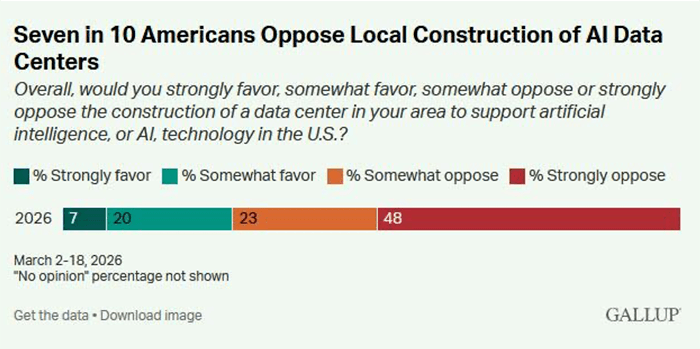
Gallup recently found that 71% of Americans oppose building AI data centers in their local area. Nearly half strongly oppose them. Their concerns are familiar: energy, water, traffic, quality of life, and higher utility bills.
Source: Gallup
And now opponents in other communities know the playbook. They need to organize early to challenge the zoning. If that fails, use the courts to stall construction. And then pressure local officials and make the political cost too high.
The backlash is not just showing up in lawsuits. It is moving into policy.
Virginia has approved a new electricity consumption tax on data centers. Beginning July 1, 2026, operators will pay $0.011 per kilowatt-hour consumed. For a large campus, that adds up quickly.
This is a major shift. Data centers were treated as economic development. Now they are viewed as large industrial power users.
Voters see data centers drawing enormous amounts of electricity. Then they see utility bills rising. The political narrative is simple: Big Tech gets the compute. Local families get the bill.
I noticed this when I visited my home state of Wisconsin last month. Several friends, mostly tech-savvy, were lamenting the rising costs of their power bills. And they blamed a couple of large data centers going up.
This is a sign to me that backlash is spreading beyond just a few environmentalists.
But the AI infrastructure buildout is too big and too important to let a few communities stop it. The building will happen somewhere.
Hyperscalers, enterprises, startups, and AI labs still need compute. The returns they’re getting from AI are too great to pull back usage.
But if new projects take longer to approve, existing capacity becomes more valuable.
CBRE reported that demand from AI startups, neoclouds, and hyperscalers pushed vacancy rates to record lows. Northern Virginia vacancy fell to just 0.3% in the first quarter of 2026.
A 0.3% vacancy rate means the market is effectively full.
That means building sites with zoning in place and secured power will get the majority of financing, labor, and equipment.
Campuses with substations, fiber, cooling, and expansion rights. Those assets are becoming the new scarce resource.
These challenges validate Elon Musk’s move towards launching compute modules into low Earth orbit. There are no angry residents or zoning challenges in orbit. Long term, this is a benefit for SpaceX (SPCX).
But more immediately, this is obviously good for the hyperscalers.
Amazon, Microsoft, Google, Meta, and Oracle can lock up capacity years in advance. They can pre-lease entire campuses, absorb delays, and fund power infrastructure before competitors get a seat at the table. And they already have a large pipeline of projects underway.
But this is also good for some of the smaller, neocloud companies.
Neoclouds are AI-native cloud providers built around GPU compute. They serve customers that need AI accelerators without waiting for the hyperscalers.
The bear case against these companies is that they won’t be able to get meaningful AI contracts because many have smaller data centers that aren’t capable of training AI models. But we don’t need large data centers for inference calculations. This is the compute for running these models.
And as the models get smarter and can handle more agentic tasks, inference compute is growing. And we don’t need large data centers. Often any compute will work. And if new compute additions slow, that makes the compute these clouds have more valuable.
Several of these neoclouds also have expansion plans approved and underway, and they have the potential to grow profits exponentially once they are completed in a year or two.
This is one area I’m paying close attention to for additions to the Near Future Report portfolio.
Blackstone’s pullback is not a sign that AI demand is collapsing.
It is a sign that AI infrastructure is becoming harder to build on Earth.
That is bullish for owners of existing capacity. It is bullish for already permitted projects. It is bullish for hyperscalers that locked up capacity early. And it is bullish for neoclouds that secured powered buildings before the backlash got worse.
Every canceled project makes existing capacity more valuable. Every new power tax makes efficient operators more valuable. Every lawsuit raises the premium on capacity that is already energized.
The chips are going somewhere.
The workloads are going somewhere.
And the market will reward whoever already has the power, permits, and space to receive them.
Regards,
Nick Rokke
Senior Analyst, Brownstone Research
Read the latest insights from the world of high technology.
Last Tuesday, September 8, Google announced AlphaGenome Atlas: A predictive map of every possible DNA letter change in the human...

It’s hard to imagine that developments will continue to pick up at an even faster pace than what is...

An “insider” from Anthropic has quit his job – walked away from a ton of money, in fact –...