




SpaceX to Launch a Mobile Network in the U.S.
Starlink Mobile is coming, and it can’t arrive soon enough.



The idea of a matter compiler has been a science fiction dream for decades. Not any longer.
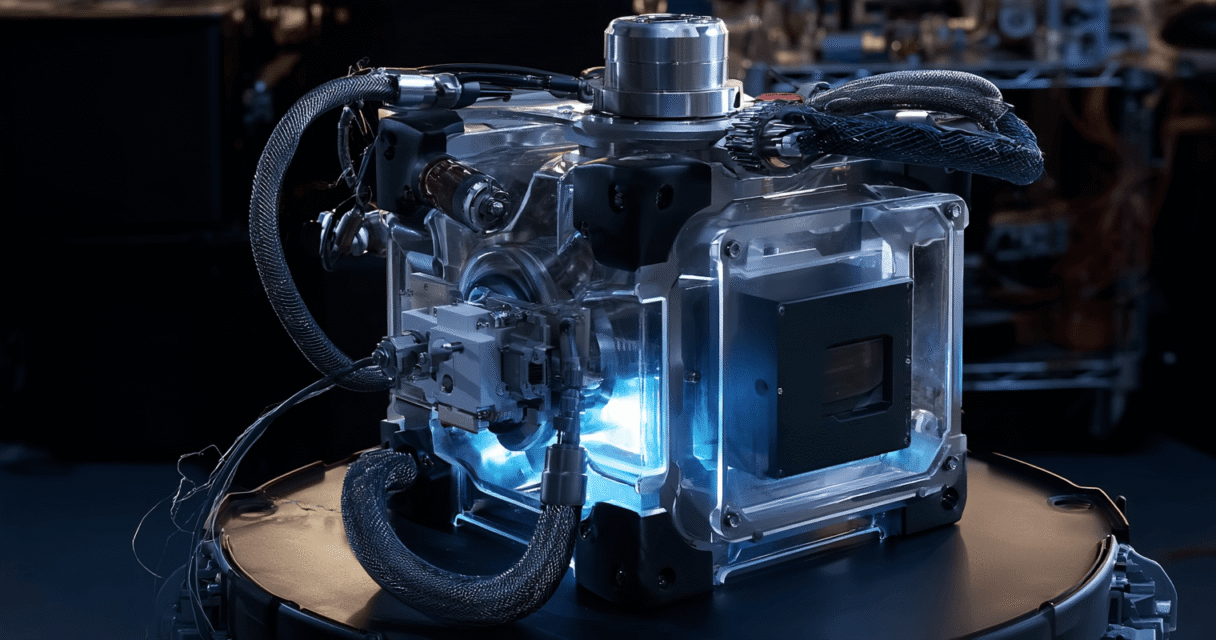
Managing Editor’s Note: We’re coming up on Jeff’s October Million-Dollar Cycle strategy session…
On October 14, he’s getting into all the details of this cycle that occurs every four years like clockwork… yet still manages to fly under the radar of most investors.
But for those who know what to watch for – and how to prepare – it presents an incredible opportunity.
You can go here to sign up automatically.
The world Neal Stephenson envisioned in Diamond Age is a world we very well may be headed towards.
Written in 1995, Stephenson envisioned a world of abundance in his book – a world enabled by technology, of course – where the basic necessities for life were made free and available to everyone.
Rather than providing for some kind of universal basic income, basic necessities like food, water, clothes, components for shelter, and medicines were made available at no cost to everyone.
Money was only needed for luxury items, high-end goods, and lifestyle.
It was a post-scarcity world… and it’s one in which we are quickly moving toward in our near future.
In Diamond Age, free provisions were made possible through the wide distribution of matter compilers.
These high-utility devices were capable of molecular-scale manufacturing.
Matter compilers were “fed” by the feed, which provided basic raw inputs to the matter compilers, such as hydrogen, carbon, oxygen, nitrogen, etc.
These inputs were the feedstocks for anything that the matter compilers would manufacture.
The idea of a matter compiler, or something like a replicator in Star Trek, has been a science fiction dream for decades.
Not any longer.
A few days ago, a company that has been in stealth mode for the last six years – Atomic Machines – just announced the release of its advanced manufacturing technology, literally named the Matter Compiler as a nod to Diamond Age.
The concept is simple…
To be able to prompt the matter compiler to produce a product. It’s that simple.
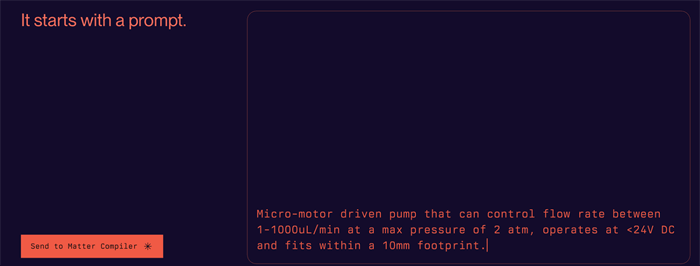
Source: Atomic Machines
This is not 3D printing (additive manufacturing).
3D printing typically deposits layers of various materials to create simple or complex geometries.
The matter compiler can take a prompt, produce software code, and manufacture a working machine – like an electromechanical device – start to finish, fully automated.
The idea is that the “factory,” the matter compiler, stays the same. Only the software changes with each product design.
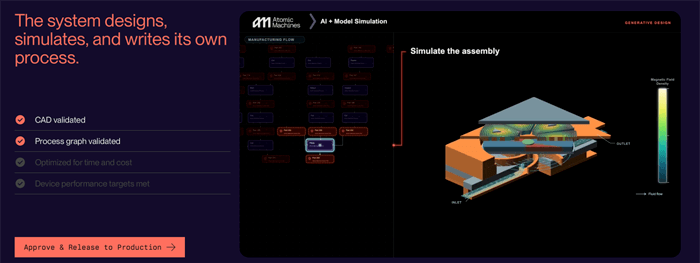
Source: Atomic Machines
The matter compiler system designs a product based on a prompt.
It validates the design using computer-aided design software…
It then optimizes the design for manufacturing and cost of production… and validates performance of what will become the manufactured product.
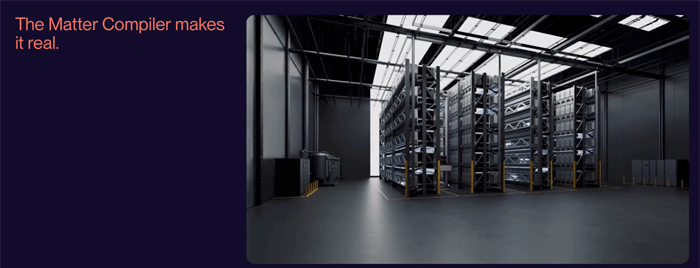
Source: Atomic Machines
Once completed, the matter compiler makes the finished product.
But to grasp how radical this is, consider what it is not.
The matter compiler isn’t at all like a semiconductor manufacturing machine.
Semiconductor equipment is capable of one modality: etching and depositing complex integrated circuits onto silicon wafers, for the purpose of making a semiconductor die. It doesn’t create working machines.
To do that, the die has to be packaged and then assembled onto a printed circuit board of some kind.
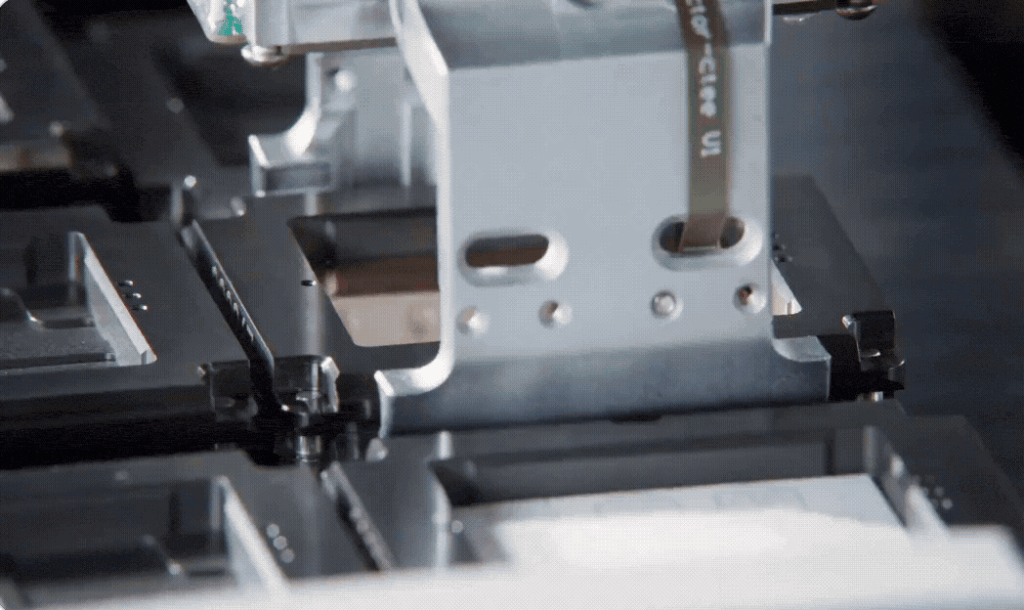
The matter compiler, on the other hand, can manufacture tiny machines – with features measured in microns – with moving parts.
It could even be used to create millimeter-scale robots.
Source: X @Jeff Holden
This concept flips advanced manufacturing on its head.
Rather than having specialized manufacturing equipment that needs to be designed and retooled for every single individual product, the matter compiler can manufacture a wide range of working machines without the need for retooling at all.
The only thing that changes is the software code.
And of course, the entire machine is powered by generative AI, designed so that it learns with every new machine/device it produces.
Atomic Machines has already produced an incredible working machine with its Matter Compiler… the Prime Switch 150.
This is an entirely new class of power relay that has never existed before.

Elon Musk just dropped another bombshell...He's going after your cell phone provider. For months, Elon kept these plans under wraps. But late last week, he finally showed his hand. I've tracked this story for months, and it's playing out exactly as I predicted. Next, I believe Elon could launch a new device that kills the iPhone... and hands early investors his biggest payday yet. Potentially 50 times their money. Here's everything you need to do BEFORE he makes his move. Just act quickly because this story is moving fast.

On Wednesday, October 14 at 8 p.m. ET, Jeff Brown is going live with a HUGE AI update… To discuss a NEW AI trade that could mint millionaires… starting by the end of this month. Click here to save your seat for The October Million-Dollar Cycle…
The Prime Switch 150 is an exciting project because the semiconductor industry has been stuck with a major trade-off with this kind of device for decades.
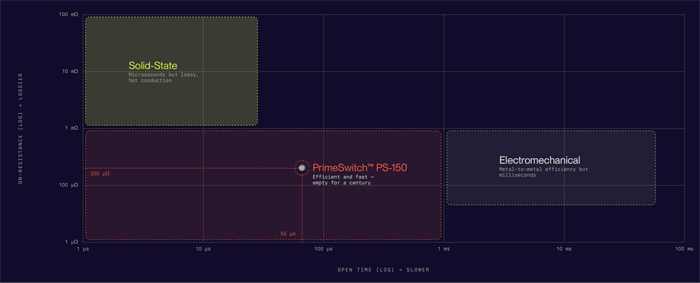
The Prime Switch 150 is designed for 800-volt power in AI data centers. It’s a perfect application.
The industry problem has been that these devices could be made either fast or efficient. Not both.
A solid-state semiconductor is fast to protect against a power fault, but it bleeds heat and is not efficient.
This is the nature of semiconducting materials.
And an electromechanical device is efficient, but it is a slow switch offering less protection.
What the Matter Compiler built is something that hasn’t existed before.
The Prime Switch 150 has the best qualities of both solid state and electromechanical.
It is both fast and efficient.
And no semiconductor manufacturing equipment can make this product.
And there is nearly unlimited demand for what Atomic Machines has built with the Prime Switch.
While this is clearly an emerging company having only raised $250 million to date, the potential for these Matter Compilers is mind-boggling.
The Matter Compilers can already manufacture working machines at a tiny scale across a number of domains.
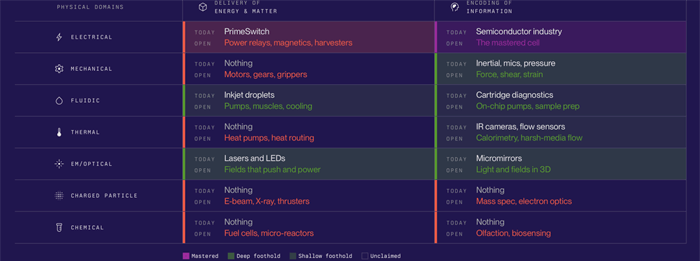
The goal in future versions is to build these intelligent manufacturing machines to be able to make products across seven physical domains: electrical, mechanical, fluidic, thermal, EM/optical, charged particle, and chemical.
Some examples for mechanical might be micromotors, robotic grippers, or force and strain sensors.
Or consider the chemical applications, with product examples like electrical “noses” and biosensors that can detect smells.
If this company is successful, it will radically change manufacturing.
This isn’t just about rapid prototyping or low-volume production of customized devices.
It is about being able to manufacture products that couldn’t be built otherwise.
All with just a few lines of product description.
Prompt to product.
All in a matter of days or just hours, as compared to months if not years.
No more science fiction.
It’s happening right now.
Jeff
Add Brownstone Research as your preferred source on Google to see our latest stories in your feed.
 Add as a preferred source
Read the latest insights from the world of high technology.
Starlink Mobile is coming, and it can’t arrive soon enough.

Most Bitcoin predictions are not about being right... They're about grabbing a headline.

The fundamental relationship between man and machine has remained largely unchanged… Humans gave machines instructions, and the machines followed...