


An Exciting Moment for the Nuclear Fusion Industry
While I maintain that the “AI Fear Trade” is largely overblown, that doesn’t mean there won’t be market shocks...


Take this step into the new era of Brownstone Research with us.

Managing Editor’s Note: Behind the scenes, we’ve been working on a major project…
And today, we’re so excited to be able to share it with you, at last.
A new era for Brownstone Research…
The newly revamped Brownstone Research website has officially launched! For the past 18 months, since Jeff retook the helm, we’ve been quietly and tirelessly working to reimagine and amplify the Brownstone experience for our members.
True to our name, we believe in building something of the highest quality and building it to last. State-of-the-art craftsmanship meets the vibrant world of high tech. A bright future, full of possibilities.
This meant thinking up new ways to bring you our best ideas, our most cutting-edge recommendations, and the best research from the bleeding edge of high tech.
We’ve overhauled the user experience to make it more intuitive, more streamlined, and all around more fun to engage with. Everything from how you discover new ideas to how you track your positions. Faster, cleaner, simple to use, with a much-improved design.
So, please, enjoy! Click around and explore your new account page… Dig through your latest issues, alerts, and special reports… Take this small step into the new era of Brownstone Research with us.
A giant leap towards the new and improved Brownstone Research.
If you just click the thumbnail below, it’ll take you straight to the home page where you can hear from Jeff what Brownstone is all about… see what others are saying about our research… and log in to see the fully upgraded Brownstone Research website.

We couldn’t be more thrilled to be able to bring this to you. So, we hope you have fun exploring the new site. We’re so thrilled to have you along for the ride, and as always, you can let us know your thoughts right here.
We truly have so much to look forward to…
If there is one sector of technology where the impact of artificial intelligence is being severely underestimated, it’s biotechnology and life sciences.
I’ve been researching and investing in biotech for much longer than anyone was even thinking of applying artificial intelligence (AI) to the technology, but with the recent developments in AI – and the growing realization of just how much of a leap AGI will be from current iterations of AI – many have begun to understand the gravity of these developments.
Longtime readers know the intersection of AI and biotechnology has nearly unfathomable implications for the future of medicine.
Timelines – and costs – will be diminished across the board. Drug development will be significantly faster. AI algorithms are working from start to finish, tackling the inefficiencies of traditional research & development… and with the advent of artificial general intelligence (AGI), these algorithms will be able to run constantly and with minimal human oversight. Even self-directed research will be possible.
More treatments for diseases with no known cures, faster therapeutic development – think scaling back timelines from matters of months and years to weeks or days – and an entirely new generation of profitable biotech firms… just to name a few changes.
Folks are only just beginning to understand the sheer potential of AI-empowered biotechnology… and still, they don’t realize just what’s coming.
But because I’ve tracked the technology so closely, and for so long, I can say with certainty that what has happened in just the last two years is Earth-shattering with profound implications.
Every major area of biology that has been hampered for decades by the need for manual experimentation limited by time, grants, and how many hours a researcher could work a day in a laboratory has been deconstructed and reconstituted into a computational process that leverages artificial intelligence.
For example, a team at the Zitnik Lab at Harvard Medical School developed ATOMICA, a geometric deep-learning model that discovers atomic-scale representations of intermolecular interfaces across five modalities:
ATOMICA was trained on 2.1 million molecular interaction interfaces and can now model atomic-level interactions between all five modalities listed above. It has the ability to now understand the biophysics involved with how molecules interact with one another.
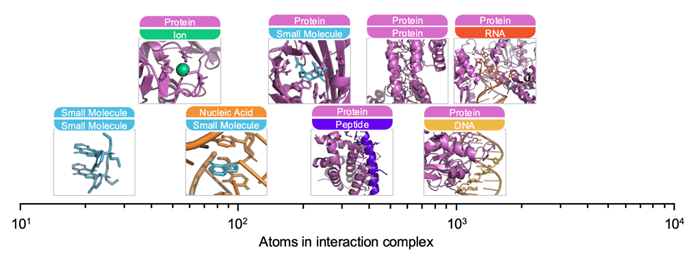
Or how about Meta’s Universal Models for Atoms (UMA)? It’s life sciences breakthrough this year was highly unusual coming from an advertising company known for its social media software.
Meta’s UMA – which is open-sourced – used Meta’s advanced frontier AI model to predict the forces and energies between atoms. Historically, this was such a complex problem that it required quantum calculations to predict.
But with Meta’s AI, it can use this information to now simulate materials, molecules, and sorbents (a material that collects liquids or gases) quickly and cheaply at a scale that was previously impossible.
As a result, Meta, of all companies, was able to produce the largest and most significant materials database used for AI research in the field.
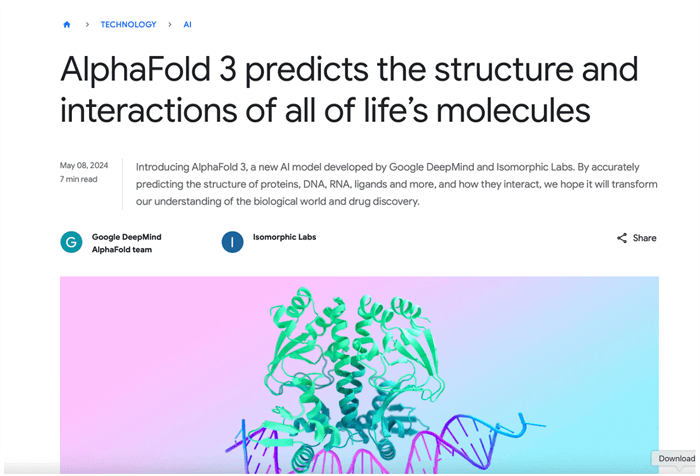
And before Meta released its UMA, Google’s DeepMind released AlphaFold 3 – an AI capable of predicting “the structure and interactions of all of life’s molecules.” This was a subject I recently wrote about in The Bleeding Edge – How DeepMind Made History.
And if developments in AI-empowered biotech couldn’t get more interesting…
Last month, a research team at Notre Dame announced some incredible research that will help transform disease modeling.
Human cells are 10 microns – that’s 10 one-millionths of a meter – wide. And Notre Dame’s research focused on something even smaller – proton concentration, typically referred to as pH.
pH-dependent structures are critically important to understand as they regulate cell movement and division. This research was widely missed by the media. They didn’t understand the significance of what the team had developed.
pH changes are linked to diseases like:
Using AI, the team at Notre Dame developed a methodology for identifying pH-sensitive proteins and the molecular mechanisms that regulate their pH-dependent activity.
For example, in the research, the team discovered the pH-dependent function of c-Src, a well-studied enzyme that is activated in many forms of cancer.
The lead author noted that…
These proteins are central to cell regulation in addition to being mutated in certain cancers, and in addition to showing that they are pH-sensitive, we’ve also found exactly where on the protein the pH regulation is occurring.
She went further to summarize the significance of their work: “We’ve managed to condense 25 years of work into a few weeks.”
Unbelievable… Something that used to take two and a half decades is now possible in a few weeks with AI and enough computational resources.
Another researcher involved stated the practical implications of this discovery:
Before even picking up a pipette or running a single experiment, we can predict which proteins are sensitive to these pH changes, which proteins actually drive these critical processes like division, migration, cancer development, and neurodegenerative disease development.
And that’s exactly the point…
Thanks to developments in computer science, artificial intelligence, and oddly, teams at advertising companies like Google and Meta, the days when human researchers labor manually in laboratories for decades to make just a few discoveries are over.
Every biotech company, before they ever “pick up a pipette” in a lab, will conduct the equivalent of decades of work in a matter of days using a range of AI-powered tools like ATOMICA, UMA, AlphaFold 3, the pH-related predictions from Notre Dame, and others.
The power of these computational systems has already proven to be more capable than the summation of every life sciences researcher on the planet. What these systems have discovered would have simply been impossible to achieve via manual experimentation.
It’s like the entire life sciences and biotech industry has been transported decades into the future, where it can predict the atomic interactions between any molecules and use that knowledge to design highly precise drug therapies.
This accomplishes six critical things:
While we may not see and feel the significance of these developments yet, it is important to understand that these breakthroughs are very recent events.
Every biotech company is leveraging these breakthroughs in its own drug discovery and therapeutic pipeline. The changes are happening now, in real time.
Investors and patients will soon be beneficiaries of these AI-enabled breakthroughs. And just imagine what we’ll be able to accomplish once we achieve artificial general intelligence.
We have so much to look forward to,
Jeff

Read the latest insights from the world of high technology.
While I maintain that the “AI Fear Trade” is largely overblown, that doesn’t mean there won’t be market shocks...

The more transactions that take place over Meta’s networks, the more money it makes. So why limit that to...

Cortical Labs has been developing a biological computing system based on human brain cells…
Thanks for signing up for The Bleeding Edge — we’re glad you’re here!
Want updates sent straight to your phone too? Sign up for SMS alerts to get the latest delivered via text.
Brownstone Research: By submitting your phone number, you agree to our SMS Terms & Conditions, Terms of Use, & Privacy Policy, and give express written consent to receive marketing text messages from BSR. Messages are recurring & frequency may vary. Reply STOP to 94703 to opt out. Reply HELP to 94703 for info. Consent is not a condition of purchase. Message and data rates may apply. For additional information, you may contact Customer Service at 888-512-0726 or smssupport@brownstoneresearch.com.