


Niantic’s Hidden Agenda
Those who played the game paid Niantic to work for them. And none of them were told that Niantic...


Here at Brownstone, we know how invaluable a strategy that lets us leverage momentum anywhere disruption strikes can be when employed tactically.

One of the major perplexities in the stock market, especially in the last few months, has been the surprising decline of high-quality growth technology companies in an otherwise bullish market.
While this dynamic has been present in a wide range of sectors like nuclear energy, quantum computing, and even select technology stocks, it’s been most pronounced in the software as a service (SaaS) sector.
So much so, that a term was coined…. The SaaSpocalypse…
Ominous-sounding, I know.
What made these declines in share prices so unusual and uncomfortable is that they were in great companies, with great technology, and lots of growth ahead.
In the case of nuclear energy or quantum computing, it was an easier story to understand. The share prices ran too far too fast, and valuation multiples were way out of whack. Declines were easy to predict from those levels.
But with SaaS companies, the decline to historically cheap valuations was more difficult to understand…
These are market leaders, with great gross margins, loads of free cash flow, and still plenty of growth ahead of them, and yet…
They fell like rocks over the last year.
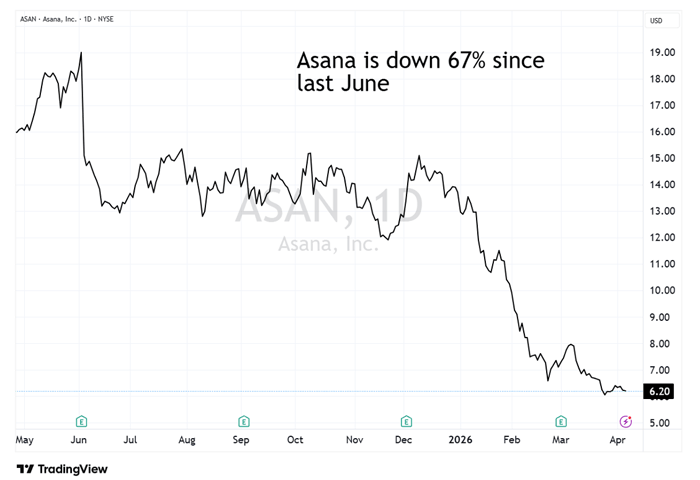
Asana (ASAN) is down 67% since June last year.
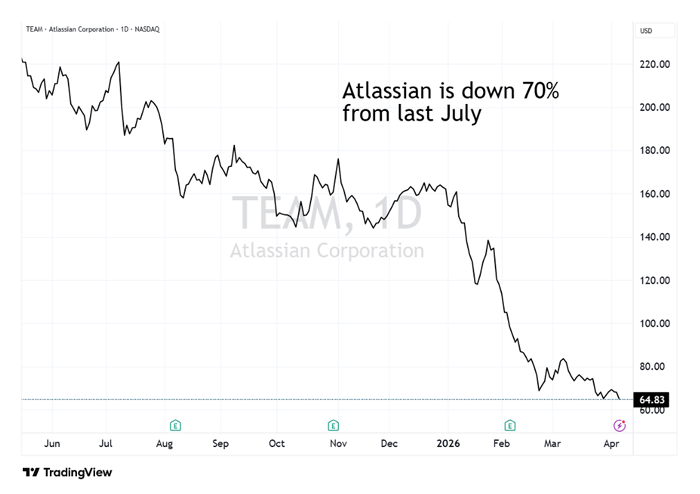
Atlassian (TEAM) is down 70% since July last year
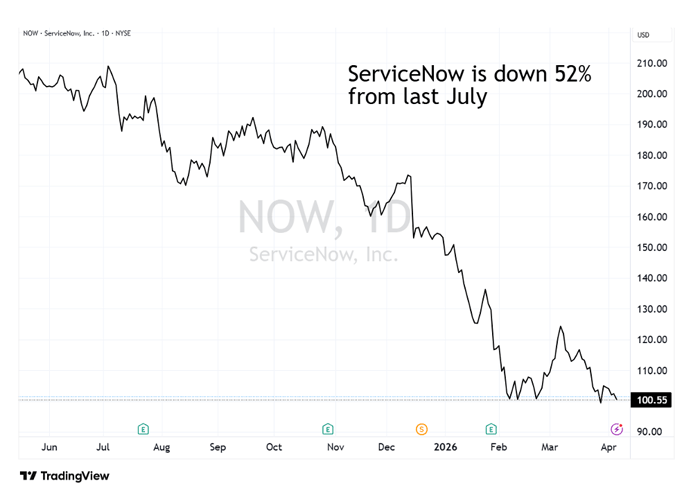
ServiceNow (NOW) is down 52% since July of last year.
And these are just to name a few.
Most striking was the decline in all the stocks since December of last year. That’s when the slide was the steepest. Again, great technology, great companies, profitable, and throwing off cash.
What was the culprit? Well, artificial intelligence (AI), of course. Specifically, a series of announcements from the frontier AI model leader, Anthropic, related to agentic AI solutions.
The threat is clear. Agentic AI has the potential to automate much of what these SaaS companies’ products can do.
It’s not just that they can replace the enterprise software. It’s that they will put competitive pricing pressure on existing SaaS companies.
These are hard effects to model, and Wall Street has taken something near a worst-case scenario as they have run their numbers.
This has resulted in unreasonably low, and in many cases irrationally low, valuations for many SaaS companies. Some represent incredible value today, but if institutions continue to sell their shares in these stocks, we don’t want to try to catch a falling knife.
We’ve also seen the exact opposite happen, even when the markets are falling in the current chaotic geopolitical climate.
Oil is racing higher, some are calling for a global recession, many are screaming about a nuclear war, the shortages of helium, which negatively impact the tech industry, and a whole lot more doomerism…
And yet, some stocks, typically those with tight links to AI infrastructure, keep moving higher even if the market is dropping.
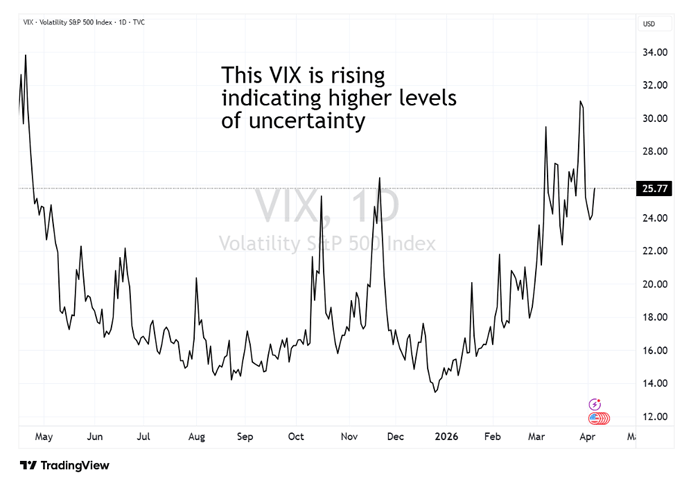
We’re in very volatile market conditions right now. We can see it in the volatility index below (VIX). And that means it is just as important to know which stocks are going to fall as it is to know which stocks are going to run higher.
If that wasn’t enough to worry about, President Trump has given an 8 p.m. deadline tonight for Iran’s response to his demands to reopen the Strait. Assuming the parties can negotiate an agreement, normal trade through the Strait of Hormuz will return.
If that happens, we should see a meaningful reduction in uncertainty around oil and gas prices, which would ease inflation expectations as well. If it doesn’t, all hell may break loose.
At the same time, we’re approaching an important transition at the Federal Reserve. The April 28–29 FOMC meeting is expected to be Jerome Powell’s final meeting as Chair, with his term ending May 15.
Assuming the transition to Kevin Warsh moves forward as expected, this will mark a shift in policy direction.
The broader backdrop supports that shift. Inflation had been trending lower before the surge in oil prices, the labor market is beginning to soften, and AI-driven productivity gains are starting to show up in the data. That combination gives the Fed room to begin lowering rates, which would act as a meaningful tailwind for equities.
It’s easy to understand why there is so much uncertainty in the markets right now. There is a lot going on.
And markets hate uncertainty.
I don’t. I see opportunity. I see investment and trading potential. Knowledgeable, experienced investors feel the same.
But most of us don’t. We don’t like uncertainty much at all, and most investors fall into two camps…
Camp one is the “sell everything” and run for cover crowd. Nothing’s going right, they think, so they think their best bet is to cut their losses now and get out before the carnage gets worse.
But when the underlying fundamentals are good, it tends to result in locking in losses and ensuring that they miss out on the inevitable turnaround. And this approach risks stacking losses rather than building positions in the lows and maximizing wins.
Camp two is the group that knows selling into short-term volatility is a mistake. These conditions are never permanent, and patience is key. Nothing good can come of giving in to the pinch and selling in panic.
It takes a lot of discipline to stay calm when markets are volatile and unpredictable.
But even camp two is left sitting around doing, at best, not much. Maybe adding to some positions on the lows. And at worst, they’re doing nothing and just waiting for things to stabilize.
It’s safe, but it’s static. And it means missing out on a lot of exciting market opportunities that, with the right strategy, can provide quick profits and even hedge against some long positions in a portfolio.
This is what my Deep Access trading advisory is specifically designed to do. My team and I designed a special kind of artificial intelligence called a neural network – something longtime Bleeding Edge readers will likely be familiar with – to spot high-probability setups in seemingly unpredictable markets.
Neural networks excel at pattern recognition, and particularly patterns that humans would struggle to pick out.
The sort of setups it’s watching for are built on massive amounts of data that analyze institutional short positions in thousands of publicly traded companies. We have access to a real-time proprietary data set that allows us to see it all, even the short positions and trading in dark pools.
Aside from the geopolitics, changes in monetary policy, and other short-term events that affect volatility, I’ve long been predicting tech-induced volatility as AI becomes more and more capable and sophisticated.
That’s a trend that will only increase.
AI disruption is going to affect all industries, some more significantly than others. And here at Brownstone Research, we know how invaluable a strategy that lets us leverage momentum anywhere disruption strikes can be when employed tactically.
We can build profitable trades in any bear market, and when we know/expect a stock to decline for any number of reasons.
I’m actually hosting an event tomorrow afternoon at 2 p.m. ET, where I’m breaking down all the disruption we’re already seeing across the market as a result of artificial intelligence, as well as what we can expect in the future, and my strategy to make the most of it.
You can go here to add your name to the guest list. No need to enter your number to attend, but you can if you’d like to be added to our VIPs list.
We’ll send you alerts leading up to the big event, as well as a notice when we’re kicking things off. You can also collect a special report I’ve put together called The Next Wave of AI Disruption: One Stock to Buy and One to Sell.
In it, I cover two stocks. The first is one to buy… an AI infrastructure company that is critical enough to the entire AI buildout that, no matter what disruption shakes things up in the short term, this company is a steady, safe bet.
The other is one to sell… an “AI” company that’s bleeding cash with no apparent avenues to achieve any sort of sustainable growth.
The last handful of stocks I predicted were in trouble are performing exactly as I said they would. Just year to date, IBM is down about 15%… Microsoft is down more than 21%… Soundhound.AI is down nearly 38%… among others. And the one I named in the report is quickly going the same way.
Here’s that link to automatically sign up again, or to sign up to receive that report. I hope to see you there.
Regardless of the market direction, there will always be weak stocks going lower. It is truly invaluable to know how to not only avoid the losers, but actively turn a profit from them so you aren’t stuck twiddling your thumbs or biting your nails waiting for the volatility to stop.
And the disruption caused by AI, geopolitical conflict, and policy changes will only intensify in the months to come. But we’ll be here to guide you through it all.
Jeff

Read the latest insights from the world of high technology.
Those who played the game paid Niantic to work for them. And none of them were told that Niantic...

The entire internet will need to be upgraded to post-quantum encryption technologies.

We’re on the cusp of the most extraordinary productivity boom in the history of the world.
Thanks for signing up for The Bleeding Edge — we’re glad you’re here!
Want updates sent straight to your phone too? Sign up for SMS alerts to get the latest delivered via text.
Brownstone Research: By submitting your phone number, you agree to our SMS Terms & Conditions, Terms of Use, & Privacy Policy, and give express written consent to receive marketing text messages from BSR. Messages are recurring & frequency may vary. Reply STOP to 94703 to opt out. Reply HELP to 94703 for info. Consent is not a condition of purchase. Message and data rates may apply. For additional information, you may contact Customer Service at 888-512-0726 or smssupport@brownstoneresearch.com.