




A Cure for Cancer?
This level of personalized medicine has been the future of medicine for a long time.



In November of last year, the United States Geological Survey added silver to the official U.S. Critical Minerals List. And with good reason.

Managing Editor’s Note: On August 26, NVIDIA’s earnings report could trigger a historic shift in the market… Potentially sending more than $1 trillion flooding into an overlooked part of the market.
That’s according to our colleague – Market Wizard Larry Benedict.
Larry has identified one ticker that sits directly in the path of that $1 trillion…, and he believes it could become the first major opportunity of this shift. He’s getting into all the details on the day of the earnings release – Wednesday, August 26, at 8 p.m. ET.
Just go here to add your name to the guest list.
Then read on for today’s Bleeding Edge from senior analyst Joe Withrow on a metal that recently made the United States Geological Survey’s official U.S. Critical Minerals List for its strategic role in the AI infrastructure buildout.
And mind the note at the end from Jeff about a way you can access opportunities in the critical metals and resources enabling the AI boom…
We can clearly picture the scene…
“Sir, we can’t coin that.”
The miner was confused. He had walked into the U.S. Mint with sacks of silver a dozen times before, and it had never been a problem.
“It’s good silver,” the miner replied politely. “You can weigh it yourself.”
The clerk offered a slight, somewhat confused smile. He appeared to be truly sympathetic.
“Sir, I don’t doubt that it’s good silver. But I’m not allowed to make it into dollars anymore. The law changed.”
The miner was shocked.
The sack of silver on the counter represented months of his labor. He had pulled the ore out of a Nevada mountain himself. Then he had it smelted down, and he made the long trip to the U.S. Mint – just as he always had. And just as his father had done before him. It was a business as old as the country itself.
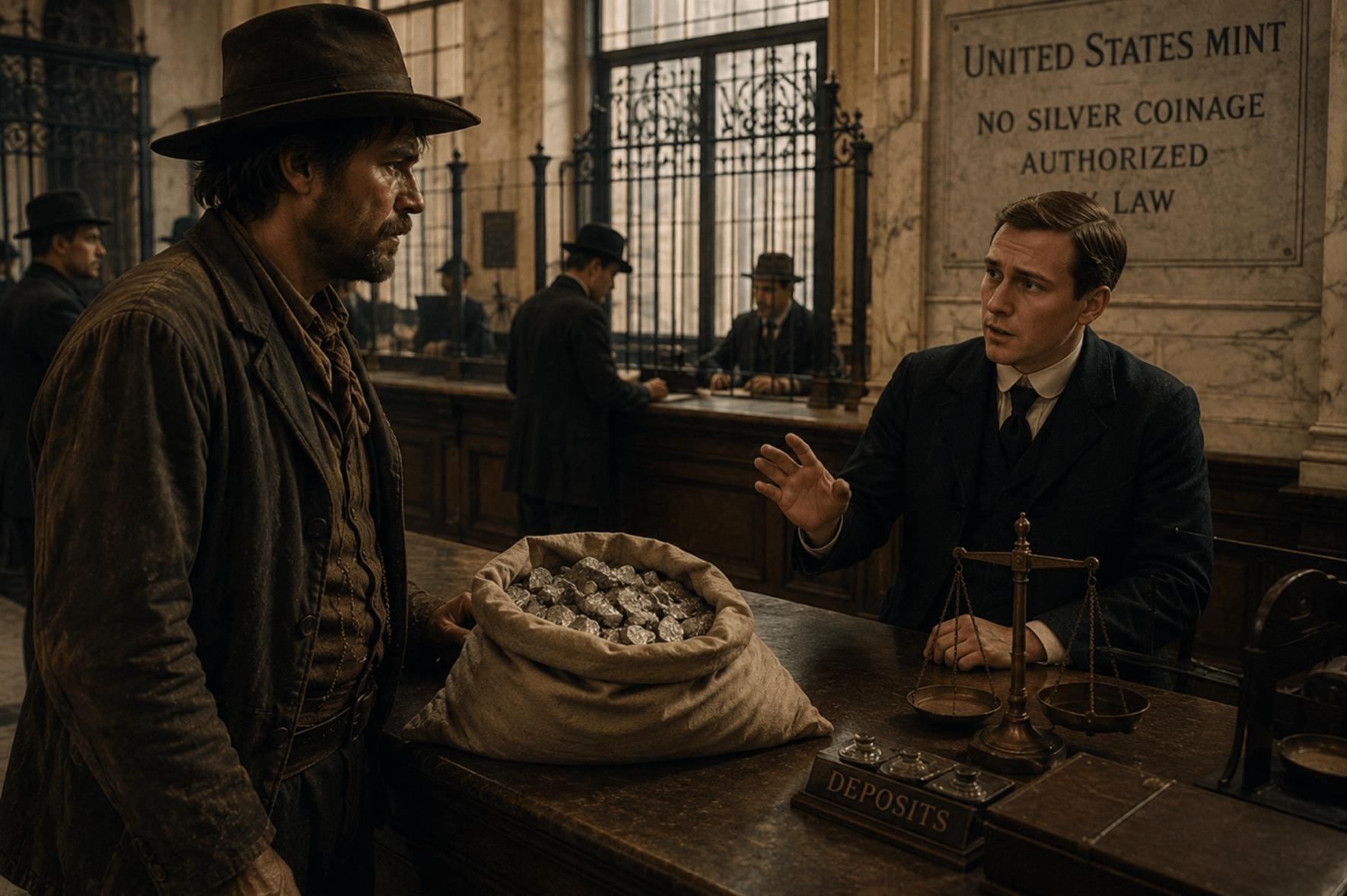
AI rendering | Source: Brownstone Research
The miner couldn’t contain his frustration.
“Changed how!? Silver’s been money my whole life. We have made this transaction countless times.”
The clerk could only shrug and offer his sympathies. He explained that he didn’t entirely understand it either. Apparently, Congress had passed a new law. The President had signed it, and now, the silver dollar was no longer to be struck.
The clerk admitted that he didn’t know anything more than that. He was simply told that he could not accept silver bullion any longer.
“You can take it home,” the clerk offered. “Or you can sell it as metal. But it doesn’t come out of here as money. Not anymore.”
The miner couldn’t do anything but shake his head. He grabbed his sack of silver and stomped out… never to return.
The miner’s name was lost to history. But his interaction, and scores of others, were recorded by the U.S. Mint in those days.
He was one of thousands of men working the great silver lodes of the American West – the Comstock in Nevada most famous among them. The miners would risk it all to pull silver ore out of the mountains in the belief that what they mined would be converted into money.
And for the history of the American republic up to that moment, it was. Silver was money.
You could take your silver to the mint, hand it over, and walk out with silver dollars. That was the law. It had been the law since Alexander Hamilton wrote it into being in 1792.
With the Coinage Act of 1873, Congress ended the coinage of the silver dollar. Populists would spend the next 25 years calling it the Crime of ’73. But from that point forward, silver was no longer money in America.
Here’s why I’m telling you this story in a technology letter…
In November of last year – 152 years after the U.S. Mint turned that miner away – the United States Geological Survey added silver to the official U.S. Critical Minerals List. And with good reason.
The Critical Minerals List was introduced as part of the Energy Act of 2020. As the name suggests, a critical mineral is any commodity that:
It may come as a surprise to some, but silver fits the bill here. It may be the oldest monetary metal in the world… but it’s now essential to industry and electronics.
In other words, silver is now an industrial metal.
Silver’s largest industrial customer is the solar industry.
Photovoltaic manufacturers consumed 197.5 million ounces of silver in 2024. That’s roughly 30% of all industrial silver demand on earth.
Naturally, this heavy demand makes the solar industry extremely sensitive to fluctuations in the silver price.
So as silver soared from $31 an ounce in January 2025 to an all-time high north of $120 in January of 2026, the solar industry began to adjust its engineering to require less silver.
And it worked.
Per the World Silver Survey 2026, photovoltaic silver demand is forecast at 151 million ounces this year. That’s down 23.5% from 2024 levels. And it’s 19% below 2025.
Thanks to the engineering adjustments, the solar industry eliminated nearly 36 million ounces of annual silver demand in just twelve months. That’s the largest single-year reduction in silver demand the industry has ever seen.
Given that the solar industry accounted for roughly 30% of annual silver demand globally, and that solar demand fell by 19% this past year, one would expect total industrial demand to fall by nearly 6% annually. But it hasn’t.
The data shows that industrial silver demand has only fallen 3% – half of what the math suggests we should expect.
What’s more, the Silver Institute projects silver to record a shortfall of roughly 46.3 million ounces this year. Meaning, industry will consume 46.3 million more ounces of silver than is mined. That’s a hefty supply deficit.
That begs the question – if the solar industry is pulling back on silver, but reduced solar demand is not closing the supply gap, where’s all the extra demand coming from?
The answer, as I suspect readers already know, is artificial intelligence (AI). Simply put, the AI infrastructure buildout is accelerating.

During the 2022 Retirement Reset, approximately $3.4 trillion was wiped from US retirements. Yet Larry Benedict put together 14 straight winning trades for his members. Inside that streak, he even created the potential to turn $10,000 into more than $156,000… In just 44 days. Now Larry believes the biggest Retirement Reset of his 40-year career has begun. He’ll reveal the ONE ticker he believes should be your first move, during a free briefing this Wednesday, August 26 at 8 p.m. ET. Click here to register.

Take a look at this… It’s smaller than a fingertip. It’s made of glass. And it’s about to reshape AI from the ground up. Jensen Huang, Nvidia’s CEO, says this device is shattering the limitations of AI and without it, AI can’t scale. Google Ventures says it’s the future of AI compute. And Sequoia Capital – the firm that backed Anthropic and OpenAI – calls it a “holy grail”. Yet most Americans have never heard of it… Wall Street insider Jason Bodner – the same man who called Nvidia at $4.50 – says this critical “light-speed” device could be bigger for AI than GPUs… and it’s about to launch a whole new wave of AI winners. And to prove it, he’s giving away his #1 stock involved with it – for free. Click here for all the details.
Silver demand from AI data centers and all the associated hardware is now growing 15-25% annually, depending on which study we favor. This reflects the sheer scope of the hyperscale buildouts.
And here’s the thing – the AI industry cannot engineer silver out of the equation as solar did.
In the AI buildout, silver sits in switchgear, power distribution, relay contacts, high-speed connectors, chip packaging, conductive pastes/solders for signal integrity, and thermal interface materials that help dissipate heat from GPUs and other high-density components.
And silver is perfectly suited for these tasks because it is the best electrical and thermal conductor of any metal.
That’s exactly why it cannot be readily replaced in AI infrastructure without accepting higher losses, greater heat generation, or reduced reliability – trade-offs that are unacceptable in mission-critical, high-power AI facilities.
As power densities move toward higher-voltage architectures in next-generation designs, silver’s advantages in conductivity, oxidation resistance, and arc performance become even more valuable.
This emerging demand layer is contributing to the multi-year structural deficits in the silver market.
And it’s worth noting that, from the industry’s perspective, the cost of silver pales in comparison to the cost of GPUs and all the advanced hardware that make AI facilities work. So, there is no incentive to thrift it.
And here’s why this matters…
For decades, silver deficits didn’t matter much. The market ran shortfalls, and very few noticed, because there was an enormous pool of above-ground metal in vaults to absorb the difference.
But as the old saying goes, deficits don’t matter… until they do. And we’re now at a point where the silver deficit is starting to matter.
Throughout 2025, roughly 225 million ounces of silver drained out of the London Bullion Market Association (LBMA). This raised concerns that there wouldn’t be enough silver in LBMA vaults to cover the various silver exchange-traded funds (ETFs) that require physical silver backing.
Indeed, Metals Focus estimated that roughly 83% of the LBMA’s silver inventory served as the underlying backing for silver ETFs. That left a free float of only 136 million ounces of silver.
But here’s the thing – the average daily silver spot trading volume in London is roughly 450 million ounces. That means the market’s entire accessible inventory amounts to less than a third of a single day’s trading.
That’s a big reason why we saw silver soar above $120 per ounce at the beginning of this year. Simply put, the shorts had to cover but couldn’t source metal, and they paid unprecedented rates for near-term liquidity.
And as we noted, the supply gap is not improving. In fact, silver is set to run a larger annual supply deficit for the sixth consecutive year.
That means the era of virtually unlimited silver liquidity is gone. And that brings us to our takeaway today…
In 1873, Congress legislated silver out of the American monetary system… but silver didn’t go away.
It simply changed roles.
What was once the backbone of everyday currency use is now a critical industrial input powering the technologies that define the 21st century – especially the massive AI infrastructure buildout.
The inelastic demand from data centers, high-power electronics, and next-generation computing is emerging as the dominant new driver of silver demand.
And unlike past silver cycles, the above-ground buffer has been drawn down to historically thin levels relative to trading volumes. This makes the market far more sensitive to physical tightness.
For investors focused on technology and AI, silver has become something of a leveraged play on the physical constraints of the AI era.
The same metal that once minted dollars is now indispensable to the chips, power systems, and thermal management that make hyperscale AI possible – and supply cannot ramp quickly enough to match.
Regards,
Joe Withrow
Senior Analyst, Brownstone Research
P.S. And on the note of metals and resources essential to the AI boom…
Hi, Jeff’s managing editor here again. In case you missed the big news, we’re thrilled to announce we’ve brought Dave Forest to the Brownstone Research team to help tackle coverage in a space we’ve never formally covered before…
Commodities, resources, and energy.
And we’ve already had an outpouring of enthusiasm for his taking on the role of senior analyst of our newest research advisory, Critical Assets…
I can’t believe you are bringing in Dave Forest for Critical Assets coverage! I followed him at Casey Research, and he is a “rock” star (pun intended). I’m totally stoked. Best news all summer!! Please consider allowing him to recommend Stock Warrants as well in the new service. Regards.
– Carlton L.
And we have a special note from Jeff regarding the crucial timing of this launch and on bringing Dave into the fold…
I just want to thank you all again for sharing in our enthusiasm for the Critical Assets launch, and for welcoming Dave to the Brownstone Research team.
This has been years in the making. I have long wanted to launch a commodities/resources/energy research advisory, and I have patiently been waiting for the right time to do it.
I used to invest heavily in the resource sector in the early 2000s and have continued to invest since then. Some of my largest individual gains came from the sector, and it’s a sector that I’ve studied intensely over the years.
It’s also one that comes in waves/cycles. There are times when it’s just not as interesting and not in growth mode, and other times when the resource sector is in a major growth cycle.
This time is different. We’re entering a supercycle being entirely driven by what’s happening in the tech sector and the reindustrialization of the U.S. economy.
I’ve never done something like this before. This is a collaboration between Dave and me. Our approaches are very similar. Dave is a boots-on-the-ground kind of researcher, just like I am.
For those who aren’t already familiar with Dave – or who missed our initial broadcast introducing him – he has been both a researcher and investor in the commodities and natural resources sector for decades.
His work has taken him all over the world – Colombia, Brazil, Zambia, Uzbekistan, Kazakhstan, Laos, Russia, Mongolia, and the Czech Republic, to name a few places.
His own successes include buying a gold deposit in Colombia… uncovering a treasure trove of silver, gold, copper, lead, and zinc in Nevada… and even founding his own minerals company, based in Myanmar.
And as a geologist with decades of experience in the sector, he has an incredible perspective on the resources industry and an amazing network to draw upon, just like I do in the tech industry.
He and I will be collaborating on this research, with regular issues going out on the second Wednesday of each month. We’ll be writing about the technology trends and developments driving the resource sector and identifying the individual companies uniquely positioned to benefit from those trends.
And for anyone who might have missed our initial broadcast…
There was such an outpouring of enthusiasm and interest, we’ve decided to reopen the replay.
It’s difficult to overstate how significant this opportunity is… and we want to ensure that anyone who is interested in making the most of this historic boom in the resources, rare earths, and critical metals going into the AI infrastructure buildout has the opportunity to do so.
I believe the replay comes down in a few days, so if you haven’t had a moment to watch it and are interested in learning more about Dave, the upcoming commodities supercycle, and our work with Critical Assets, I invite you to go here to watch the replay.
We’re incredibly lucky to have Dave with us as a partner on this project. I can’t wait to get started. And I’ll give some more thought to the suggestion on warrants.
Regards,
Jeff
Read the latest insights from the world of high technology.
This level of personalized medicine has been the future of medicine for a long time.

This is one of the most exciting developments I’ve seen this year… There is now a large language model...

The frontier of AI is no longer just the chip. It's the conversation between chips. And that brings us...