


OpenAI on Trial
The trial between Elon Musk and Sam Altman’s OpenAI is about to begin, and it will set the course...


The Artemis II team has now traveled farther from Earth than any humans in history…

With NASA’s Artemis II mission having successfully completed its lunar flyby – and begun its return to Earth this Friday evening – it’s hard not to think about space.
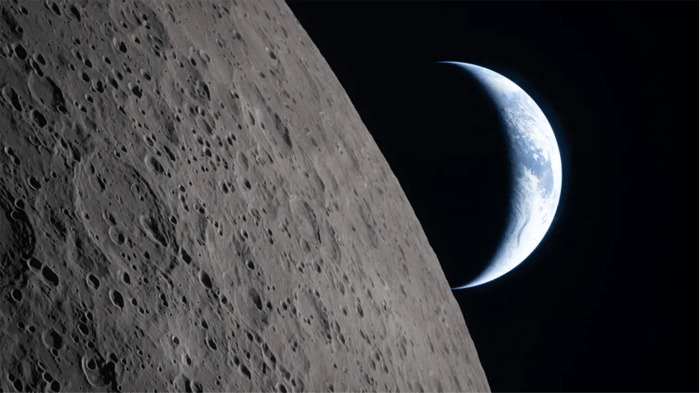
Earth Setting as Seen by Artemis II, Monday, April 6, 2026 | Source: NASA
Thankfully, the mission has been going perfectly, and the images are breathtaking.
The Artemis II team has now traveled farther from Earth than any humans in history and was the first to set eyes on areas of the moon that have never been seen before.
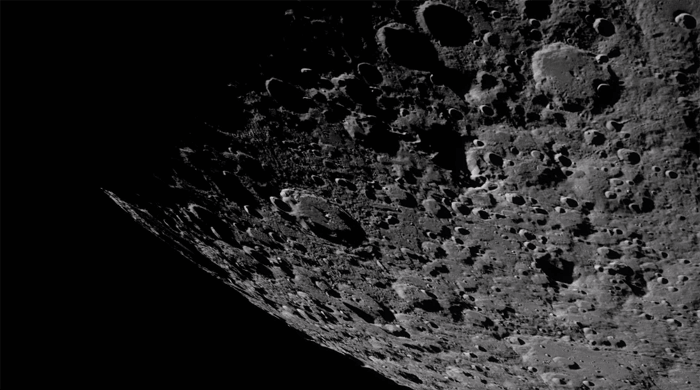
The South Pole Aitken Basin | Source: NASA
Above, we can see an incredible image of the South Pole Aitken Basin of the moon, which is almost certainly rich with water (frozen, of course) and an even more valuable commodity…
Helium-3.
The moon has an abundance of helium-3.
Without a magnetic field to protect itself from the solar wind, the moon has been bombarded by helium-3 for billions of years.
Helium-3 is critically important for nuclear fusion, thus clean energy, as helium-3 is not radioactive and doesn’t produce any radioactive waste products in the production of energy from fusion reactions.
The end game, of course, is to establish a lunar outpost near the south pole of the moon, as well as mining and processing facilities to extract helium-3, as well as water for life support and eventually rocket fuel.
It’s kind of hard to believe that NASA has maintained a human presence in space for more than 25 years on the International Space Station (ISS).
The Expedition 1 crew arrived on the ISS on November 2, 2000.
Of course, other nation-state space stations have existed, like Russia’s Mir and Salyut space stations, but Russia has long since exited the space race.
It has been the U.S. and China remaining.
China entered the race in 2022 with its launch and commissioning of the Tiangong Space Station (TSS), which is also fully operational.
Up until now, space stations have been the purview of nation-states, not industry.
In the absence of a vibrant space economy, the costs were simply too high for private industry… and there was no economic justification for putting a commercial space station into orbit.
But thanks to SpaceX, that has all changed.
Thanks to a recent SEC filing made by Voyager Technologies (VOYG), we can get a feel for what the costs are like to launch a commercial space station into orbit on a SpaceX Starship.
Voyager is one of the legitimate contenders in the race to launch and operate a privately owned commercial space station through its joint venture, Starlab.
Starlab is a U.S.-led joint venture between Voyager, Airbus, Mitsubishi, and MDA Space. Voyager currently has a 61.9% controlling interest.
The Starlab is a metallic spacecraft that is 17 meters long and 7.7 meters wide with a pressurized volume of about 450m3, which is about half as much as the ISS.
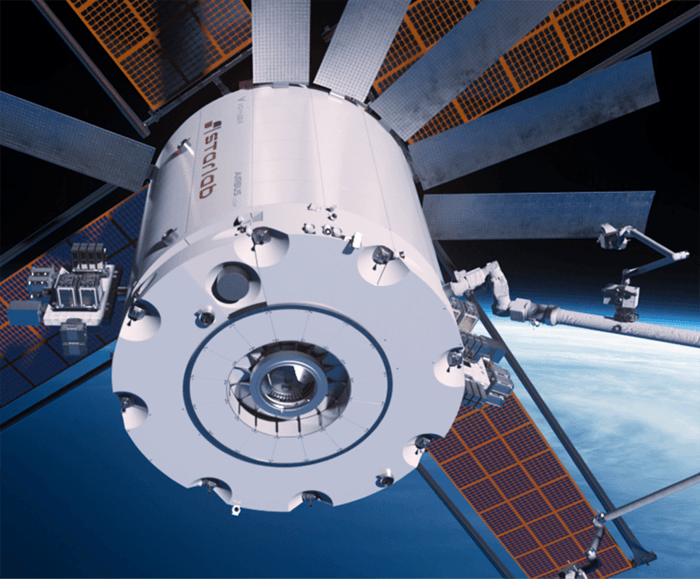
Starlab Space Station | Source: Starlab
From Voyager’s March SEC filing, we learned that it has contracted a $90 million launch into orbit at some future date to be determined.
And we know that Voyager will be launching on a SpaceX Starship, so this gives us an early understanding of launch costs using SpaceX’s latest rocket technology.
It goes without saying that $90 million isn’t much at all, within the financial wherewithal of relatively small companies. This makes it possible to do something as extraordinary as launch a commercial space station into low Earth orbit (LEO).
The Artemis II mission alone cost NASA well over $4 billion, an absurd sum considering the technology available to NASA today.
The commissioned SpaceX Starship launch for Voyager is just 2.25% of the cost of the Artemis II launch. Remarkable.
While we don’t know the mass of the Starlab, we can make some general assumptions.
The ISS is about 420,000 kilograms and twice the volume of the Starlab.
The ISS is decades old and doesn’t use the latest materials and composites, so I assume that Starlab’s weight per volume will be significantly less than the ISS’s.
If we halve the weight of the ISS, because Starlab is half the volume, we get to 210,000 kilograms.
And I’m going to assume that the Starlab is about 30% less heavy than the ISS per volume.
Under those assumptions, we’d arrive at 147,000 kilograms, which puts the Starlab right in range of the SpaceX Starship 150 metric ton capacity.
So, $90 million divided by 147,000 kilograms gives us about $612 per kilogram to low Earth orbit.
This is a fraction of the current price to launch payloads to orbit on a SpaceX Falcon 9.
And this would be a decided launch, meaning Starlab is almost certainly taking the entire Starship for its launch of Starlab.
One launch, and an operational space station. Incredible.
In addition to learning the launch cost, Voyager also announced that Starlab’s commercial payload capacity is fully reserved.
This means that Voyager has secured commercial relationships that will generate revenue once the Starlab is operational for essentially leasing out operating space on the Starlab space station.
While Voyager didn’t announce the company, or companies, that have a commercial deal with Starlab… separately, Starlab announced that a German space biotech company, Yuri, has reserved space on the Starlab for the first full year of operations.
Without SpaceX, space-based biotechnology companies would not be possible.
It’s not just for research, but the goal is space-based manufacturing of drugs and compounds.
Manufacturing drugs or compounds in space is desirable because protein and small molecule crystals are pure as they are unaffected by the gravity of Earth.
They are larger, more uniform, free of gravity-caused defects, and more stable.
This results in not only a longer shelf life, but also improves bioavailability and absorption of the drugs in the human body.
Varda Space has been leading the race in manufacturing drugs in space by launching manufacturing satellites and returning the satellites back to Earth after the manufacturing process is complete.
But with an operating space station, the scale can be that much larger.
In addition to drugs and pharmaceutical compounds, high-performance semiconductor manufacturing and ultrapure fiber optic cables are early targets for space-based manufacturing.
This is an incredibly exciting time for the industry, as the SpaceX Starship moves into commercial launches later this year.
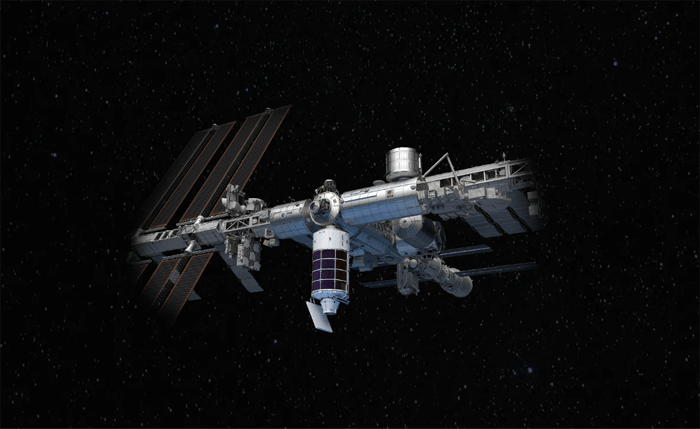
Axiom Space Station | Source: Axiom Space
Not only is Starlab in the running for a commercial space station, but Axiom Space, Vast, and Blue Origin – through its partnership with Sierra Space – plan to launch the Orbital Reef.
These are privately funded companies that all have the financial resources to make a commercial space station a reality in the years to follow.
Not only that, these companies can make these stations an economically viable business without the need for funding from NASA.
And it goes without saying that the launch costs on a Starship will quickly fall to $100 a kilogram, roughly one-sixth of the price per kilogram that Voyager has contracted for.
Wishing the Artemis II crew a safe journey home,

Read the latest insights from the world of high technology.
The trial between Elon Musk and Sam Altman’s OpenAI is about to begin, and it will set the course...

In the event an AI has become sentient, can the sentient AI file for a copyright or a patent?...

It’s nearly impossible for Wall Street to assess the degree to which AI, more specifically agentic AI, will have...
Thanks for signing up for The Bleeding Edge — we’re glad you’re here!
Want updates sent straight to your phone too? Sign up for SMS alerts to get the latest delivered via text.
Brownstone Research: By submitting your phone number, you agree to our SMS Terms & Conditions, Terms of Use, & Privacy Policy, and give express written consent to receive marketing text messages from BSR. Messages are recurring & frequency may vary. Reply STOP to 94703 to opt out. Reply HELP to 94703 for info. Consent is not a condition of purchase. Message and data rates may apply. For additional information, you may contact Customer Service at 888-512-0726 or smssupport@brownstoneresearch.com.