



Anthropic’s Risky IPO
Anthropic’s gig could be up, and its value as a private company could collapse.



This war has been raging for years… digital invaders versus those defending the ultimate prize: our data.
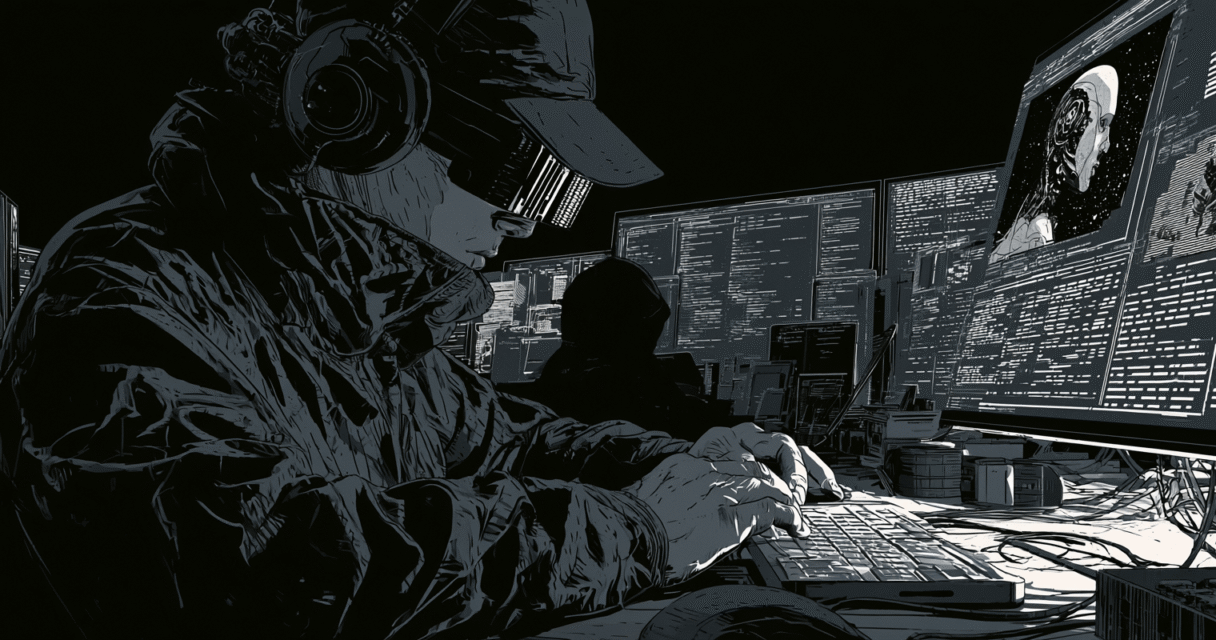
An invisible war is raging every second around us…
There are no explosions. No broken windows. No police sirens. Most of the time, nobody even notices.
You wouldn’t have heard about it. But there are attacks on many fronts. While you slept last night, there’s a great chance someone tried to break into your bank account.
Or the hospital down the street.
Or even the power grid.
This war has been raging for years… digital invaders versus those defending the ultimate prize: our data.
And artificial intelligence just handed both sides a much bigger weapon.
We’re the good guys… AI helps us work smarter, faster, solve big problems, and do really important stuff – like planning vacations. We happily link our computers, file directories, accounts, and data to the ever-growing network of AI communications.
But in every war, there are adversaries…
Think about the typical image of a hacker. Some dude in a hoodie and shrouded face sitting in a dark basement, banging away at a keyboard trying to crack your password.
But hacking today no longer looks like suspicious, hooded figures glued to their computers, pulling off complex digital heists from the shadows… because the bad guys are arming themselves with AI, too.
Now, AI can scan for vulnerabilities and automate attacks. Those old phishing emails that look oddly suspicious? AI can make them indistinguishable from the real deal. Technology can even impersonate voices and faces.
This means criminals can now operate at a scale and sophistication that would have required armies of hackers just a few years ago. The FBI has specifically warned that criminals are using AI-generated voice and video to impersonate trusted people and trick victims into handing over information or money.
Truly frightening.
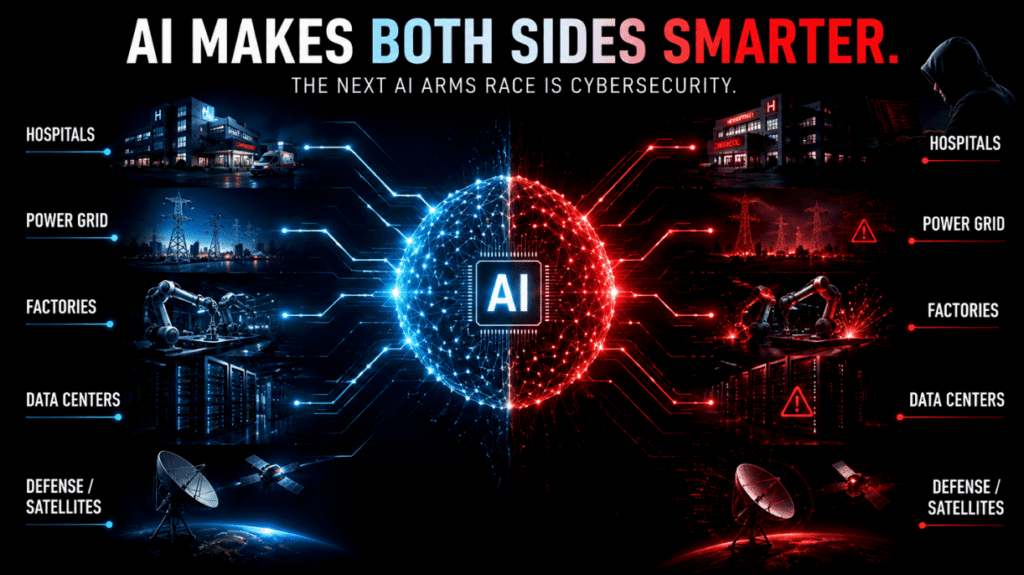
And the bad guys don’t even need to be smarter than you. They just need to be faster than the people protecting you.
That’s where the situation escalates.
We spent the last 25 years connecting everything.
Your phone connects to your bank. Your car connects to the cloud. Factories connect machines to networks. Hospitals connect medical equipment and patient record databases. Utilities remotely manage infrastructure. Data centers communicate with other data centers.
We did it because connectivity makes everything faster, cheaper, and smarter. But each connection is also another door… another vulnerability.
And locking your own door isn’t always enough to protect yourself. Verizon’s 2025 Data Breach Investigations Report (DBIR) examined more than 22,000 security incidents.
Third-party involvement in breaches doubled to 30%. Ransomware appeared in 44% of breaches, while exploitation of software vulnerabilities jumped 34%.
In other words, a company can secure its own house and still get robbed because somebody came through the neighbor’s door.
And it’s getting worse.
Verizon’s new 2026 DBIR shows third-party involvement has now climbed to 48% of breaches– up 60% from last year. Employee use of unauthorized AI tools tripled to 45%. And AI is helping attackers exploit vulnerabilities that once took months to weaponize in a matter of hours.
That’s an arms race.
Here’s the statistic that stopped me.
The World Economic Forum recently asked cybersecurity leaders about the risks they’re seeing… 87% identified AI-related vulnerabilities as the fastest-growing cyber risk of 2025, and 94% expect AI to be the biggest force shaping cybersecurity this year.
Meaning the technology nearly every major company is racing to adopt is simultaneously creating one of the fastest-growing security problems in the world.
While AI solves one problem, it creates another one. And increasingly, AI will have to help solve that one.
This circle will continue too, because humans simply can’t fight machines manually.
If an AI system can probe thousands of potential vulnerabilities, identify the weakest one, and launch an attack at machine speed, you can’t have some poor cybersecurity analyst sitting there drinking coffee and clicking through 37 different security applications trying to figure out what happened.
By that time – it’s way too late.
The defense has to operate at machine speed too.
That’s why companies such as Palo Alto Networks are building platforms designed to detect threats across networks, cloud systems, and endpoints. And Fortinet is heavily involved in securing networks and operational technology, where the digital world meets factories, utilities, and other physical infrastructure.
Same problem. Different approaches.
The world we’ve built needs a force field.
This is the part I think many people miss.
Cybersecurity isn’t just about protecting your credit card anymore.
Imagine an attacker getting into a factory and stopping production. A hospital losing access to critical systems. A utility being unable to operate equipment. Transportation systems going offline.
The line between the digital economy and the physical economy is disappearing.
IBM estimates the average data breach now costs $10.2 million in the United States. But dollars may not adequately reflect the risk.
Because we’re growing at breakneck speed.
We are building AI data centers, autonomous factories, robots, connected vehicles, smart power grids, and eventually entire cities that depend upon software. That’s extraordinary progress.
It also means the target size for attacks is ballooning exponentially.
For years, investors have focused on the infrastructure required to build the AI economy: chips, memory, data centers, power and networking.
There’s another layer underneath all of it.
Someone has to protect it.
Cybersecurity is quietly becoming the invisible force field around the modern economy. You rarely see it. You probably don’t think about it.
But increasingly, everything depends on it.
Regards,
Jason Bodner
Founder, Outlier Intel
Add Brownstone Research as your preferred source on Google to see our latest stories in your feed.
 Add as a preferred source
Read the latest insights from the world of high technology.
Anthropic’s gig could be up, and its value as a private company could collapse.

This morning, SpaceX launched the 14th flight of its Super Heavy booster and Starship from its Starbase, Texas facility,...

In today’s AMA, we explore the true utility of full self-driving vehicles… what to do when markets crash… and...