




Anthropic’s Liquidity Event
Any self-directed investors should be aware of these crazy valuations and this liquidity event for thousands of Anthropic employees,...


The hardest part is actually launching payloads into orbit consistently and economically…

Managing Editor’s Note: Elon Musk has quietly filed a document with the Texas Department of Licensing and Regulation… And Jeff believes it’s about to set in motion what he calls “M.A.G.I. Phase II.”
Jeff’s calls on Phase I have already given his readers the chance to make 12 times… 13 times… 25 times… 60 times… and even 360 times their money.
But Jeff believes Phase II could be even bigger. That’s why he’s airing a strategy session with all the details on Phase II next Tuesday, November 24, at 8 p.m. ET.
If you missed out on Phase I, be sure to sign up with one click to join Jeff next week to learn about what’s coming next…
I’m sure for most of us, this was not a comfortable week.
There were so many conflicting signals. After all, the NASDAQ Composite was down 10% on the week, and yet it supported the second-largest IPO in history at the same time – Anthropic (ANT).
For some bizarre reason, the media are calling the Anthropic IPO the largest of all time, yet it failed to beat out SpaceX.
Anthropic raised $81.3 billion, and SpaceX raised $85.7 billion. And Anthropic’s valuation on pricing was $1.5 trillion compared to SpaceX at $1.77 trillion. SpaceX was larger on both valuation and amount raised…
Regardless, it was a massive IPO. And just as I predicted it would, it opened significantly above its pricing and collapsed lower.
Anthropic (ANT) is down about 20% from where it started trading on Thursday. For anyone interested in more details on the IPO, I recommend reading Thursday’s Bleeding Edge – Anthropic’s Liquidity Event. This is an issue anyone should read if you are at all tempted to invest in this company.
This week we also explored the media’s fabrication of what took place with NVIDIA CEO Jensen Huang in Bleeding Edge – NVIDIA’s Board Got Played. There are some powerful forces at play right now, and it’s worth understanding what’s happening behind the scenes.
I strongly support reinstating Jensen to NVIDIA – for those who agree, I recommend joining me and more than 200,000 others who want the same at Stand With Jensen.
Standing in stark contrast to the nefarious activity involved in Jensen’s takedown, NVIDIA reported spectacular results again this week:
And yet amidst these stellar results, NVIDIA has fallen nearly 50% from its all-time high less than two months ago. More astonishing is that NVIDIA is trading at just 6.2 times fiscal 2028 EBITDA (FY 2028 is roughly calendar 2027). I don’t know how to say this, but NVIDIA is dirt cheap at these levels. Free money as far as I’m concerned.
And for those of us who enjoy video games, have kids, or grandkids, you may have heard about the drop of the latest installment of Grand Theft Auto – GTA VI. It has been 13 years in the making, and it was just released yesterday. Take-Two Interactive (TTWO) generated $3.79 billion in sales on the very first day of the release.
That’s what I call a product launch.
There are so many incredible buys in the stock market right now. This volatility is temporary. The economy is so strong right now.
We have so much to look forward to.
Have a great weekend,
Jeff
Hi Jeff, I have been a Brownstone Unlimited member for many, many years and have enjoyed reading your responses to questions from your subscribers.
My question has to do with the physics of data centers in space. I know that Elon Musk claims that space is a great place for a data center because of unlimited solar energy and cooling potential.
However, the physics of data centers don’t make sense to me because of the fact that the huge amount of power needed would also require a solar cell many square miles in area. In addition, the idea of cooling would require some kind of medium to carry away the heat, and in space, as you know, there is a vacuum. So the only way to cool would be a large area for the heat to radiate away because there is no air or liquid to carry it away.
Also, there is the problem of upgrading the chips as they become more powerful, and also, if there is a malfunction in the chips on the satellite, how would they be changed or upgraded in an economical manner? I would appreciate it if you could address these physical challenges to placing a data center in space.
Longtime subscriber,– Gary B.
Hi Gary,
Thanks for being an Unlimited member and writing in.
You’re definitely on the right track. There are some unique challenges operating in the vacuum of space, but they are achievable.
Let’s have a look at how SpaceX will make it happen…
The SpaceX AI1 will be the first AI data center satellites that will become part of the Starmind constellation.
These will be designed for 250 kW of peak compute with an average of 175 kW of compute operations. These operational power requirements are what determine the size of the solar panels and radiators.
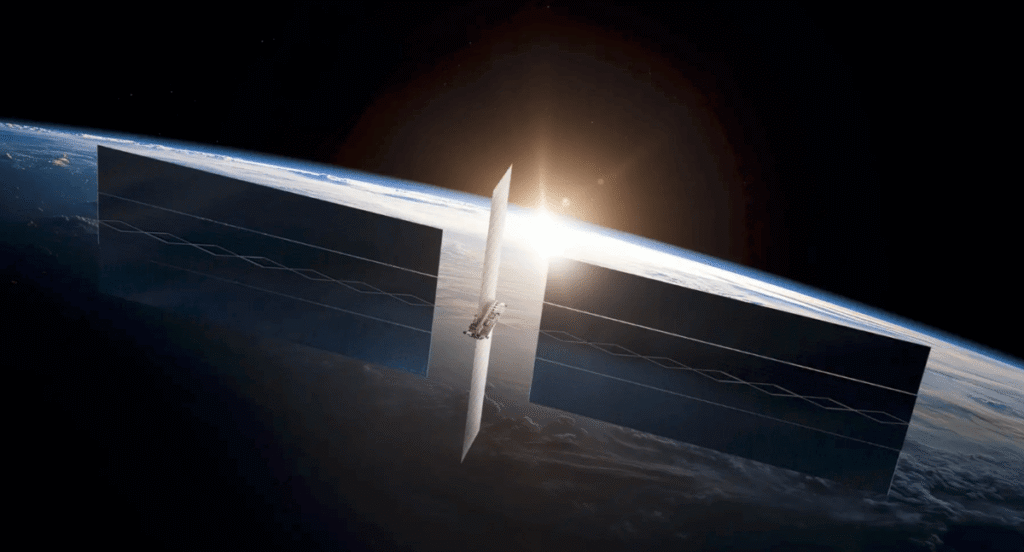
SpaceX AI1 | Source: SpaceX
In the image above, the large bluish rectangles are the solar arrays, and the whitish vertical blades are the radiators. The actual “data center” in the middle is tiny in comparison to the rest.
The solar arrays will generate about 250 W/m2, and the solar array will be designed to generate 210 kW, so we can back out the size of the solar array. The total solar array area will be 840 square meters. The two arrays will definitely be large at 420 square meters each, but not unmanageable.
As for the radiators, SpaceX will use aluminum radiators pointed away from the sun. As shown in the image above, the edge of the radiators will be pointed at the sun so the radiators don’t heat up from the sun.
The GPUs (or other AI-specific semiconductors) will have cold plates near the chips to remove the immediate heat and then active fluid cooling to pump the heat away from the chips through the radiator. The fluid will most likely be liquid ammonia to carry the heat into the radiators.
Given that the heat rejection rate for the aluminum radiator should be around 1,300 W/m2, the radiator area can be much smaller than the solar array area. SpaceX has defined the radiator area as 160 m2, which is 19% of the area of the solar arrays.
As for the semiconductors, there is no intention to upgrade those chips. One of the biggest false assumptions that has been made by Wall Street analysts is that after three years, older versions of GPUs would become useless.
That demonstrated how little they understand about technology. GPUs have already proven to have a useful lifespan of at least five years. And what we have seen is that GPU rental rates have actually increased over the last two years, even for older GPUs.
An equally important point is that a Starlink satellite has a useful lifetime of five years. A Starmind satellite will be very similar. So, after five years or so, the satellite will be de-orbited and replaced, just as Starlink satellites are today.
And you’re right, on occasion, a GPU will malfunction in orbit. Most likely this will happen due to a micrometeorite strike or radiation damage. These computational systems will be designed in such a way that they have redundancy built in.
If one GPU malfunctions, the system simply routes around that GPU and operates with one chip down. Total system performance will drop proportionately, but it will continue to function.
I’m happy to say that these are all proven engineering solutions.
The hardest part is actually launching payloads into orbit consistently and economically. And fortunately, SpaceX just demonstrated that it can do precisely that by catching a returning Starship at the launch pad.
We had fun with that on Monday in The Bleeding Edge – Starship Just Unlocked the Masterplan.
It’s happening…

Jeff Brown says Musk's new filing in Texas unleashes what Elon himself calls "an infinite money glitch." On Tuesday, November 24, at 8 p.m. ET, he'll show you how to prepare and name one essential supplier, completely free. Register in a single click.
Elon Musk says the final step of his masterplan could hand early investors “more than a 1,000x return.” That turns $500 into half a million dollars. Former tech executive Jeff Brown shows you where to put it… and names one of Elon’s critical partners free. Watch this video to get your free stock.
Jeff,
Any updates, background noise on CBRS? Looked like there were some potential production rollout partnership announcements soon, but nothing so far. No news is good news, or are they struggling with some of the production scaling efforts?
Great work and really enjoy your writings.
– Scott G.
Hi Scott,
Cerebras (CBRS) just reported its Q3 2026 results, which were phenomenal. Here are a few highlights…
Operationally, Cerebras has really hit an inflection point. Its most advanced system, the CS-4, is going into full production now. By December, its manufacturing capacity will be 10X what it was at the beginning of the year.
And Cerebras has already announced its next-generation CS-5 system, which will hit the market next summer.
Cerebras has more business than it can handle, which is why it is scaling up its system manufacturing capacity as quickly as it can.
Also worth noting is that the lockup expiration on its shares was on November 10. Therefore, there are no further post-IPO lockups. Any selling pressure relating to employees and early investors wanting liquidity has now passed.
There’s nothing wrong at all with Cerebras. Quite the opposite. It is currently trading at only five times 2027 forecasted sales and 12.8 times forecasted 2027 EBITDA. This is ridiculously cheap for a high-growth company of this quality.
The latest market volatility has created an incredible buying opportunity in this incredible semiconductor company.
Mr. Brown,
Thank you for all you do, as well as your team. Hope all is well with you and the family.
I was hoping to get your thoughts on Standard Carbon. It looked promising, but not sure about its product. So volatile. Thank you again.
– Alfred F.
Hi Alfred,
I hope I get this one right, and I’m not sure if I’ve got the correct company that you’re referring to. I’m assuming you are referring to www.standardcarbon.com.
If so, this is a tiny company with extremely limited capital that is trying to raise money via a crowdfunding round.
As I can’t give personalized investment advice, my comments are going to be more general in nature. We can use this as an example of what to look for when evaluating a small company like this.
Assuming I have the correct company, Standard Carbon purports to be a carbon capture company, claiming to convert carbon emissions into “low-carbon” fuel by producing synthetic natural gas.
This kind of carbon capture approach might sound cool and novel, but the technology has been around for a long time, and the chemistry is well understood. The process is pretty simple…
There are two reasons I don’t care for this approach.
First is that it typically isn’t a clean process because most electricity is generated using fossil fuels. If you are using “dirty” electricity to produce the synthetic methane, what’s the point?
And more importantly, the economics of this process aren’t attractive. Efficiency is low with electrolysis and methanation, so for the business model to work you need super cheap energy, and preferably large tax credits for what is positioned as a “green energy” process.
There is nothing special here at all.
The company claims to have $75 million of “signed deployment contracts” and a $1.7 billion “commercial pipeline on the horizon.”
This is a company that has just $1.236 million of cash and a net loss of $2.657 million in its most recent fiscal year. This is a tiny company. The claim of having a $1.7 billion commercial pipeline makes no sense at all.
It is attempting to raise $1.235 million under Regulation CF (Reg CF) in a crowdfunding raise. It is raising money at a $40 million pre-money valuation. It has $0 in revenues and is paying the broker/dealer – DealMaker Securities – $47,500 up front, $15,000 a month, and 8.5% commission for funds raised in the Reg CF offering.
For anyone who would like to see the offering statement, which is filed with the SEC, you can go right here to see more details.
There are no notable investors in Standard Carbon. It has nothing special in terms of technology, it is extremely low on cash, and its process is heavily dependent upon the price of electricity and any tax credits that it (or its customers) might receive for the use of carbon capture.
I always hesitate to write about companies/raises like this because I don’t want to give them attention. I’ve definitely seen worse, but this is a good example of an investment opportunity that has nothing compelling to offer.
With small private companies, there have to be strong, compelling reasons to invest to justify the risk that we take investing in them.
Maybe it’s a breakthrough technology, perhaps it’s an incredible founder who has already built a billion-dollar company before, or a novel process that no one has ever thought of before. Or perhaps the company is raising additional capital from well-known venture capital firms that have also vetted the opportunity.
When I don’t see strong, compelling reasons to invest in a company, public or private, I simply move on to another opportunity.
I hope I got the right company, Alfred.
That’s all for today’s AMA. Thanks to everyone for writing in. And if you have your own question you’d like to see featured in a future AMA issue, you can reach us via our feedback line at brownstonefeedback@brownstoneresearch.com, or simply click right here.
Just keep in mind I cannot give individual investment advice.
Have a great weekend.
Add Brownstone Research as your preferred source on Google to see our latest stories in your feed.
 Add as a preferred source
Read the latest insights from the world of high technology.
Any self-directed investors should be aware of these crazy valuations and this liquidity event for thousands of Anthropic employees,...
It was a classic story… A wealthy, successful executive working in Asia becomes the target of a Chinese Communist...

Anxious and uncertain. That’s the mood right now… just like it was in 2022.